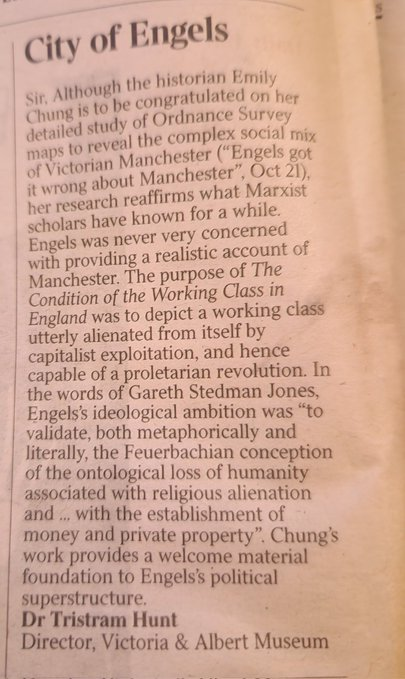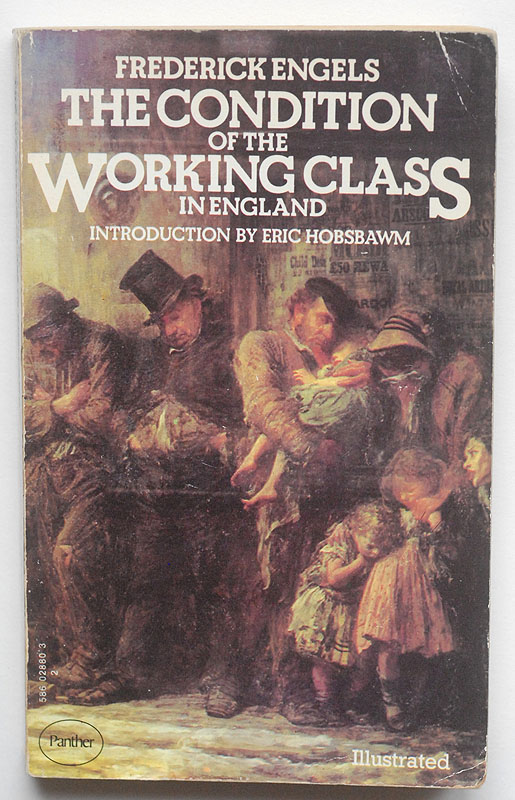
Below are two letters about new research by Emily Chung into Engels book on the condition of the Manchester working class in 1844 (published in German in 1845). The research uses some new techniques to suggest, broadly, that Engels work was perhaps more polemic than entirely accurate social description. Who knew? That point summarises a point Engels biographer Tristram Hunt made in a letter to the Times (23rd October)
Ralph Darlington takes issue with Dr Chung’s research, reasonably so I think, as do I in typically Flettian way by looking at where and what Engels drank in mid-nineteenth century Manchester.
If Dr Chung’s research, which received a good deal of publicity, gets people who have not looked at Engels book to do so- its available free on-line- that will at least be a positive.
On a personal note, I’m sure not known to the Guardian, Ralph Darlington and myself have known each other since we came up as socialist activists in North London fifty years ago now.
The research on which you report (Friedrich Engels ‘took creative liberties’ with descriptions of class divides in Manchester, 21 October) reads like a deliberate attempt to diminish the nature and extent of class differences that Engels observed and wrote about.
There clearly were areas of the inner city marked by extreme residential segregation, such as Little Ireland, where Engels’ companion Mary Burns lived and showed him around and informed his book. You report that the study says that “in Manchester’s ‘slums’, more than 10% of the population was from the better-off … classes”. In Moss Side and Hume in the 1970s and 80s there were some professional people living there whom I knew, but the overwhelming majority of inhabitants were working class, and many of them impoverished and discriminated against. To suggest class was not that important is surely to throw the baby out with the bathwater.
Prof Ralph Darlington
Manchester
Emily Chung has used modern historical research methods to suggest that Friedrich Engels’ 1844 study of the Manchester working class was as much polemic as social investigation. The same might be said of Henry Mayhew’s journalistic investigations of the London working class from 1849. Chung notes that while middle-class and working-class housing was not as differentiated as Engels suggested in reality, while the middle class went to church, the working classes went to the pub. Here Engels, and his Irish proletarian partner Lizzie Burns, broke the mould. They might be found drinking Manchester beer in the Thatched House, Market Street, a pub knocked down for the Arndale Centre. But Engels as a Manchester businessman also drank German pilsner in the Albert Club and Schiller-Anstalt Club.
Keith Flett
Tottenham, London