Oktoberfest is underway in Munich and there are between 1500 and 2000 waiters to serve the six official festival beers (all of which can also be found in the UK btw).
The rise of the fascist AfD party is according to a Times report (29th Sept) causing issues as waiters report an upsurge in racist, sexist and homophobic comments from drinkers.
As a result 170 waiters have formed a ‘Waiters Against the Far Right’ group designed to tackle abuse from Oktoberfest drinkers.
The organisers of Oktoberfest reportedly have found no issues, but they would say that wouldn’t they..
From the Rise & Fall of Reginald Perrin. Written by David Nobbs
The full list was:
‘wreckers of law and order. Communists, Maoists, Trotskyists, neo-Trotskyists, crypto-Trotskyists, union leaders, Communist union leaders, atheists, agnostics, long-haired weirdos, short-haired weirdos, vandals, hooligans, football supporters, namby-pamby probation officers, rapists, papists, papist rapists, foreign surgeons – headshrinkers, who ought to be locked up, Wedgwood Benn, keg bitter, punk rock, glue-sniffers’
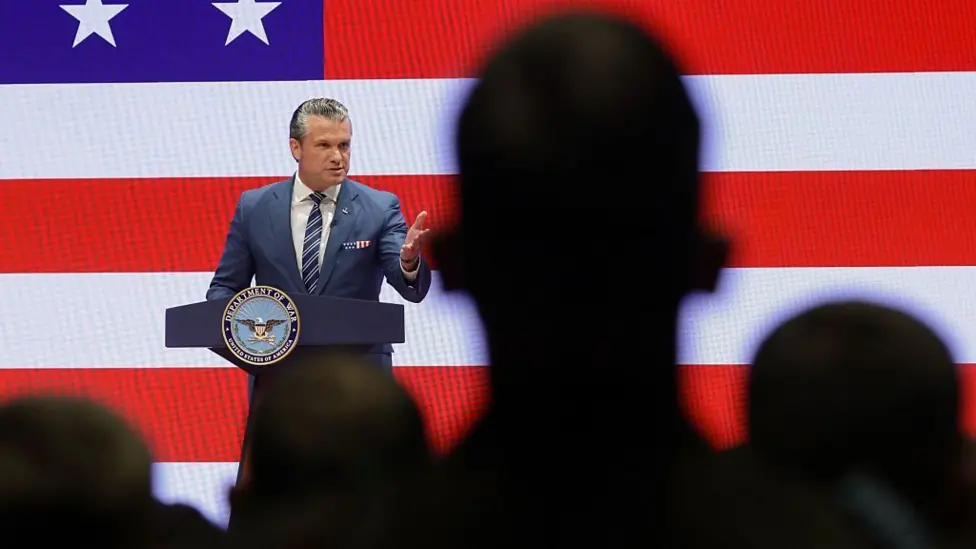
The late Leonard Rossiter played Reggie Perrin and in the clip listens with understated sarcasm to the kind of list of the Woke which one might hear in 2026 from US War Secretary Pete Hegseth
Hegseth: “It’s worth saying again so the fake news understands it. We are no longer the woke department or the weak department. Simple translation of that — no fatties no trannies no beardos no weirdos no wimps no radicals. Just warriors.”
He was right about keg bitter btw & Hegseth definitely likes a drink
Tony Benn had been told by Eric Heffer MP that at the end of the 1986 Blackpool conference the organist had said the Red Flag would not be played. After protests it was but Benn recounts that at the end ‘Neil and Glenys (Kinnock) threw a whole mass of red roses at the delegates from the platform. Benn writes in his diary ‘it was a disgusting spectacle… I rushed out before the crowd left and caught the train to London’.
The reference for those under 50 is the Smith’s second single released on 31st October 1983. Andy Burnham is a Smiths fan.
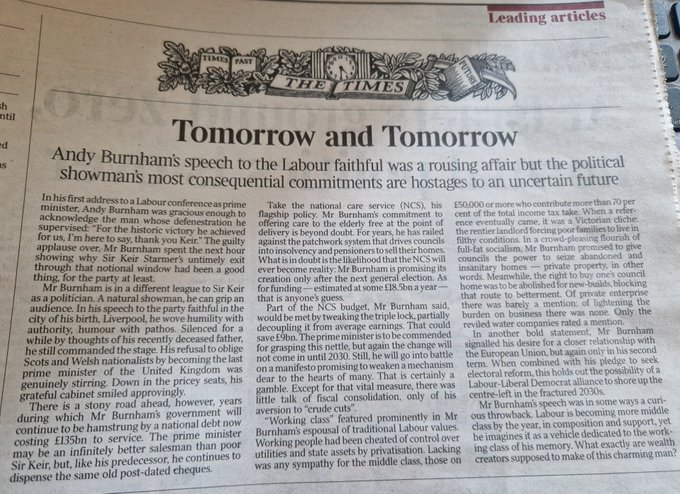
Beyond that The Times while making some mild criticisms is unusually restrained in its comments. It normally drones on about Labour from the right come what may. In particular while Badenoch has launched a petition on the triple lock pension, the Times is constrained because it has been demanding its end for a very long time.
Whether or not Andy Burnham should be pleased that one part of the Murdoch media has temporarily called the dogs off it should be a warning for the left, if it continues
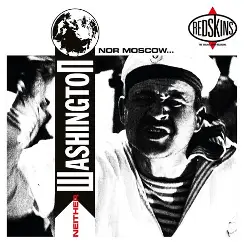
Manufacturing Marxist music (and culture) has been the missing component of the theory and practice of the revolutionary left in Western Europe. To do so, as The Redskins did, gives us a glimpse of what can be achieved in certain conducive circumstances.
Andy Burnham’s Conference Speech: history man, Unions, Co-Ops ( but Manchester also saw the birth of the world’s first working class political party)
On 29th September Andy Burnham delivered his first speech as Labour leader and PM to the Labour Conference.
One line referenced labour history
The United Kingdom my dad represented is the one I believe in.
A union of nations that gave trade unions and the cooperative movement to the world.
Is he right here?
In respect of the Co-Operative movement (Rochdale 1844) almost certainly yes. On trade unions there may be room for question. The TUC was formed in 1868 but unions existed well before that, the Grand Consolidated Trade Union of the early 1830s for example. The wider issue is whether unions also existed in other places. That requires some research
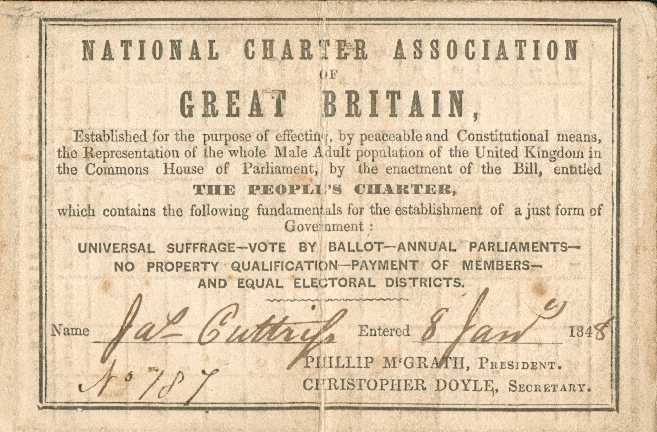
What Burnham missed, puzzingly, was that Britain saw the birth of the world’s first working class political party, the National Charter Association, in Ancoats in Manchester in July 1840.
Ir was not a direct antecedent of the Labour Party but the idea that there should be a working class political party was born in Manchester.
The London Socialist Historians Group, that organises the socialist history seminar at the Institute of Historical Research, University of London, has said that it is backing the current wave of UCU strikes over job cuts and course closures.
Strikes are underway at Dundee, Edinburgh and Glasgow Caledonian, with Nottingham due to start action this week. The long running strike at Goldsmiths also continues.
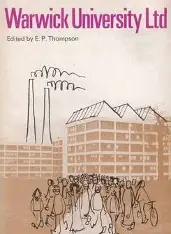
The historians say that after almost 60 years its clear that the Business University model has failed. With the loss of academic and related skills, education for future generations will be downgraded. The claim is that there is a financial crisis in much of the sector. However this is not universally the case. In some instances Universities are building financial surpluses at the expense of jobs and courses
Looking historically to the Robbins Report which saw the rise of new Universities from the early 1960s, the foundation of Polytechnics which became Universities, the focus was not on how much profit they did or did not make. Rather it was about extending the educational opportunities for young people, investing in skills and education as a general good for a liberal society.
LSHG Convenor Dr Keith Flett said, the Business University model has failed. Academics and related skills are being thrown on the scrapheap, impoverishing the education system and denying the chance of future students to learn essential skills and knowledge. We back the UCU’s action. They are beacon of light in the academic gloom
A post on UnHerd has argued that Andy Burnham should rekindle his youthful dalliance with Trotskyism. Rather fanciful. Burnham noted in 2010 that he had briefly been a fan of Derek Hatton before settling on Neil Kinnock. This does not suggest however that Burnham spent his youth studying Trotsky’s Transitional Programme.
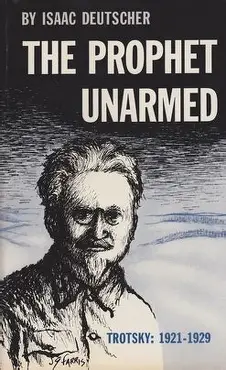
Blair went further noting in 2011 that he had read Isaac Deutscher’s classic biography of Trotsky. There is an issue with this however. Blair is known for being somewhat economical with the truth and for not being a great reader.
Starmer by contrast was in the second half of the 1980s very much associated with a variety of orthodox Trotskyism….
This might be career-limiting to say but, as a young teenager, I was very taken in by Derek Hatton who in the early 80s seemed to be on the north-west news every night taking on Maggie.
UnHerd September 2026
Tony Blair
The nine-item list appeared in recently launched magazine We Love This Book and includes Treasure Island, The Lord of the Rings, The Crusades Through Arab Eyes and biographies of Mohammad and Jesus. On The Prophet, Blair writes:
This book may seem an odd choice for an originator of New Labour, which is about as far from Trotskyist politics on the progressive political wing as you can be, but it was, curiously, the first political book I read and the one that got me interested in politics. It is in three volumes. It was, for its time, hugely significant. In that era, the Soviet Union was supreme: Stalinism had crushed all dissent in the communist empire; Trotsky, one of Lenin’s original lieutenants in the Bolshevik revolution of 1917, was an outcast. Deutscher’s trilogy was a powerful counterblast. It described Trotsky as the true revolutionary who stood out against the cruelty and oppression with which communism came to be associated. Trotskyism and its fight with the official Soviet-style left defined student politics in the 1960s and 1970s, and no one who lived through that period can forget it. But the most interesting thing for me is the character of Trotsky that Deutscher reveals. For all his faults and inconsistencies, the range of his thinking and the energy of the creativity were remarkable. And ultimately, despite his rigid adherence to Marxism, he was moved by an impulse far more moral than scientific.