Tory membership down to 123,000. Badenoch embraces ‘anarcho-capitalism’
The Spectator has reported that Tory membership has declined further from 132,000 to 123,000. For comparison subscribers to Nigel Farage’s Reform UK business are also falling, tho don’t expect him to mention it(essentially due to competition from the far to fascist right of politics)
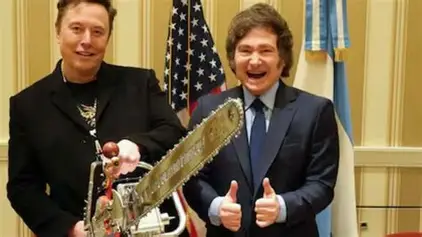
Badenoch has told the Financial Times (23rd July) that she regards Argentinian President Milei as the ‘template’ to revive both the Tory Party and the UK. Badenoch said that the UK needs a Milei ‘zeal for cutting spending’ (with his trademark chainsaw prop) and that she sees herself as a politician in his style.
The difficulty here is that the Milei is a self-described ‘anarcho capitalist’ while the Tory Party is founded on the principles of Church and King, neither of which it seems Milei is interested in..
The founding conference of the first working class political party held in Manchester in late July 1840 discussed whether not alcohol should be banned.
Delegates from across England, Scotland and Wales met in the Griffin pub in Manchester from Monday 20th to Friday 24th July 1840 and agreed to form the world’s first working class party, the National Charter Association.
After discussing membership, leadership, organisation and propaganda discussion turned to Clause 21
This Clause recommended total abstinence to the people and made it incumbent on the officers of the new Party.
Mr. Philp said the adoption of this clause would damage the revenue, and put more money in the pockets of the people. If the delegates adopted this clause, they certainly ought to practise what they preach, and themselves set the example. Mr. Alton spoke in favour of the clause, and hoped the delegates would give it their most serious consideration. It was generally allowed that the ignorance of the people was the basis of their political slavery. There was not such a great cause of degradation as drunkenness. He himself knew a man, who, from a degraded -character, became principally instrumental in agitating a district , and sending a delegate to Convention. The duty on malt and hops amounted to upwards of fire millions, and if people were sober the greater part of that would be lost to the country.
Mr. Leach was not a teetotaller. He had no objection that it should be recommended, but the clause made it compulsory of the missionaries and officers. Mr. Morgan was of opinion with the last speaker. Mr. Philp had been of opinion, when in committee, that total abstinence should not be compulsory, and be should vote for an alteration of the clause to that effect. He then moved that ” sobriety” should be ” recommended.” Mr. John thought the principles of total abstinence ought to be carried out. They had friends in prison and over the sea, who could not get it; and the man who would not make the sacrifice was not worthy of advocating the Charter.
Mr Baker spoke in favour of recommending sobriety to the people. Mr. Williams made a long and able address in favour of the total abstinence principle, and moved as an amendment on Mr. Philp’s motion, that ” total abstinence” should be recommended. Mr. Hasson supported Mr. Philp’s view of the question. Mr. Arran would make any sacrifice for the Charter, but it was no use to order the people to observe total abstinence, if they would not obey. It would only give occasion to their enemies to ridicule them. Mr. Williams’s motion was rejected by the casting vote of the Chairman. Mr. Spurr then moved an amendment to the effect that total abstinence should be compulsory on the officers of the society it did not however meet with any encouragement, and Mr Philp’s motion was adopted.
Thus the clause as passed merely recommends sobriety to the officers and members of the society.
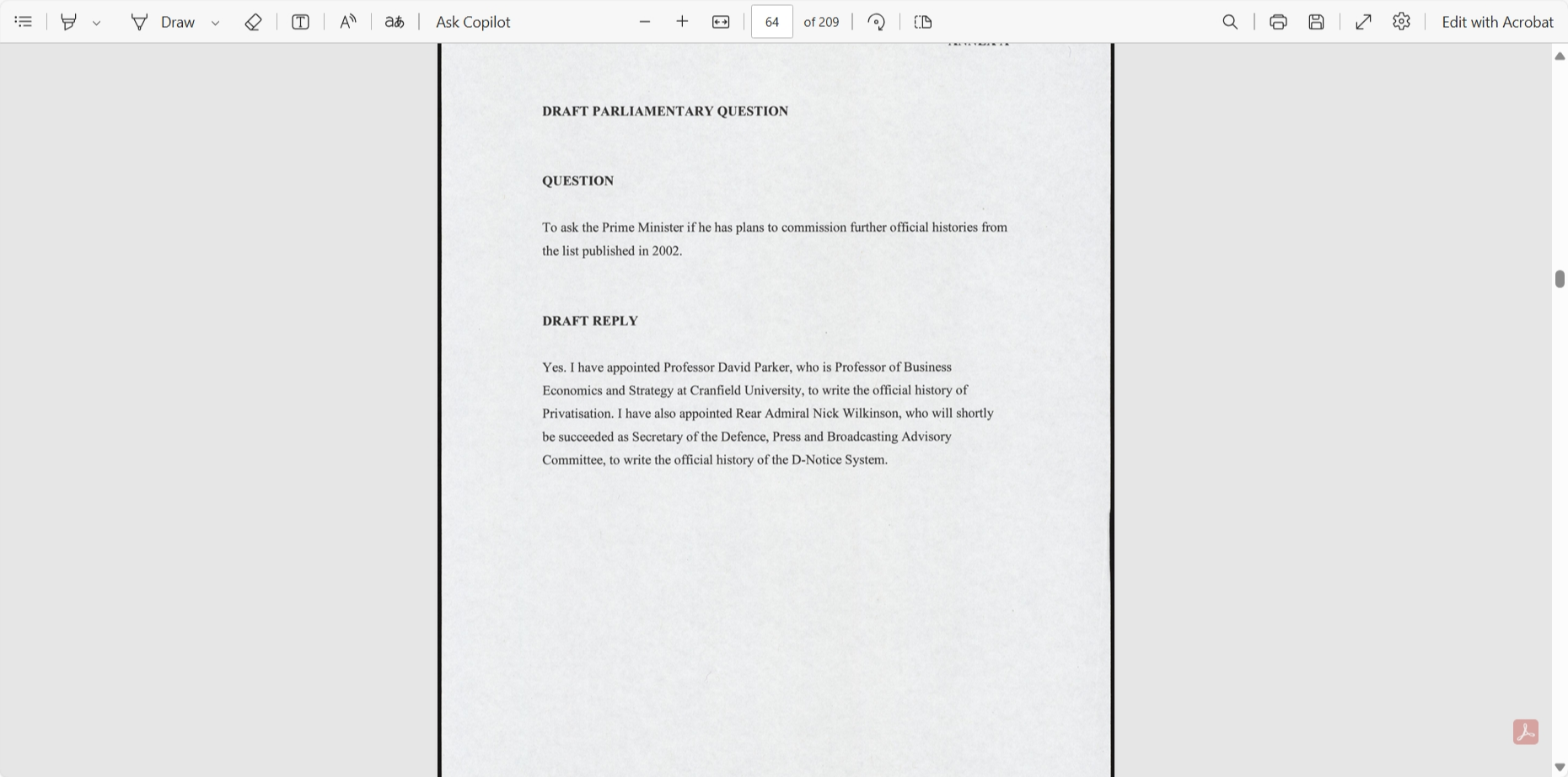
One file amongst the many of Government papers posted at the National Archives this week relates to ‘Histories’. The file PREM49-3541 contains correspondence about war memorials, the Falklands and Cenotaph ceremonies.
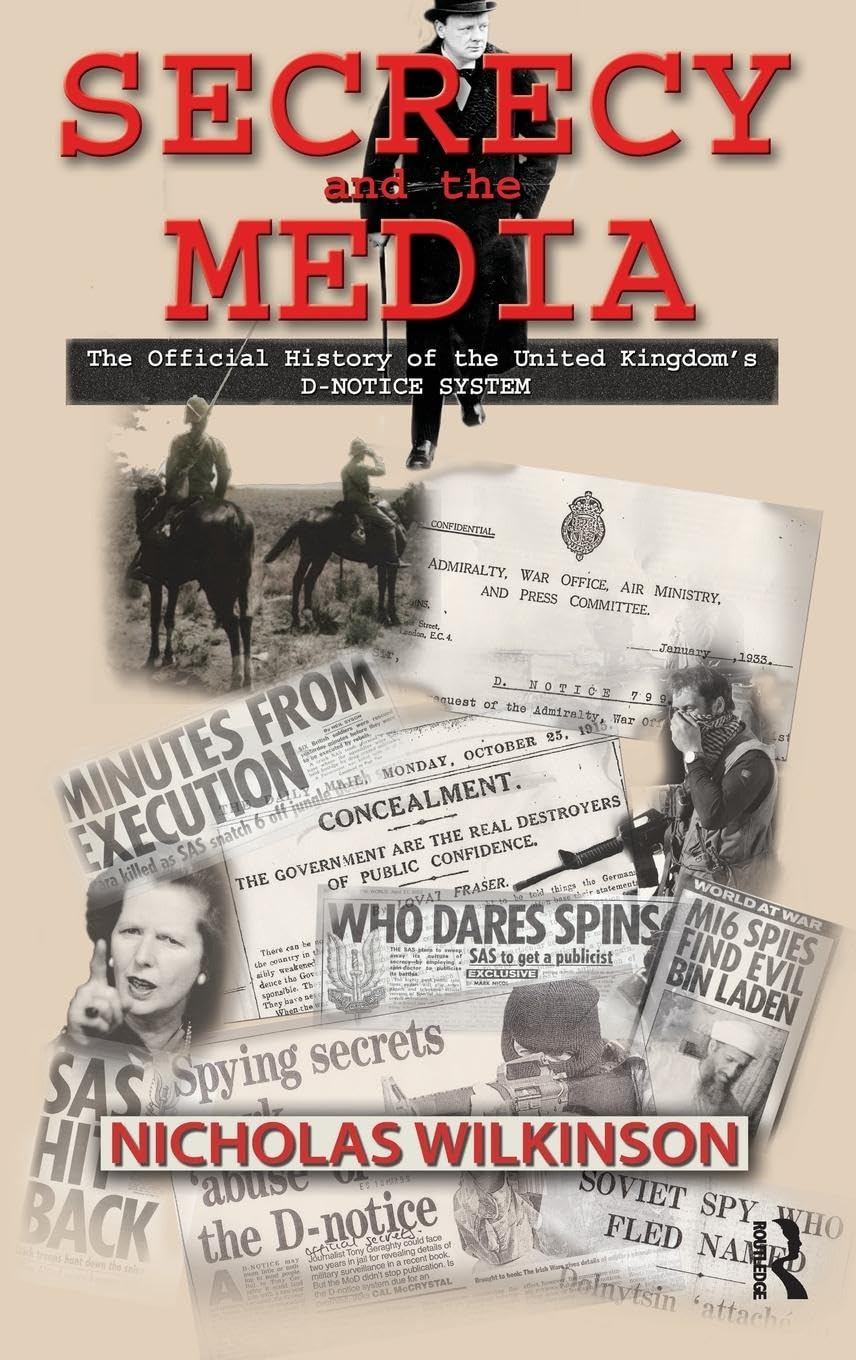
It also contains a draft Parliamentary question on the commissioning of histories of Privatisation and the D-Notice system. The question was duly asked in Parliament in early 2002 and answered in the affirmative by Tony Blair.
Perhaps surprisingly both histories were published as academic books in 2009.
One wonders if the current Government is planning to commission an official history of the New Labour years
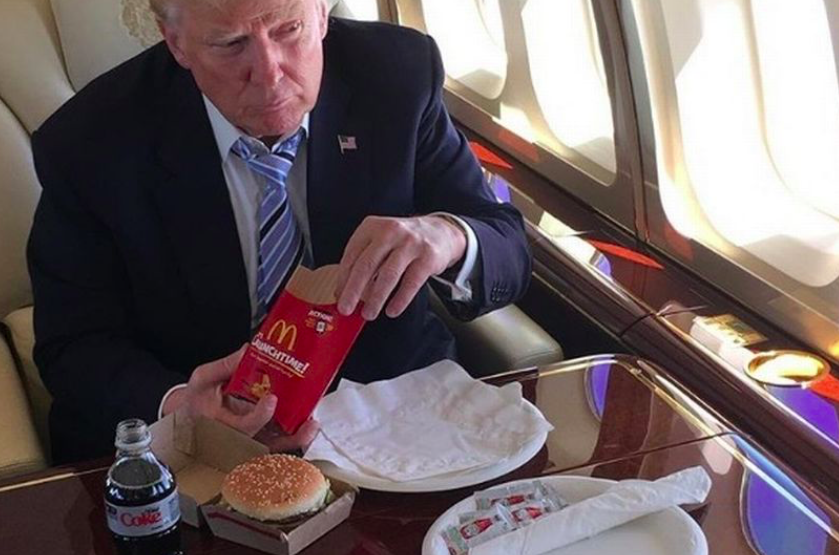
The statistic below, which should probably be taken with a pinch of salt, is from a Sunday Times feature (20th July) on the further expansion of McDonalds outlets in France. They are appearing in regional locations, bringing jobs but also food a long way from classical French cuisine.
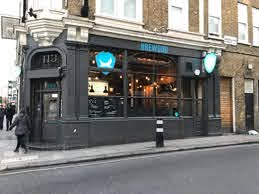
First Brewdog bar outside of Scotland- in Camden Town-to shut (Dec 2011- July 2025)
Camden was the fourth Brewdog bar to open and the first outside of Scotland, hence the opening was something of a landmark at the time. The pub itself is not a huge- a ground floor and lower ground- a far cry from some of Brewdog’s more recent openings.
At the time Brewdog still produced cask beer (it was soon to stop) so a talking point 14 years ago was that there was no cask, it was all keg. This is hardly remarkable in 2025 but then it was at best rare.
I have memories of drinking in there with people still well known in the Indy Beer world, when it was the only Brewdog bar in London and Brewdog was the benchmark for what was then called craft beer, both its own brews and guest beers.
I haven’t been in Camden Brewdog for quite a while- after all there are many more convenient craft beer bars now. In fact I haven’t been in a Brewdog bar at all in 2025 because of the employment and cultural issues at the brewer that still seem to me unresolved. In 2011 this would I think have surprised us, even if we were no fans of James Watts’ style.
The pub, well before it was a Brewdog, also featured in the never ending Spycops inquiry into police infiltration into left and radical campaigns. It was a meeting place for the Camden left in the late 1960s and hence undercover police officers were also to be found at the bar.
Brewdog of course have other London bars- including a rebadged Draft House not far from the Camden site- but in recent times, the Waterloo monolith notwithstanding- they seem to close more than they open. A long way from the path breaking times when Camden Brewdog opened.
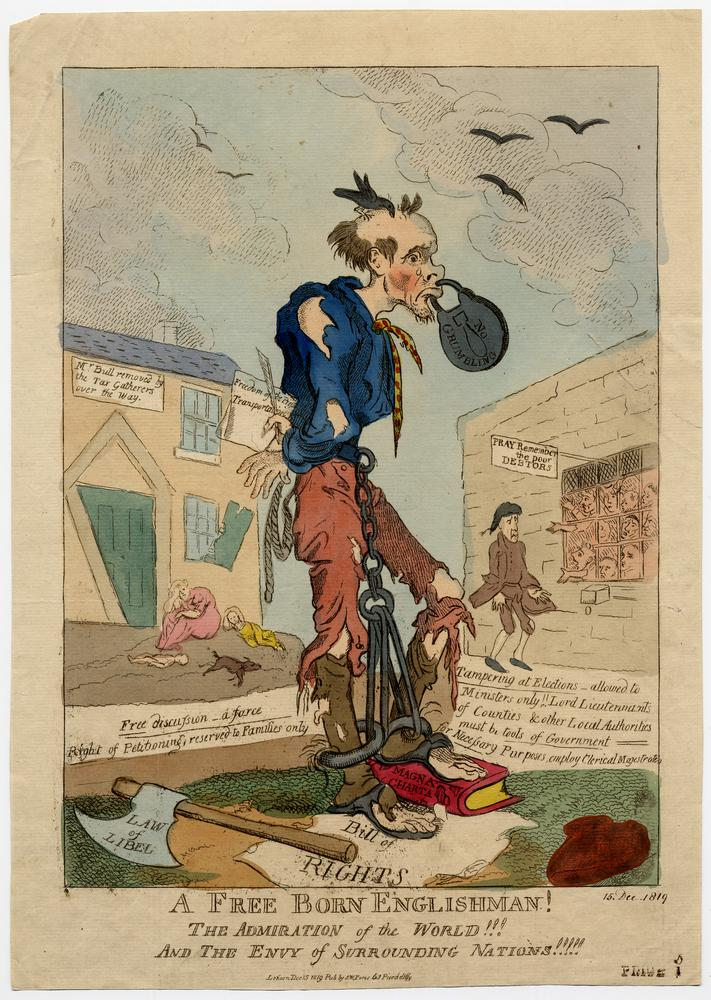
Arrest of Leeds man for holding up a Private Eye cartoon on Palestine protest & the Freeborn Englishman
The police have decided to take no action against a man that arrested at the weekend under the Terrorirism Act for displaying a Private Eye cartoon on Palestine demonstration.
The socialist historian E P Thompson wrote about the history of the Freeborn Englishman in this introduction he wrote to the Secret State (1978):
By the end of the eighteenth century, this was an all-pervasive Whiggish rhetoric, shared by Tories, Whigs and Radicals alike. Moreover, it was a rhetoric taken over and applied to greatly more democratic ends, by the rising popular reform movement. The parliamentary oligarchs wished to contain their debates within the privacy of the walls of parliament; they did not wish the British people to overhear how their governors talked, in private, about them. Wilkes and the printers defied ‘the law’ and breached this privacy; we owe Hansard to this defiance. In area after area, the ‘common people’ insisted that the civil rights of the ‘freeborn Englishman’ were not the privileges of an elite but were the common inheritance of all: freedom of press, speech and conscience, rights of assembly, inhibitions upon the actions of military or police against crowds, freedom from arbitrary imprisonment or unwarranted arrest and entry upon private premises. The insurgent British working-class movement took over for its own the old Whiggish bloody-mindedness of the citizen in the face of the pretentions of power. Even when labouring under the manifest class discrimination of the Combination Acts, the secretary of an illegal trade union branch of framework knitters in Mansfield in 1812 was able to protest against a clause in a Bill proposed by the workers’ representatives themselves, which authorized the search for shoddy goods in the houses of manufacturers : ‘if iver that bullwark is broke down of every english mans hous being his Castil then that strong barrer is for iver broke that so many of our ancesters have bled for and in vain.’ The workers had appropriated the democratic precedents and practices of past generations for their own; the ancestors were not ’theirs’ but ’ours’.
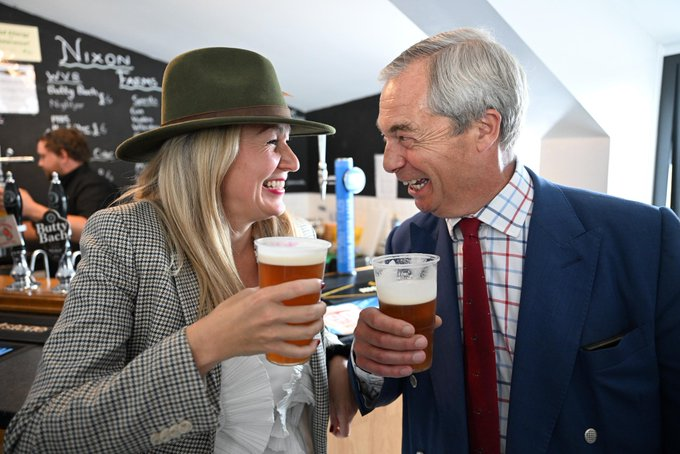
Farage visited the Royal Welsh Show (near Builth Wells) on 22nd July. He ‘unveiled’ a Tory defector to Reform. It can only be assumed that Reform’s head of vetting Tom Waterhouse is on holiday.
As usual it became clear that as ever with Farage he was only there for the beer (and no doubt a proper lunch with fine wine followed)
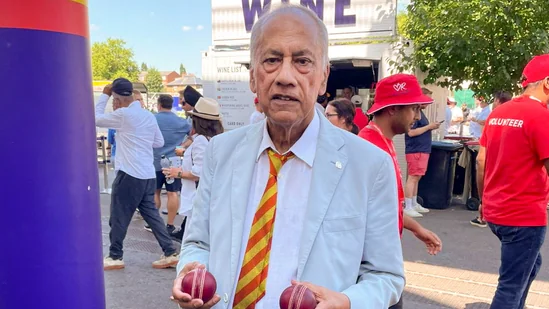
The Dukes cricket ball is used for England and Welsh first class cricket matches including Test Matches. Its history dates back to 1760 in Tonbridge Kent.
In fact Dukes is a global cricket ball business. Negotiations have been underway for the ball to be used in Indian cricket for example.
The UK operation is run from a back street unit in Walthamstow North-East London. It seems like a slightly odd arrangement as British Cricket Balls Ltd (the UK front for the Dukes ball)does not have an actual contract with the ECB that runs cricket in England and Wales. Its owned by MCC member Dilip Jajodia, who also owns the cricket equipment company Morrant
In recent seasons there have been increasing issues with balls going out of shape and needing to be changed before the 80 over ‘new ball’ cut off. Possible reasons include the use of heavier bats, electronic advertising boundary boards that can damage the ball and more six hitting, meaning balls can land on concrete beyond the boundary.
One suggestion is that the ball change should be 60 not 80 overs.
The process of production has not obviously changed in recent times, although details are rather less than transparent. It might be assumed that quality control and checking of the balls is done at Walthamstow as is, perhaps, the production of the basic ball. Hand Stitching, lacquering etc is done in the Sub-Continent.
English leather is still used for the balls, although reportedly the long term preferred supplier ceased trading in the pandemic period and the leather has to be sourced from elsewhere. An issue with consistency might be a question here.
Cricket is a game but in 2025 also a global business. Cricket ball production is the same but like cricket itself it has elements of less regimented past.
The Beard Liberation Front, the informal network of beard wearers, has said it is concerned about the launch of Royal Beard Oils which are on sale at Balmoral.
King Charles has not worn a beard for over 50 years so he clearly cannot endorse them personally. He may however have outsourced trials to Prince William.
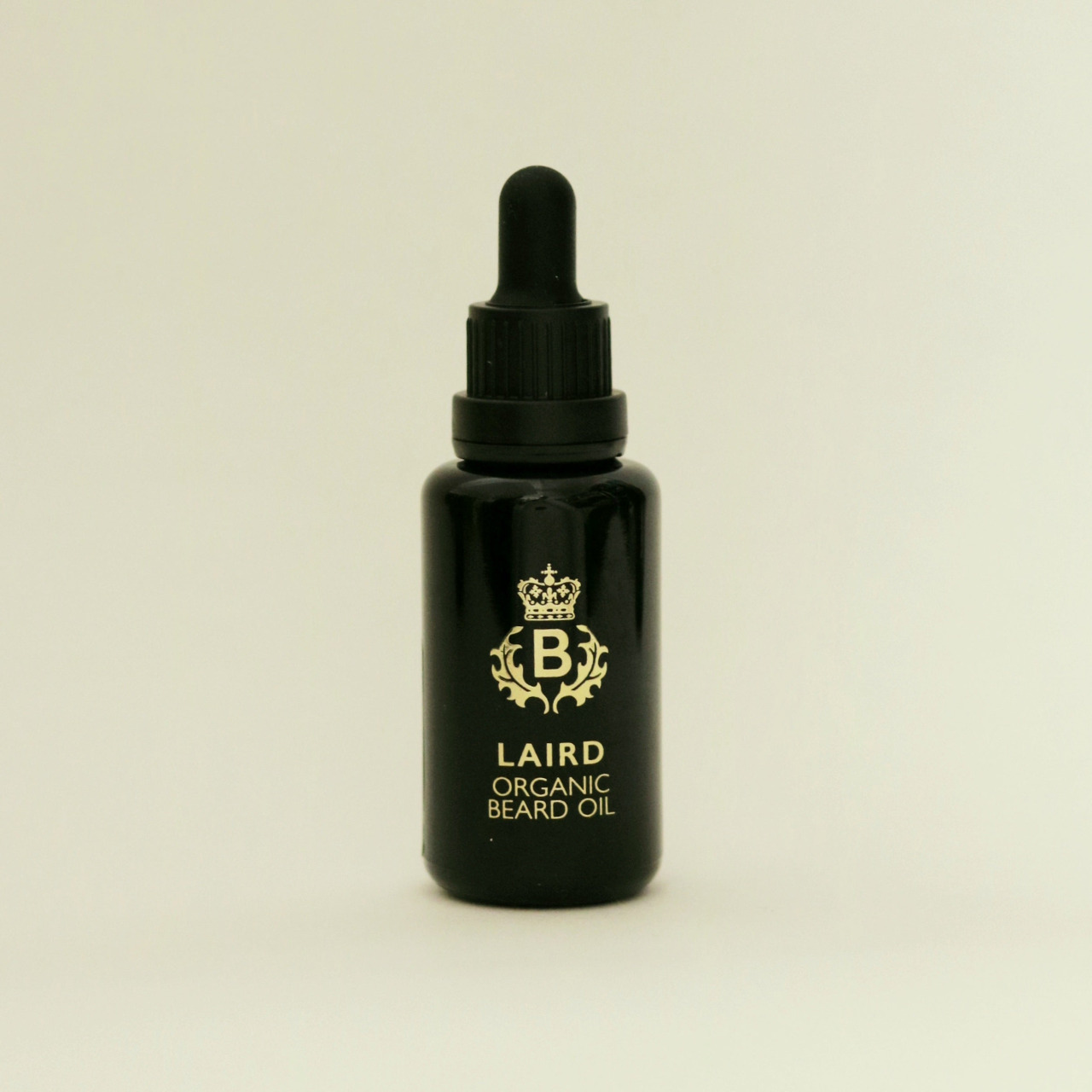
There are two versions of Royal Beard Oil. Laird, citrus based, which costs £25 and Chieftain, cedarwood based, which retails for £32.
The campaigners say that while Beard Oil is a popular product amongst a section of the hirsute, it can lead to sticky follicles.
BLF Organiser Keith Flett said, we don’t tell people what or what not to put in their beards, but in general our advice is that thoroughly washing and combing through the beard at least once a day is the best way to promote follicle health.
What Balmoral says
Laird Organic Beard Oil – 30ml
Laird scent opens with the crisp zest of Pink Grapefruit and Lemon Verbena, gently grounded by the warming spice of Cinnamon Leaf. A refreshing, citrus-forward scent with subtle depth – fresh, composed, and unmistakably elevated.
Infused with wild Bog Myrtle from the Balmoral Estate, this bespoke beard oil was crafted exclusively for Balmoral Castle by Hairy Highlander, Scotland’s leading eco-focused creator of beard care. Designed for skin comfort and daily beard control. A daily oil that pairs traditional botanicals with modern, skin-conscious performance.
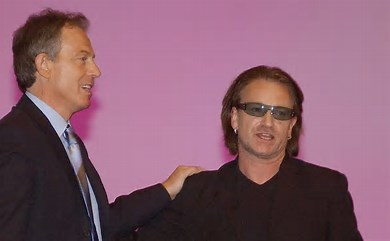
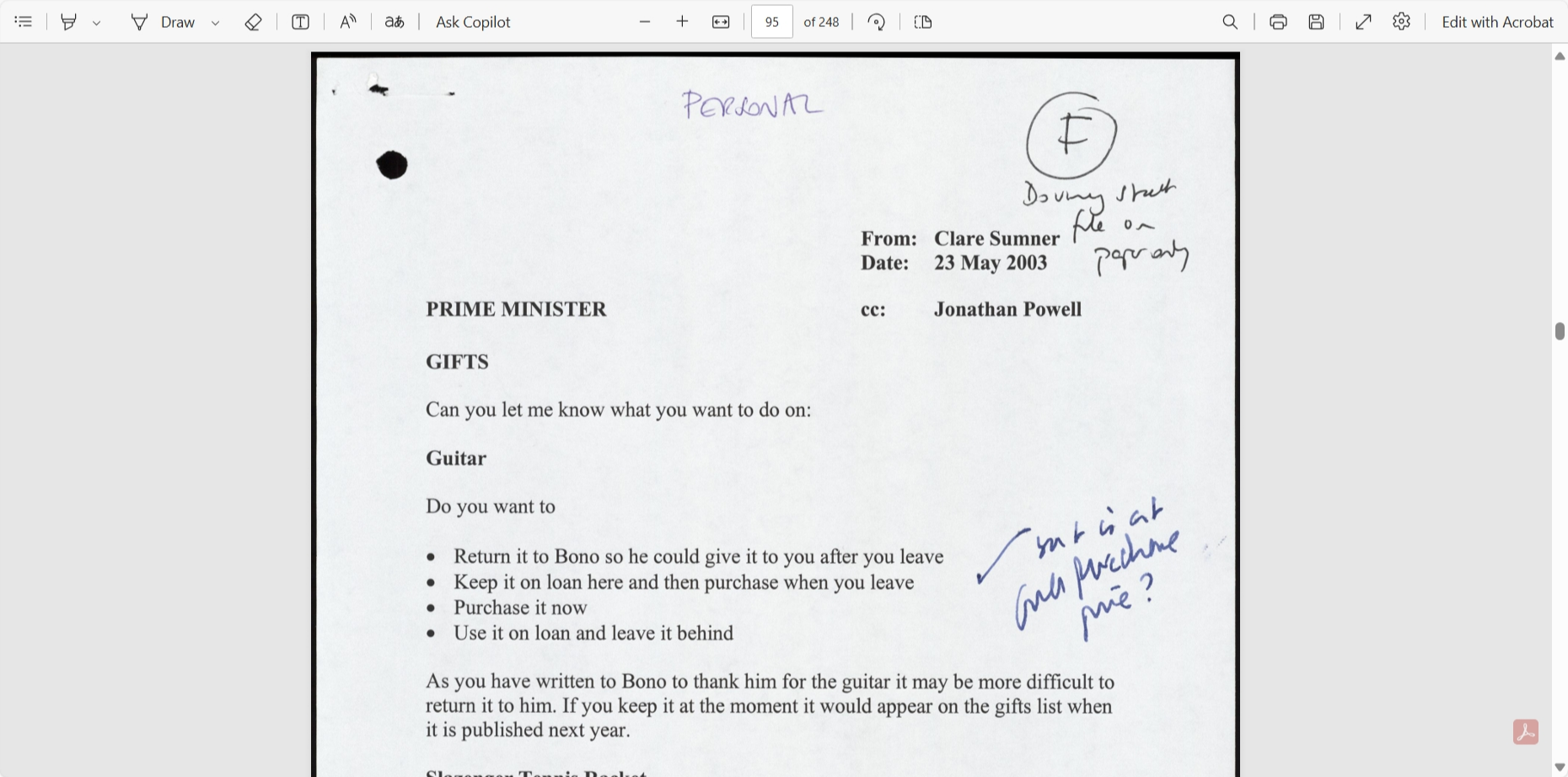
Tony Blair may have had a few other matters on his agenda in May 2003 but he still had time to ponder what to do about a guitar gifted to him by Bono. The decision was clearly to keep it after he left Downing St but his hand written note raises a query about cost.
One wonders if he still has it or ever actually played it.
The note is part of the latest release of Government papers at the National Archives, all of which are downloadable, free. I’ve had a look through a few files and so far it doesn’t look like the most interesting release. Files on Europe and Northern Ireland etc will of course be of interest to researchers.
Since the old 30 year rule on the release of papers was changed (in some cases) to 20 years the names of people still in public life appear including Jonathan Powell, Sue Gray and, inevitably, Peter Mandelson..