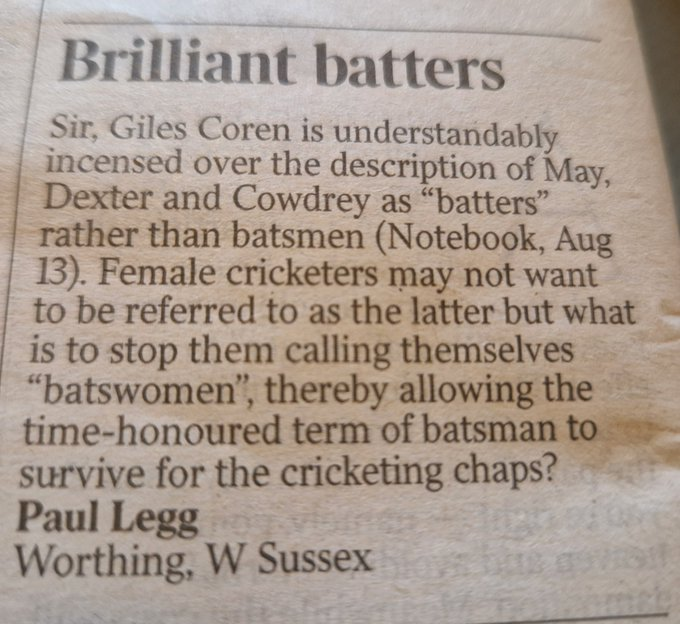
The dispute that has been rumbling on for a bit has appeared in the Times. Giles Coren apparently (I swerve anything written by him) has complained about the use of ‘batter’ to describe the person on strike in cricket be they a man or woman.
A letter writer (14th August) has now agreed with him.
The welcome rise of women’s cricket does require some minor adjustment to cricketing terms and batter is one. Of course batsman and batswoman could be used. Alternatively you could have Batman and Robin with the Umpire as the Joker.
It might be noted that there is and always has been only one term for bowler. There is no bowlerman. Why? There may be a history to it but a thought is that in the days of Gentleman v Players the bowler was invariably the proletarian Player, while the Batsman was more often than not a Gentleman. In short a matter of class, and now of gender too.
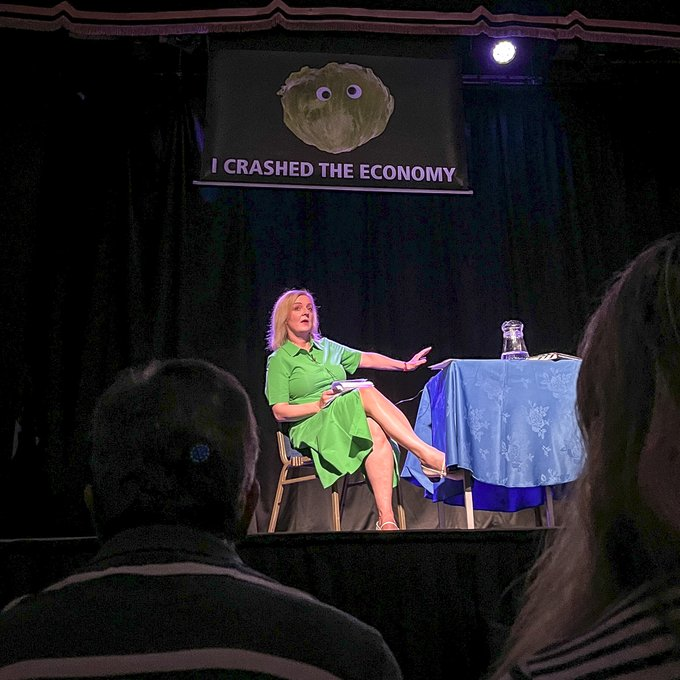
Liz Truss was speaking on her book Ten Years To Save The West at Beccles on 13th August (Tickets £16.50). It appeared to be mainly in praise of Donald Trump. According to a report in the London Evening Standard (14th August) the audience, unsurprisingly, was made up mainly of Tory supporters
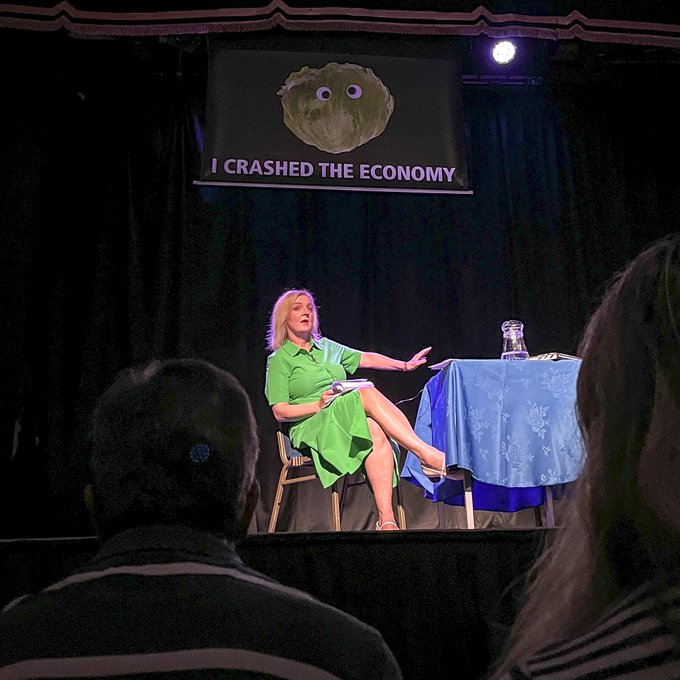
In the Q&A session at the end of the evening the master pranksters Led By Donkeys lowered a banner. Truss who had been tweeting on 13th August about the importance of free speech stormed off the stage noting ‘that’s not funny’.
The Evening Standard reports that one Tory audience member went to Beccles police station to complain about an unspecified offence. Unfortunately it was shut, a victim no doubt of Tory cuts to policing levels.
Truss tweeted on 14th August
What happened last night was not funny. Far-left activists disrupted the event, which then had to be stopped for security reasons. This is done to intimidate people and suppress free speech. I won’t stand for it….
Led By Donkeys are not of course ‘far left’ unless anyone that opposes the Tories is ‘far left’. The drop down was operated remotely. No one was threatening her security. Someone who can be ‘intimidated’ by a picture of a lettuce and a line of criticism really should not be in politics at all
In late August 1857 Engels was in Waterloo a north-west England seaside resort for health reasons. Feeling better he wrote to Marx on 26th August 1857:
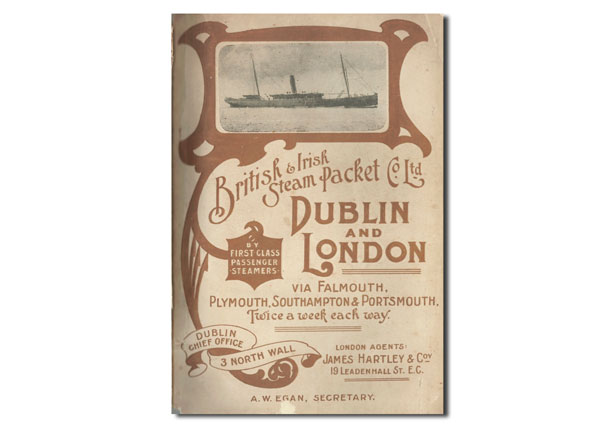
I shall at once go to Manchester and then, within a few days, to a more bracing seaside resort, possibly the Isle of Man. So write to Manchester in the meantime. As soon as I’m completely recovered and no longer require such regular sea-bathing I intend to take a sea trip, probably by STEAMER via Dublin to Portsmouth and the Isle of Wight, where we could hold a council of war together. But that will depend on circum-stances.
The British and Irish Steam Packet Company ran between Dublin and Portsmouth. Engels was in Ryde (and Portsmouth) for much of September 1857. However there is no evidence that Marx joined him (or least none I’ve found so far) and nothing on the ‘council of war’ might specifically have been about although Marx and Engels invariably had political projects and interventions in progress.
Perhaps oddly, given where I live, I am no fan of Tottenham cake (sold in Greggs’ London shops). I do, however, frequent Greggs (Zoe Williams, 6 August). I enjoy its sausage breakfast baps, and – unlike some fast food chains – it is fully unionised. That definitely makes the food taste better. Keith Flett Tottenham, London
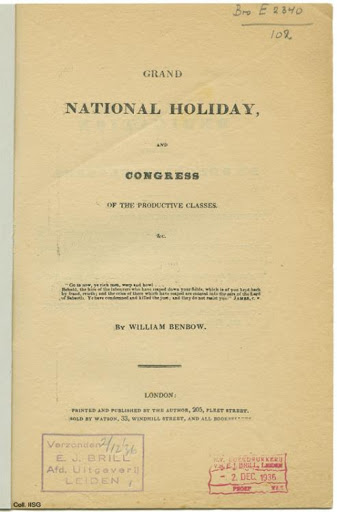
August marks the 185th anniversary of the 1839 Grand National Holiday or Sacred Month.
Ignored or derided as a failure by many historians it was an early attempt at a General Strike- its aim being to bring down capitalism.
The ‘Holiday’ was the idea of William Benbow. Like many radical activists in the nineteenth century he ranged across a variety of occupations, from pornographer to coffee house keeper to grocer and journalist, to survive.
He had been pushing the idea of a Sacred Month for decades in radical circles with no great immediate impact. He did however publish it as a pamphlet in the early 1830s and this can be freely accessed on the internet today!
Benbow’s plan might well have stayed simply an interesting idea were it not for the fact that the Chartist Convention of summer 1839 adopted it as policy and determined to put it into operation in August of that year, starting on the 12th of the month.
It is very much a view of the early labour movement. We are familiar with General Strikes around the world which are in protest at something or which are demanding specific things. The Grand National Holiday was neither of these. It simply planned to disengage from capitalism until the system stopped working.
This meant that not only was no work to be done, but that supporters of the Sacred Month should withdraw any savings they had in banks or other institutions. They were also required to abstain from all excisable articles such as drink and tobacco. On 12th August 1839 in many, mainly northern areas, the pubs were shut.
It was argued that aside from anything else this prevented any disorder and drunkenness as the month got underway.
How was the call for the Sacred Month implemented?
Again as with more recent General Strikes it was not and could not be a matter of trade unions issuing instructions to members to stop work, mounting picket lines and so on. The labour movement infrastructure for this did not exist in 1839.
Instead the method used- and it was one to be echoed in the 1842 General Strike, which is better known to history-was different.
The weekly Chartist newspaper The Northern Star for the 17th and 24th August 1839 reports meetings across the north, often with very large turnouts comprising a majority of the working population of particular areas, which then proceeded to march to surrounding locations to pull others out in support of the Sacred Month.
Perhaps the best way of describing it is a mass flying picket, but before the motor vehicle, the only way to do this was to march on foot.
There is not a uniform picture of how long people stayed out for- some days in a number of areas- but not the whole month. Again the logistics were complicated. With so many out, and long before any kind of welfare system, people had to balance support for the holiday with the need to survive in terms of eating and providing for those unable to work.
Perhaps some had small holdings that allowed them to survive without wage labour, possibly being only recently agricultural workers. This was part of the project that became in the later 1840s the Chartist Land Plan, but for the Sacred Month itself detail on this remains, as yet, scarce.
Even in areas where the strike did not take hold there was at least symbolic support. In London on 12th August there was a mass Chartist meeting on Kennington Common for example.
Why did the strike fail?
Firstly because many leading Chartists were preoccupied with State persecution, arrests and trials, relating to the 1839 Convention.
Secondly because the 1839 Metropolitan Police Act had seen the introduction of new police forces in some areas. For example in Manchester the police, known as the ‘bludgeon men’ attacked and arrested strikers.
Yet this was not the last of the Chartist Challenge. The Sacred Month was just part of a repertoire of strategies that were being tried, mostly for the first time anywhere in the world, to see which might succeed in bringing an end to capitalism.
In November 1839 in Newport South Wales there was an attempt at armed revolution. It almost succeeded.
Liz Truss was speaking on her book Ten Years To Save The West at Beccles on 13th August (Tickets £16.50). It appeared to be mainly in praise of Donald Trump. According to a report in the London Evening Standard (14th August) the audience, unsurprisingly, was made up mainly of Tory supporters
In the Q&A session at the end of the evening the master pranksters Led By Donkeys lowered a banner. Truss who had been tweeting on 13th August about the importance of free speech stormed off the stage noting ‘that’s not funny’.
The Evening Standard reports that one Tory audience member went to Beccles police station to complain about an unspecified offence. Unfortunately it was shut, a victim no doubt of Tory cuts to policing levels.
Truss tweeted on 14th August
What happened last night was not funny. Far-left activists disrupted the event, which then had to be stopped for security reasons. This is done to intimidate people and suppress free speech. I won’t stand for it….
Led By Donkeys are not of course ‘far left’ unless anyone that opposes the Tories is ‘far left’. The drop down was operated remotely. No one was threatening her security. Someone who can be ‘intimidated’ by a picture of a lettuce and a line of criticism really should not be in politics at all
On 205th anniversary historians call on Tories to apologise for Peterloo
The London Socialist Historians Group, which convenes the socialist history seminar at the Institute of Historical Research, University of London has called on the Tory Party to apologise for Peterloo on the 205th anniversary.
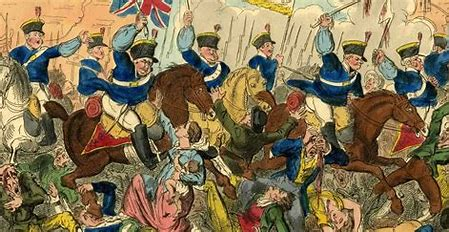
Many thousands had come from surrounding towns and villages to hear speakers including Henry ‘Orator’ Hunt at a demonstration demanding the right to vote held on St Peters Field in central Manchester on 16th August 1819.
They were cut down by Yeomanry on horseback using sabres and numbers died or were injured.
Wlliam Hulton the Chair of the Magistrates on the day who gave the order to send in the Yeomanry, was a lifelong Conservative.
Before the 1832 Reform Act Hulton was part of the ‘blue party’. His family owned a horse called Church and King. When the Tories lost to the Whigs (Liberals) in South Lancashire in the Election of that year, Hulton was a founding member of the South Lancashire Conservative Association.
According to his biographer Robert Walmsley (Peterloo The Case Reopened 1969) Hulton did make an apology of sorts for Peterloo but this was lost on the reformers of Lancashire including The Guardian newspaper that perpetually referred to Hulton as a ‘foolish country squire’.
London Socialist Historians Convenor Dr Keith Flett said, Rishi Sunak remains Tory leader but he is on holiday in California. There are however six contenders to replace him as Tory leader currently touring England speaking at meetings. There is nothing to stop them apologising for Peterloo although if the campaign launch of Tom Tugendhat is anything to go by perhaps they will be celebrating it as a great moment in British history
Hirsute celebrate 100th Birthday of Castro’s Beard
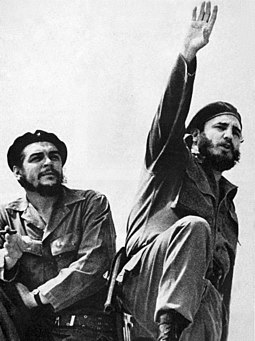
The Beard Liberation Front, the informal network of beard wearers which campaigns against beardism, has said it will mark the 100th birthday of Fidel Castro’s beard on Thursday 13th August by asking supporters to briefly chant: ‘Hail Socialist Beards; Down With Clean Shaven Revisionism’
The campaigners say that pictures of a young Castro which appear to show him clean shaven are likely to be CIA fakes and that there is every indication that the iconic beard wearer was born with a beard.
The CIA once famously tried to singe Castro’s beard with an exploding cigar
BLF organiser Keith Flett said, Castro’s beard is an hirsute icon and it survived all attempts by clean shaven counter revolutionaries to get rid of it. We celebrate its anniversary
Its probably unfair to rely on Liz Truss for consistency of thought but when self parody arises attention is warranted.
In a Telegraph podcast recently Truss was asked about the comparison of her 49 day Premiership with a lettuce. She described the comparison as ‘puerile’
On 13th August she was to be found praising the dedication to free speech of the current owner of Twitter. Its not clear whether she had noticed that on 10th August that same individual had tweeted about ‘Liz “lettuce” Truss.
The Beard Liberation Front the informal network of beard wearers has said that the idea of a beard tax is one of a number of things being mooted for Rachel Reeves Autumn Budget.
Such taxes have never worked in practice and in 2024 would cost far more to enforce and collect than they would ever raise.
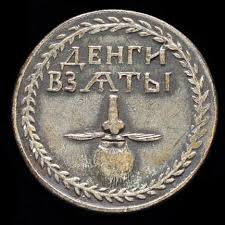
While history records several beard taxes including one imposed by Peter the Great these were aimed at the rich and powerful in society and were poorly enforced. The lower orders had insufficient money historically to pay any direct taxes.
A modern beard tax would require a Beard Inspectorate to enforce tax payment and just to check on beards in Dalston and Shoreditch in East London alone would be likely to outweigh proceeds from the tax.
BLF Organiser Keith Flett said, we have long believed that a shaving tax on all items relating to shaving would raise more money and it would also be climate friendly. We urge Rachel Reeves to a fiscally responsible approach to shaving