The Beard Liberation Front, the informal network of beard wearers,has said that it is consulting on whether a new ‘half beard’ style is one of the hirsute fashions of summer 2023
Italian athlete Gianmarco Tamberi took gold for the high jump at the European Championships on Tuesday. He shaves half his beard when competing and it is thought this gives him an aerodynamic advantage in clearing the bar.
BLF Organiser Keith Flett said, Tamberi is a hugely popular athlete and his half beard style is iconic. However it is high maintenance and we are consulting on whether it will be the beard style for summer 2024
I can’t say I agree with much of it. I don’t like cask breathers. I’d rather pubs kept their cask beer offering down to what they can sell in a few days, although I appreciate that in PubCos different terms and conditions may apply.
Alworth pours the enormous condescension of posterity all over early CAMRA activists and as a member since 1975 I find that lacks context of which Alworth is probably not aware.
In the late 1970s I lived and taught in Birmingham. The beer scene certainly had plenty of cask beer (often on electric pump) and it was very largely M&B Brew 11. It was a sweet low strength vaguely malty beer. Even in the era of old style keg when pretty much any cask was better, it was disgusting. I recall one free house that sold a range of cask, the Duck on the Hagley Rd.
I’ve been in Birmingham many times since, occasionally for demonstrations, mostly for work. There are excellent views from the employment tribunal court atop a tower block near New St station.
I was there again in early June for a national union conference at the ICC (central Bham) and obviously in the evening I tried the beer. The Thornbridge galaxy/simcoe pale at Bundobust (cask) was tasty at 4% and I also tried a Bundobust DDH IPA on keg (I am not a CAMRA fundamentalist). The Jaipur (cask) at the Colmore was of course on top form and I also tried a Thornbridge West Coast IPA on keg.
Sunday evening I tried the Wetherspoons on Broad St. A 440ml can of the local Indian brewery Mango pale (5.5%) was good as was the Oakham Citra on cask. Later I had pints of a Black Hole IPA (Burton on Trent) and Silhill (Aston) West Coast IPA both on cask and both in good form.
You may be able to spot a trend here. Compared with 45 years (and even 10 years) ago the beer scene in central Birmingham is vastly improved and cask, served well and local and regionally brewed seems to be doing decently
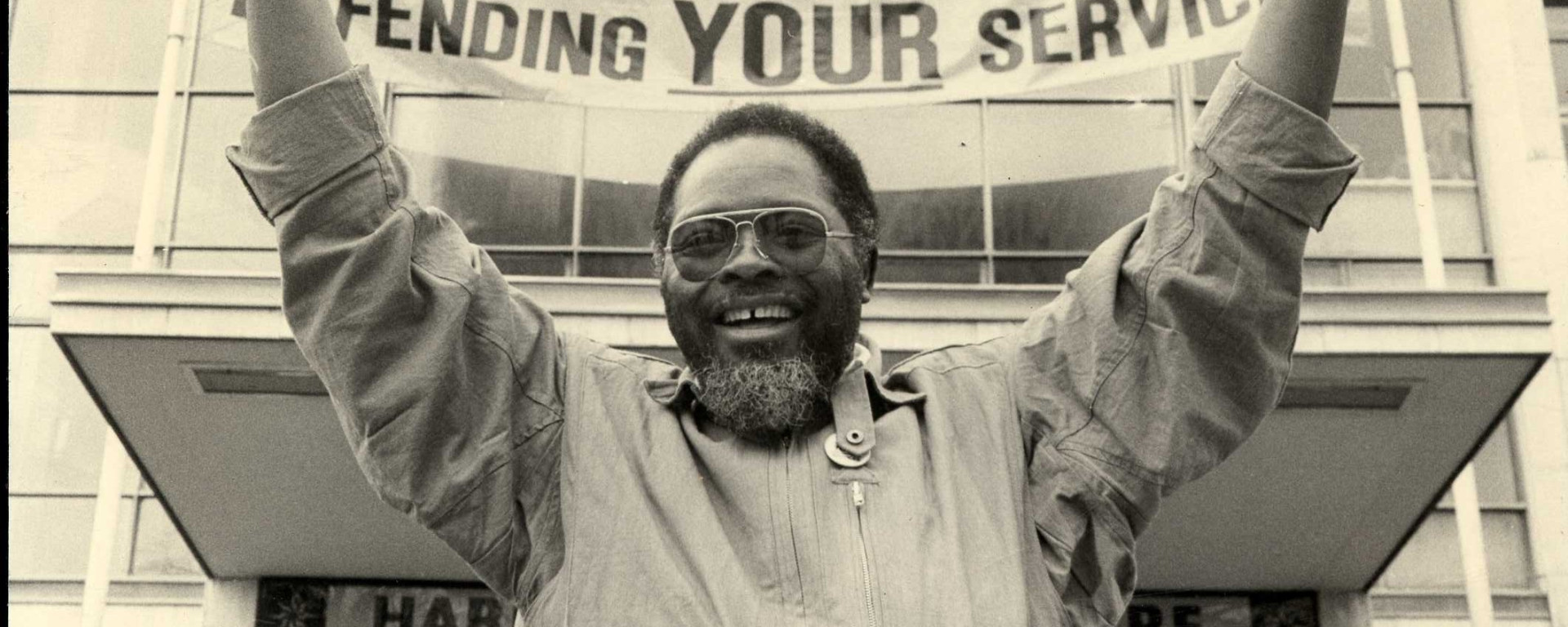
Bernie Grant entered Parliament at the June 11th 1987 General Election. Below is his maiden speech made, appropriately, in a debate on a Tory Local Government Bill on July 6th 1987.
The themes he raises such as racism, privatisation and housing remain pressing issues still.
Mr. Bernie Grant (Tottenham)
I am pleased to be here representing the constituency of Tottenham and I am also pleased to follow my predecessor, Norman Atkinson, as Member of Parliament. Norman served the constituency well for more than 20 years and I shall be pleased if I am able to equal his fine record of service to Tottenham’s citizens. I wish to add my voice to the thousands of constituents in thanking Norman for his work on behalf of the people of Tottenham. We wish him well in the future.
For myself, as for Norman, local government and the needs of inner cities are of prime importance when representing a constituency such as Tottenham. Tottenham has almost 20 per cent. unemployment and almost half our citizens are from the black and minority ethnic communities. Such are the major characteristics of life in Britain today. Therefore, I was pleased to see that this Government, somewhat belatedly, had come to recognise the need for the inner cities and for their regeneration. What a wonderful opportunity this first Local Government Bill of the new Parliament would have been to address those problems. However, once again, they have got it wrong, I believe deliberately.
The Bill before us, in common with the 14 previous Bills on local government introduced since 1979, provides the wrong answers to the wrong questions about local government, its priorities and needs. The solutions the Bill provides are privatisation of local government services, an end to contract compliance and a reduced role for local government publicity. That is a recipe for more local government domination by lawyers and the courts and less by those professional officers who provide the necessary services for our people. Last week, The Guardian showed that even among Tory local authorities privatisation was unpopular. It reported that, these days, more councils are cancelling contracts to outside firms rather than extending them
Ask the residents of London’s east end what the Government’s solution to inner-city needs means to them. It means the yuppification of docklands, putting two-bedroomed flats at £250,000, beyond the wildest dreams of local people. Yet living cheek by jowl with that is the unrestrained Thatcherite land of Spitalfields, with sweatshops, atrocious housing and dire poverty, so graphically brought to life last week by Prince Charles’ visit. Nestling beside both is Rupert Murdoch’s Wapping, the subject of our previous debate, and that other face of Thatcherism— Murdoch’s press—which simultaneously welcomes yuppies and condemns Prince Charles for drawing attention to the poverty. No wonder the Government back Murdoch’s bid to take over the British press without restriction or inquiry.
To this Government, the solution to local government and inner-city problems is to increase freedom, but their definition of freedom is freedom of choice for those who have the money to opt out, and the freedom of the private sector employers to exploit low-paid workers. That is not the answer. We with experience in inner-city local government see no merit whatsoever in worsening services and driving down the wages and working conditions of ordinary people so that they become a new servant class to an influx of yuppies. Public services in our inner cities need to be improved under democratic control, not impoverished and handed over to outside profiteers and carpet-baggers, as the Bill proposes.
The improvement that is necessary costs money, and the Government must find it. We in the Labour party do not want the freedom that the Government propose for local authorities and inner cities because it is a licence for the few to exploit and impoverish. We are interested in real freedom for everybody, a type of freedom that liberates people from the yoke of poverty and the chains of racism that infect our inner cities. The fight against institutionalised and personal racism in this country must be at the top of the agenda for anyone who seeks to address inner-city problems.
However, in the Bill the issue of racism is an afterthought. The fact that the Bill allows section 71 of the Race Relations Act 1976 to be included in contract compliance proposals is a feeble gesture in the fight against racism because the Race Relations Act itself is feeble and in need of major reform.
Furthermore, in the same Bill, the Government propose to withdraw the power of local authorities to refuse to give contracts to firms that have trading links with South Africa. That gives the lie to any pretence by the Government that they are concerned about eliminating racism. It is further evidence of the Government’s intention to prop up the racist regime in South Africa.
Let us return to the United Kingdom, where black unemployment runs at two or three times the rate of white unemployment in inner-city areas such as Tottenham. Such discrimination cannot be allowed to continue. It should be the role of Government to stop it by taking strong and positive action to combat racism in employment and other areas. The proposals in the Bill are inadequate, and we shall oppose them vigorously in the later stages of its passage.
It is clear that the Bill represents a continuation of the neglect that the Government have shown towards the disadvantaged, which has resulted in urban violence. That is a tragedy, because unless the political system can offer some prospects, particularly to our young people and our young black people, they will find other means of expressing their frustration. As an alternative approach, let me refer to one estate in my constituency, Broadwater Farm. It is an example of what local government can do in an inner-city estate.
What has Haringey council done? We have embarked on skill surveys and on the economic regeneration of the estate through our economic development unit. We have provided jobs in an estate where there is 40 per cent. unemployment and where up to 80 per cent. of the black youth are unemployed. We have gone out of our way to recruit local people to work on projects and in running essential council services. We have done that by inserting a clause into contracts for work on the estate, which states that local people must be employed wherever possible.
The architecture on the estate has major drawbacks, so we have employed architects to work with the community, taking on board the people’s aspirations for how the estate should be developed. We have improved the provision of public and community facilities by encouraging the participation of all concerned, including the police, in an open forum rather than imposing the ideas of so-called experts on that community.
What has been the outcome? There have been no more disturbances. The community spirit is high and people are confident. There is no graffiti on the estate. The local police chiefs publicly praise the co-operation that they get from the local community in improving relations.
Despite the chronic levels of economic deprivation, crime levels on the estate are at an all-time low and the police tell us that they are the lowest in Tottenham. Even the Department of the Environment uses the estate as a model of what community development can mean in practice, by bringing in visitors to the estate from home and abroad on a weekly basis. That approach is light years away from the cheapskate. mean-minded and corner-cutting solutions that the Bill offers the inner cities. That approach meets the needs of the inhabitants, not the needs of the fly-by-night profiteers.
In contrast to the measures proposed in the Bill, our approach in Haringey involves the community in controlling developments in the area and having the power of veto over those developments. By working with the community, we have been able to develop together in partnership and in confidence. The alternative suggested in the Bill and in the Government’s other proposal for the inner cities is to take power away from the people, to put it in the hands of faceless Whitehall bureaucrats and Tory politicians who have to pick up a map to find where inner-city areas are.
Nigel Farage faced a protest from Stand Up To Racism protesters when campaigning in Barnsley on 11th June. The protest was noisy but peaceful. Seperately an individual tried to throw a stone or brick at Farage from an adjacent building site. They were not connected with the protest although of course serial liar Farage tried to claim they were (Labour is probably launching a defend Farage campaign).
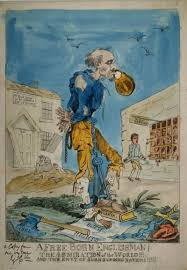
Farage claims to be a great patriot and to stand up for the rights of the Englishman (and occasionally woman). Tumults at Election times are a great tradition.
Writing in The Times on 8th June historian Dominic Sandbrook reflected on the robust history of election protests. For example at Bristol in 1818 candidates were ‘pelted with stinking fish, dead dogs, cats and rats’. A popular tradition Farage should surely be defending not complaining about
Details of National Beard Week 2024 announced with General Election twist
The Beard Liberation Front, the informal network of beard wearers, has confirmed the details of National Beard Week 2024 with a special General Election twist
BLF Organiser Keith Flett said, National Beard Week is all about promoting positive angles of hirsuteness and calling out beard haters. This year we’ve added a special Election Award for the most Beard Friendly Manifesto
National Beard Week 2024
Monday 17th June: Hirsute Personality of the Year: the beard wearer who has made the positive public impact during the year. 2023 winner- Moeen Ali
Tuesday 18th June: Beard Friendly Sandwich of the Year: the sandwich that goes in the mouth not the beard. 2023: Chip Butty
Wednesday 19th June: Hirsute Broadcaster of the Year: the broadcaster whose beard has had the most public impact. 2023 Michael Rosen
Thursday 20th June: Pogonophobe of the Year: the most notorious beard hater of the year; 2023 Ron DeSantis
Friday 21st June: Most Beard Friendly 2024 Election Manifesto
Saturday 22nd June: Beard of Summer 2023: the third of the four quarterly seasonal Awards 2023 Jamie Driscoll
Prof Tim Bale who works on election commentaries and analysis has told Evan Davies on Radio 4 (10th June) that the term ‘far right’ should no longer be used to describe Meloni or Le Pen because the parties they head are now popular. The Times (Editorial 11th June) makes a similar point claiming that Meloni is really a centrist.
The snap French Election at the end of June will test the lurch to the far right. It might be reflected however that liberals like Bale never learn. He may think the far right should be normalised but if it gets a sniff of power in the UK it will not take such a charitable view of his endeavours. By then it will be too late.
Another reminder of Michael Rosen’s view on this:
Fascism: I sometimes fear…
I sometimes fear that
people think that fascism arrives in fancy dress
worn by grotesques and monsters
as played out in endless re-runs of the Nazis.
Fascism arrives as your friend.
It will restore your honour,
make you feel proud,
protect your house,
give you a job,
clean up the neighbourhood,
remind you of how great you once were,
clear out the venal and the corrupt,
remove anything you feel is unlike you…
It doesn’t walk in saying,
“Our programme means militias, mass imprisonments, transportations, war and persecution.”
As politicians Nigel Farage and Harold Wilson have little in common. One thing they do share is a grasp of the importance of political image.
In public Wilson could often be seen smoking a pipe. Probably the best understanding of this was that he used the pipe, its lighting etc, as a device to gain a few seconds thinking time before answering a question. In private he preferred cigars, not so much a man of the people image.
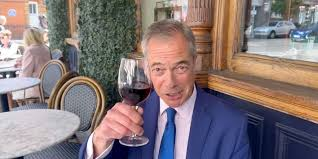
Farage also likes to present that image. It seems unlikely from a former public schoolboy and broker and it is. Of course like Boris Johnson, Farage can be found sinking the odd pint. Indeed in a Times interview (8th June) he said he’d like to meet Starmer (an actual beer drinker) for a pint in the pub.
The same Times interview finds Farage in a restaurant drinking a G&T and noting he had prepared for a TV debate with a glass of red wine.
The image has been a long time in construction. In 2014 when Farage was campaigning for UKIP the journalist Geoffrey Wheatcroft (Bloody Panico, Verso,2024) met Farage for lunch at the Belgrave branch of the Boisdale restaurant (Farage held his 60th in the Canary Wharf branch in May). They drank champagne and what Farage described as an ‘excellent claret’
With Farage the populist beer drinker hides something much more unpleasant.
The Guardian has reported that part of a new development in central Manchester includes a penthouse flat named after one of the City’s most famous former residents Engels. The flat is on the market for £2.5m
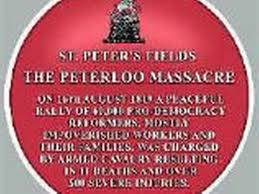
Its a far cry from the Manchester dwellings Engels found in his 1844 book the Condition of the Working Classes in England. It also disrespects radical history and not for the first time. The Radisson hotel again in the centre is built on the site of the Free Trade Hall which itself was constructed on the site of the 1819 Peterloo Massace. Having stayed in the rather upmarket hotel (for a TUC conference) I can reveal that it has a Henry Hunt room. Hunt was the only speaker at Peterloo and was jailed for his efforts.
The journalist and author Andy Beckett, currently a Guardian columnist, has lived in north-east London for 30 years, Stoke Newington, Islington and currently in Stoke Newington. I’ve lived in Tottenham since 1992, that being in a third Borough- Haringey- still very much part of North London.
His new book (The Searchers) focuses on five people Tony Benn, John McDonnell, Diane Abbott, Ken Livingstone and Jeremy Corbyn. I don’t know Livingstone, who comes from a slightly different political perspecive than myself, but I did know Benn and certainly do know the other three even if again our views don’t always coincide.
Read the book for more obviously but Beckett makes an interesting point about life in north-east London
‘These are places where interest in politics is unusually important. Election turnouts are high despite their predictable, Labour dominated, outcomes. Conversations in the pub often turn to politics. Protests are part of everyday life for well-off and poor residents alike’
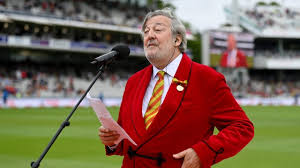
Stephen Fry speaking at the Hay Festival recently on bias in cricket attacked the MCC of which he was President in 2022 as ‘stinking of privilege and classism’ and referred to the ‘beetroot-coloured gentlemen of the MCC’.
He was right of course. By a narrow margin the Eton v Harrow schoolboys game continues to be played at Lords while increasingly popular women’s cricket doesnt get much of a look in.
Fry is not a model of consistency and when he was found out by the Times retracted and said he should learn to keep his big mouth shut