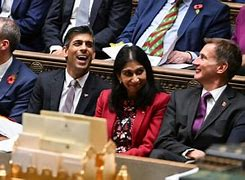
Sunak is still dithering on whether to sack Suella Braverman possibly grasping that without her support he will end up being the next Tory leader to be purged after Johnson and Truss.
The Guardian has revealed that there are five small groups of far right Tory MPs backing Braverman,totalling around 50 in all.
The groups include
New Conservatives (Danny Kruger, Miriam Cates,30p Lee)
The Common Sense Group (Braverman Groupie John Hayes)
No Turning Back
European Research Group
Northern Research Group
The latter two groupescules do their own research on the interwebs
The MPs involved here may well be racists and bigots but they are not fascists. They may well be content to encourage fascists though..
Oct 27th 1968 on Vietnam, 15th February 2003 on Iraq, to Nov 11th 2023 on Gaza. People Power worries the State
On 27th October 1968 100,000 demonstrators marched to Hyde Park to protest the war in Vietnam. It was organised by the Vietnam Solidarity Campaign. Tariq Ali one of the organisers was clear that the route deliberately avoided going to the US Embassy, then in Grosvenor Square. The aim of the march was not to have a punch up with the police, but a public display of large numbers protesting peacefully against war.
This did not stop the Times claiming that the march was really about violent revolt
‘A small army of militant extremists plan to seize control of certain highly sensitive installations and buildings in central London next month while 6,000 Met policemen are busy controlling an estimated crowd of 100,000 anti-Vietnam war demonstrators’
Times 5th September 1968
It was not of course, although a group of Maoist protesters did engage with police in Grosvenor Square, separate to the main march.
On 15th February 2003 well over a million people marched to Hyde Park to protest about war with Iraq. The protest was organised by the Stop the War Coalition and a coalition including the Muslim Association of Britain and CND. Apparently the march coincided with a heightened terror alert requiring the deployment of tanks at Heathrow. There were also arguments about whether Hyde Park could be used at all.
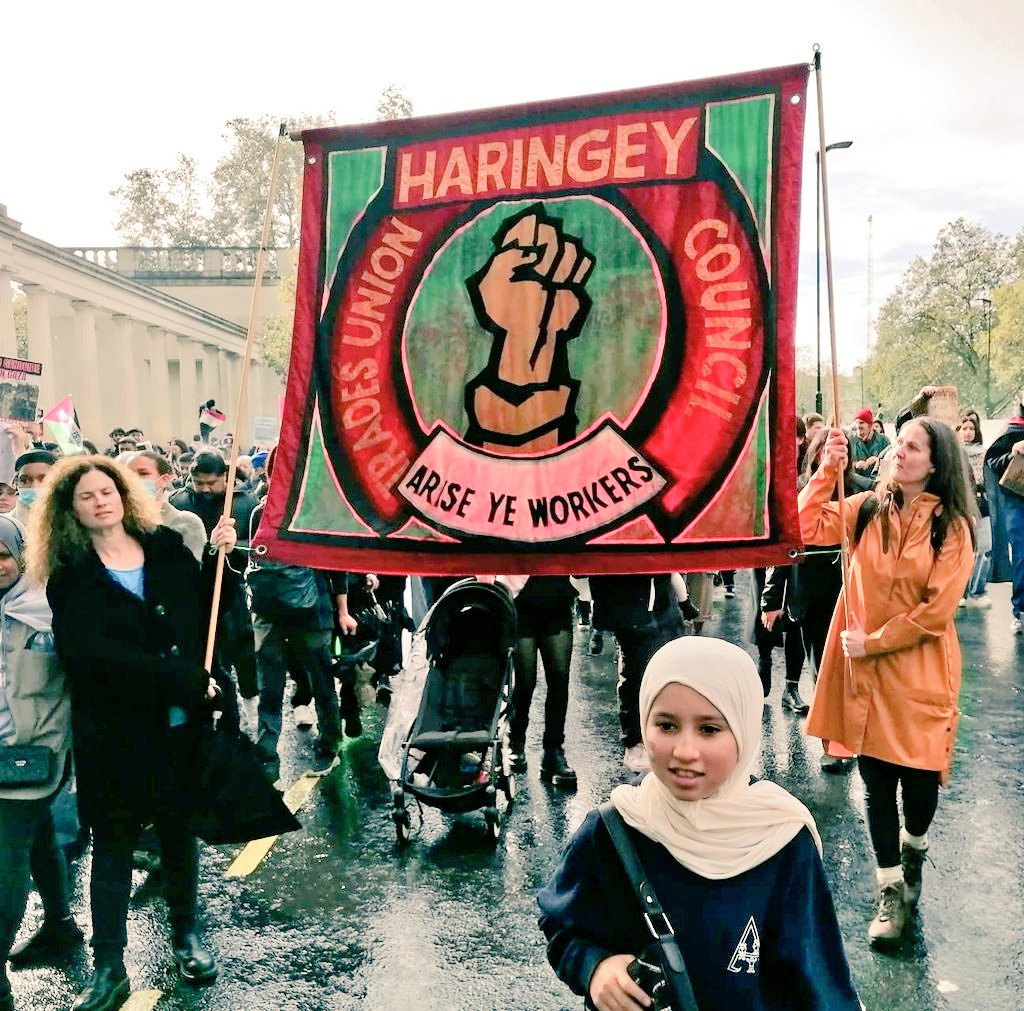
On 11th November 2023 a march set to involve very large numbers of people will protest against military destruction in Gaza by the Israeli Army, with thousands of civilians dead and injured. The march is organised by the Palestine Solidarity Campaign and others and the aim is a mass peaceful show of solidarity with Gaza.
The Government has tried and failed to get it banned and the Home Secretary Braverman has tried to incite far right groups to cause trouble on the day
Historically there are two key points about all these marches. Firstly they are all about Britain’s foreign policy and in particular the link between the British Government, of which ever party and the US on wars. Secondly that they have all been organised by coalitions from below without the official support of unions or Labour, although no doubt many trade unionists and Labour supporters have been and will be involved in all three.
People Power on the streets worries Westminster and has done for 55 years now. Yet the ability of official politics to understand and relate to the reasons for thousands taking to the streets remains absent. That is actually historically unusual
National Pudding Day. Jenny Marx’s Plum Pudding recipe, December 1867
9th November is National Pudding Day. While pudding’s traditionally contained meat- hence black pudding, haggis etc, by Victorian times the fruit focused often steamed pudding was more usual.
Below is Jenny Marx’s recipe for Plum Pudding- which is called Christmas Pudding in 2023 and is in shops now, although Stir Up Sunday is a couple of weekends off yet.
Yesterday evening we were all at home together sitting downstairs, which in English houses is the kitchen area from which all ‘CREATURE COMFORTS’ make their way up to the higher regions, and were busy preparing the CHRISTMAS PUDDING with all due thoroughness. We were seeding raisins (a most disagreeable and sticky task), chopping up almonds and orange and lemon peel, minutely shredding suet, and with eggs and flour kneading together the oddest potpourri from the whole mishmash;
Jenny Marx to Kugelmann 24th Dec 1867
It’s not recorded what Karl Marx thought of it, or if he preferred stollen…
The late socialist historian E P Thompson was fascinated by the reactionary views expressed in the Times letters columns and on its Editorial page and wrote about it in the collection, Sir, Writing By Candlelight.
Thompson died 30 years ago and while there are now some enlightened letters writers the paper’s leaders remain firmly on the centre right.
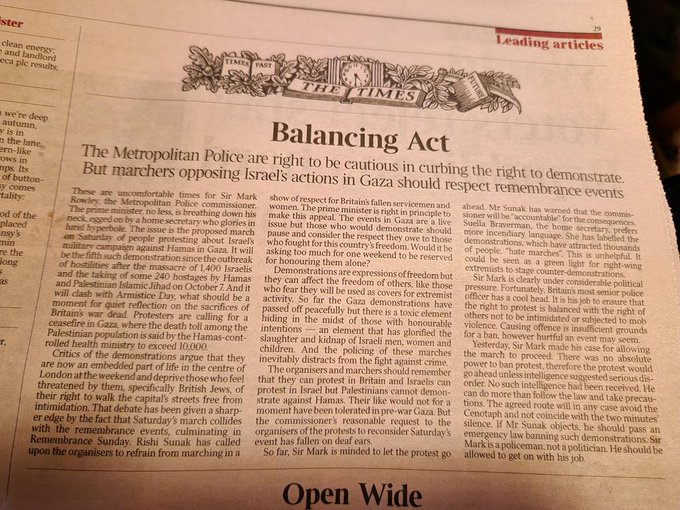
One enduring fascination is the right to protest. The Times agrees that there is a right to protest. It never agrees that its a good time to exercise it. In the case of the Palestinian demonstration in London on 11th November it thinks there should be a pause because its not the right moment (it never will be).
However since the police have agreed it can go ahead and the Times is definitely in favour of the police, then, grrr, it will have to.
Those who deconstruct the text will note that Suella Braverman is heavily criticised. Again this is a familiar theme. The paper’s owner Rupert Murdoch backs Kemi Badenoch as the next Tory leader
London Socialist Historians Group 8th November Historians say the right to protest has been hard won & must be protected
The London Socialist Historians Group, the long established group of research historians, has said it is supporting the march for Palestine and for a ceasefire in Gaza in London on Saturday.
The historians say that the issue itself is an important one in the context of British imperial history. Britain had the mandate for Palestine after World War One, yet as elsewhere around the world, this was discharged in the most unsatisfactory way possible. The existing population of the area was in large part forced off the land rather than their political rights being respected.
There is also an urgent need to protect the right to protest from an ever more authoritarian Government. As the Metropolitan Police have reminded us in recent days there is no actual right to march. The ability to do so can only be protected in practice.
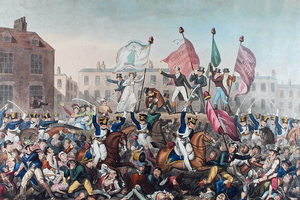
After Peterloo in Manchester on 16th August 1819 where a demonstration for the vote was broken up by soldiers with many protesters left dead and injured Governments have tended to the view that allowing democratic protest is better than provoking confrontation. However that has never been a settled view and from time to time demonstrations have been banned.
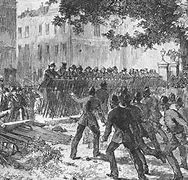
On 6th May 1867 a mass protest for the vote in Hyde Park was banned and the Government called in troops. However the demonstration was so large that they were overwhelmed. The Home Secretary Walpole resigned and a Second Reform Act extending the Suffrage was passed.
Socialist Historians Convenor Dr Keith Flett, there is a lot of very recently invented history being spouted by Tory Ministers about the Palestinian protest this weekend. They need to know that protest has always been part of Our Island Story and will continue to be so long after they have left Office,
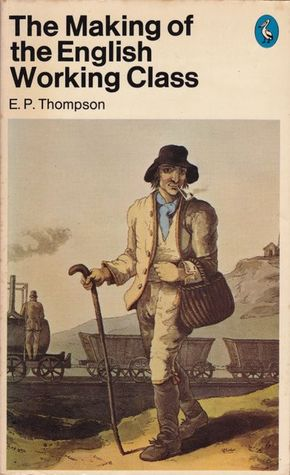
20th November Roundtable discussion on E P Thompson’s Making of the English Working Class at 60(Free on Zoom)
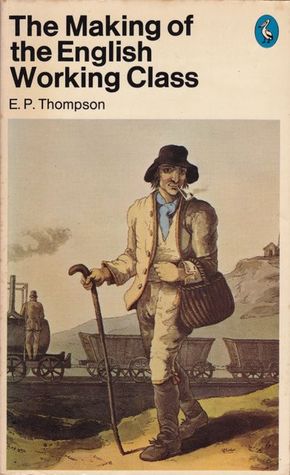
E P Thompson’s Making of the English Working Class was first published in hardback in 1963 and 2023 marks the 60th anniversary. A fair bit of the research for the book, carried out in the 1950s, has now been overtaken, either by updated empirical evidence or new ideas on how to approach subjects. Even so Thompson’s theoretical and methodological approaches still command interest.
I’ve been engaged for far too long in editing a volume of essays (for CSP) which were originally produced to mark the 50th anniversary in 2013, although updated since. The project is still live and hopefully the book will be out before too long.
In 2022 I reviewed some essays on Thompson and the book in the British Library, which were published shortly before his death in 1993 but like the volume I’m editing had been some years in gestation. Several referred back to Thompson’s formative political period in the 1950s when he left the Communist Party.
I was looking at views from the late 1980s about events in the 1950s. There was a further significant round of commentary on the 50th anniversary broadly from 2013-16 which my book is a delayed part of, but time has moved on again.
There are significant issues with Thompson’s book in terms of its coverage of women, in terms of race and still with the standard of living debate. A Making of the English Working Class for 2023 would look rather different in approach and material covered, perhaps not least in an understanding of how the English working class was not a lone actor in an imperial context
There is another point. The book is a lengthy one, what Thompson said was meant to be a history up to 1945 which managed to get as far as the 1830s. The book remains in print and much discussed but I suspect not many now carry it around in physical form. Many, like myself use an e-version and that means the text is searchable. A search uncovers things Thompson dealt with that you would probably not uncover reading the hard copy. For example there are several reference to black pudding and also, unrelatedly of Lenin.
As ever work in progress
Roundtable Seminar organised by the London Socialist Historians Group and the Socialist History Seminar at the Institute of Historical Research.
Monday 20th November 5.30pm Free on Zoom but booking (to get link) essential:
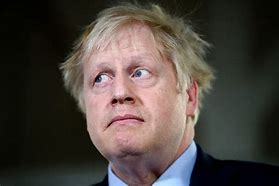
The COVID Inquiry has been hearing snippets of Boris Johnson’s perspectives on COVID. Dealing with the pandemic was not his skill set, although what this might be has yet to be revealed. Johnson queried if directing a hair dryer up the nose could get rid of COVID and also wanted to be injected with COVID to prove it was harmless. How ill he actually was from COVID remains unclear but ill he certainly was.
Finally its been confirmed that he did say let the bodies pile high as he resisted lockdown suggestions in Autumn 2020.
These details of the realities of the top of the Tory Government during the initial period of COVID in 2020 pass through a rolling news cycle, and then, as Michael Rosen has noted, disappear without any further reflection.
Johnson will give evidence to the inquiry in December,but how he can remain a public figure reflects the politically corrupt nature of much public life and not just in the UK
Tory Hate Speech 1968-2023. Powell was sacked, Braverman sits on Tory Front Bench
55 years ago on 20th April 1968, coincidentally, or not, the anniversary of Hitler’s birth, Enoch Powell gave his ‘Rivers of Blood’ speech to a Birmingham Conservative Association.
No complete recording of the speech exists, but on the 50th anniversary the BBC broadcast a recreation which was read by an actor in segments with critical comment in each section.
Powell was sacked as a Shadow Minister for the speech and never recovered his standing in the Conservative Party.
The speech is an important part of British history and should certainly be recalled 55 years on. A question is how it is appropriate to do so. There is no reason why it should not be available in appropriate archives and libraries, together with any other related documentation, for researchers and other interested parties to review. However at the same time, amplifying Powell’s sentiments is highly questionable. Fortunately there appears to be little attempt to do that
With Suella Braverman as Home Secretary and Nigel Farage an ever present media figure there is no need to do so.
Braverman has become an expert on hate speech, about rough sleepers, asylum seekers and protesters against war. In the Commons on Tuesday Keir Starmer underlined the point. Braverman, unlike Powell has not been sacked but was sitting next to the Prime Minister Rishi Sunak
Powell’s speech is a reminder that far right racist views and the Tory Party are not a recent phenomenon but 55 years on something a Culture War Tories can apparently tolerate.
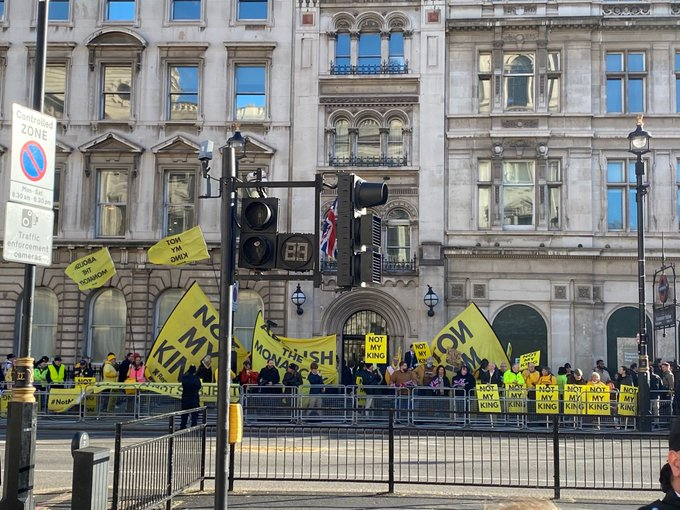
King Charles opened a new session of Parliament today. You may have missed news coverage but supporters of the anti-monarchist group Republic protested with Not My King placards as the Royal Carriage proceeded to Parliament.
It was the continuation of a very long tradition of Anti-Royalism.
On 29th October 1795 King George was ‘hissed and hooted’ and his carriage pelted by a crowd shouting No War, No King, No Pitt (the Prime Minister) Peace. There was a crowd of 200,000 or so with some holding small loaves on sticks covered with black crepe. A hawker selling Tom Paine’s Rights of Man (a banned text) for a penny was arrested but rescued by the crowd and chaired in triumph (E P Thompson, Making of the English Working Class).
It was an important part of British history which no doubt will be reflected on in media reports of today’s Kings Speech, all part of our island story…
6th May 1867. The Government banned a demonstration in Hyde Park. It didn’t work out as they expected
Historically we haven’t heard much about successful demonstrations for example, but they do exist.
When the Chartists gathered on Kennington Common on April 10th 1848 to protest for the vote they failed. They were prevented from even marching. The failure of the Chartists on that Spring Monday in South London is well known.
Rather less well publicised is what happened on a subsequent Monday, not quite 20 years later, on 6th May 1867 when many of the same activists, under the auspices of the Reform League, marched to Hyde Park, and did so again for the vote
It was one of the most immediately successful demonstrations in British history to date.
The Reform League was a combination of middle class radicals, former Chartists and working class trade union activists. The May 1867 demonstration was the latest in a series demanding an extension to the franchise.
Both Liberal and Tory Governments had looked at extending the vote to allow more working class voters, but deliberately not enough ever to have a majority influence. Gladstone boasted that his property qualification for the vote would still leave less workers enfranchised than had been before the 1832 Act.
The Government took the decision to ban the League’s proposed rally in Hyde Park and mobilised large numbers of police, special constables and troops to ensure that it did not go ahead.
The League was far from a revolutionary organisation but it determined that it would continue with its plans.
At 6pm on Monday 6th May 1867 a protest of 150,000 people approached Hyde Park led by the Clerkenwell branch of the League with a red flag topped with a cap of liberty on a pole.
There was no confrontation. Faced with the League’s determination, the Government backed down.
The right-wing press was beside itself. The Home Secretary Walpole had to resign.
Meanwhile the impact of the campaign for an extension of the franchise was felt at once. In the Commons the Liberal leader Gladstone announced his discovery that the people wanted reform of the franchise. The actual measure, known as the Second Reform Act, which was passed in short order was far more radical than anything proposed before May 6 1867, extending the franchise by four times more than previously discussed.
Historian Royden Harrison noted of the working-class impact on the demonstration ‘If it was increasingly respectable it was increasingly well organised. If it had abandoned its revolutionary ambitions it had not wholly lost its revolutionary potentialities’.
The trade union leaders of the Reform League- far from the most radical of men- Applegarth, Odger and Howell- knew why the fight was worthwhile.
In 1863 the Manhood Suffrage and Vote by Ballot Association noted that ‘the evils under which we suffer have a common origin, namely an excess of political power in the hands of those holding a higher social position’.