The global brewer Asahi that owns Dark Star brewery in Sussex has announced that it will close at the end of the year with production moving to Meantime in Greenwich which it also owns. It is at least abiding by UK employment law by opening a period of consultation. It would seem likely that most of the skilled and experienced people at Dark Star will end up being made redundant by reason of location.
Asahi, like similar closures enforced by Marstons Carlberg, claims that Dark Star is brewing under capacity and economic logic dictates the change (i.e profit). Asahi also say that existing Dark Star recipes and beers will be maintained. We have seen this kind of statement many times before. I suspect that before too long the only actually existing Dark Star beer will be a version of Hophead
Dark Star originally sold to Fullers because they were looking for investment and growth. Maintaining an independent brewery in days like these is a tough proposition. Fullers then sold to Asahi who have been promoting Fullers beers in recent times. Let’s hope the Asahi accountants eyes don’t fall on Chiswick
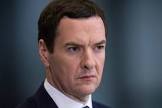
George Osborne, the former Tory Chancellor, and architect of austerity, is back as an advisor to Jeremy Hunt.
Osborne quit as an MP after falling out with Theresa May. He subsequently became Editor of the Evening Standard, picked up various roles in the City which involved doing not much for lots of money. Latterly he also fronts up the British Museum.
Osborne is an historian and heir to a wallpaper business and has no particular qualifications in respect of running the economy. His 2012 Budget for example was a disaster. He still claims that after the 2008 financial crash there was no alternative to his austerity policies. No alternative that is if the policy was to promote the wealth of the rich by bashing the poor.
Commentators seem to think that while Hunt may be inclined to Austerity 2 history won’t be able to repeat itself quite in the same way. Rather as a piece in the current London Review of Books points out Osborne’s talent is not really in economics but in political manoeuvres. His ability to find measures which the opposition struggle to deal with is his strength, and with an opponent like Keir Starmer that could prove very useful.
The Red Cap of Liberty is the symbol of the 2024 Paris Olympics
To prove that a better sporting world is possible the Phrygian Cap is the symbol of the 2024 Paris Olympics. The design is seen as a feminist one- a welcome innovation- but the symbolism is a radical one. The Phrygian Cap is known in English as the Red Cap of Liberty
As James Epstein noted in his article Understanding the Cap of Liberty (Past and Present 122,1989) it was the great symbol of 1819 and was particularly the source of a struggle between protesters wearing it and the Yeomanry at Peterloo on 16th August 1819.
He notes ‘the ability to display the cap of liberty or to prevent its display became the measure of the shifting balance of power between the forces of authority and those of working class radicalism’.
The Cap of Liberty or Bonnet Rouge had its origins in the French Revolution and as Epstein notes after an absence it had first appeared again in Manchester in January 1819 when Henry Hunt marked his arrival on the scene of Manchester radical politics by addressing a smallish reform meeting at St Petersfield.
The Government financed paper New Times reported that Hunt was surrounded by an immense mob and preceded by the Jacobin red cap.
The paper went on to demand that Parliament pass a law to proscribe for ever.. those ensigns of massacre and rebellion the Bonnet Rouge..’
The Cap of Liberty was a symbol of freedom, democracy and change to a better society in 1819, why not 200 years on as well?
On Thursday the latest Tory Chancellor Jeremy Hunt will deliver an autumn statement. He has already made it clear that he plans to raise taxes and slash spending in order to address what he claims is a £50 billion hole in the nation’s finances.
Perhaps Hunt need to pay attention to the first law of holes.
There is no doubt that a global recession and the war in Ukraine, which the Government is a keen promoter of bring economic costs. The impact on ordinary people, for example on energy costs and food with inflation at 14% in October is considerable. Hunt’s aim in what he has claimed will be a non-ideological statement, is to make sure the less well-off carry the economic burden while the rich continue to make profits as usual.
The bulk of the supposed financial hole, around £30 billion of it, is however down to the few weeks that Liz Truss spent in No.10 (Observer 13th November). Hunt isn’t really trying to deny this. The reality is that the four days after Kwarteng’s statement were the worse in terms of impact in the history of the UK economy.
Will the media who backed Truss own this and what is being done to bring her, Kwarteng and the Institute of Economic Affairs to account for wrecking the economy and the lives of many ordinary people?
Beard of the Year longlist revealed: Rylan faces Roy Keane
The Beard Liberation Front, the informal network of beard wearers, has revealed the longlist for the coveted Beard of the Year title.
The Award was first given in 2000 when the late Frank Dobson won. Author and broadcaster Michael Rosen won the on-line poll in 2021.
The longlist will be shaved to a shortlist at the end of November and after semi-finals and a final the winner will be announced on 28th December
The campaigners say that the criteria for inclusion on the longlist remain the same as in previous years:
A nominee must have had a beard for most of the calendar year
The beard wearer must have provided a positive public image of the hirsute
Beard lengths and styles are not taken into account.
BLF Organiser Keith Flett said, quite a bit has changed follicle wise since we started Beard of the Year over 20 years ago now. For example the England Football team for the World Cup features only three clean shaven players. Even so the accolade of winning Beard of the Year is still a considerable honour
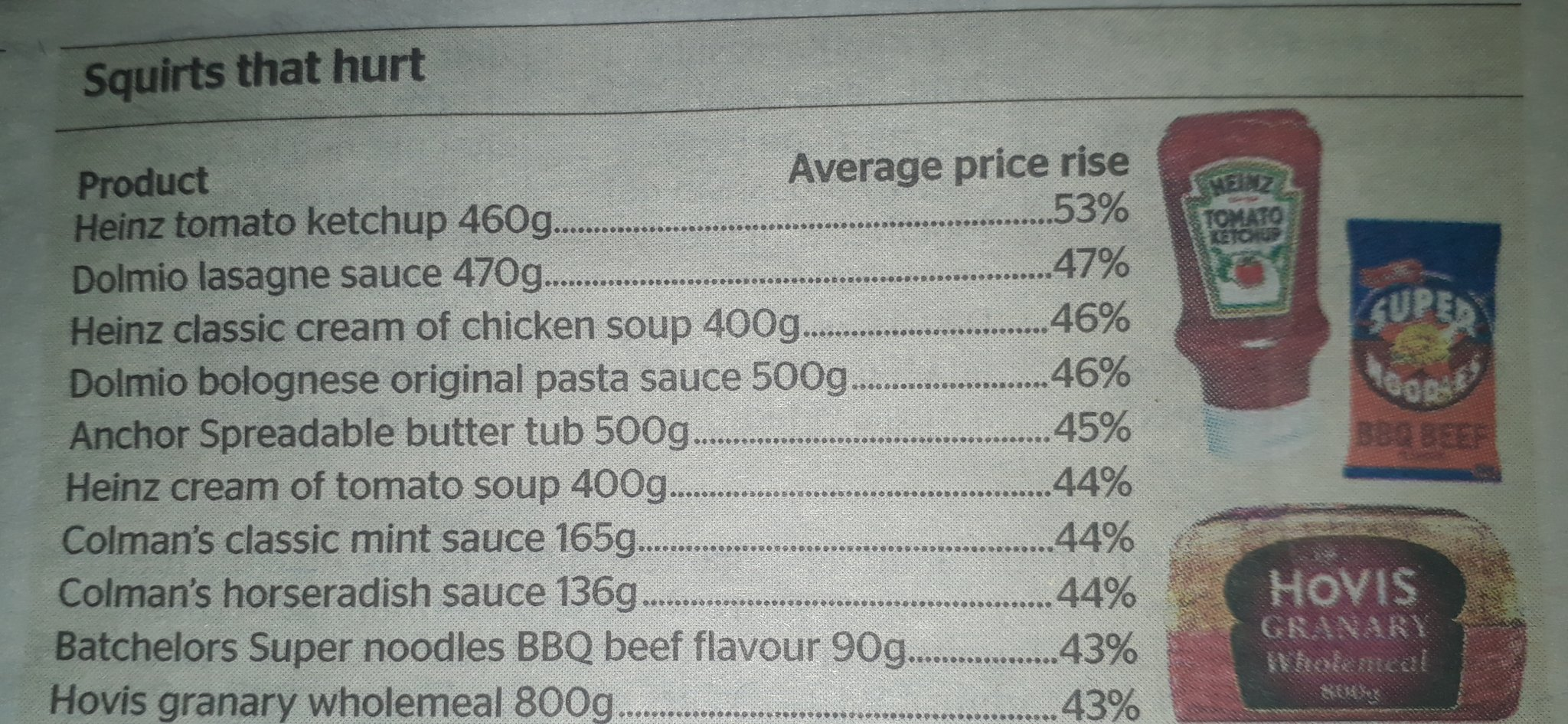
The cost of living & the price of profit. The question of Tomato Ketchup and Wholemeal Bread
The rise in food prices is often presented as just a ‘natural’ side impact of a global recession, war in Europe and of course a supposed financial black hole in the UK economy(in so far as it exists caused largely by Truss)
Food price inflation in the last months stands at 14.6% and in the 12 months before that it was 0.8%. A survey by the consumer organisation Which has looked at food price inflation from autumn 2020 for popular items sold in major supermarkets
There doesn’t really seem to be an explanation in that context for why Heinz Tomato Ketchup has gone up 53% and Hovis wholemeal bread by 43%. Perhaps they are paying their workers an appropriate wage. Then again they might be profiteering during a cost of living crisis
The Tory Culture War on statues & Guys Hospital. Not kicking over the statues
Over a year ago the then Culture Secretary Oliver Dowden and the Murdoch Times started a statue Culture War involving Guys Hospital in London
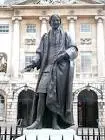
In this case the statues involved are those of Thomas Guy and Sir Robert Clayton both of whom were centrally involved in the development of Guys Hospital in London. Both men made money from the slave trade with Clayton rather more involved than Guy.
In 2020 Guys decided in principle that the statues should not be taken down but moved to less prominent positions. An consultation was then launched covering local Councils in the area, communities directly involved and others with a direct interest.
The report of this consultation appeared and concluded that there is no need to move Clayton’s statue as it isn’t in a prominent position but that of Guy should be moved. In both cases, as was preferred by Dowden, the statues would have explanatory panels added.
The Times (Editorial 4th September 2021) weighed in and demanded Guy’s statue is left as is. It claimed that the public consultation supported this. Up to a point Lord Copper (i.e it lyed). It referred to an on-line questionnaire where around 600 responses from those with a direct interest were hoped for. In fact there were 3000. That was because the hard right Save Our Statues group whose main aim is keep statues of racists in place got involved. 66% of respondents wanted the statue of Guy to stay. However 63% of those who responded from Kings College (the directly involved) wanted it moved. In other words the result was skewed by racists who had nothing to do with Guys or the impact of the statue locally.
At length the Times has now reported (14th November 2022) that both statues are to remain in place but have explanatory panels added detailing the men’s role in the slave trade. Once local authority planning permission for conservation work has been agreed the panels will be installed in 2023.
Better than nothing might be a reasonable description…
David Olusoga’s Covent Garden Piazza stands in the tradition of the Radio Ballads & History Workshop. But…
On 13th November BBC2 broadcast a programme fronted by the historian David Olusoga on the history of Covent Garden (available on IPlayer for 12 months+). It’s part of a wider project and is broadly in the context of a people’s history.
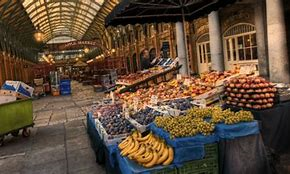
In the programme Olusoga looked at the history of Covent Garden, its connections with wealth and the sex trade and of course the fruit and flower markets. These closed in 1974. Olusoga rightly underlined the successful fight by the community to make sure that at the point the whole area wasn’t raised to the ground and replaced by a shopping centre and flats. It remains in the original market format with restaurants, bars and shops aimed at the more well to do end of the tourist market.
Olusoga interviewed several men who had worked in the market, recounting their background and what it was like. They were of course all white, since jobs were very much a friends and family affair. Almost 50 years on that fits uneasily with modern Britain. While I’m not familiar with the matter I suspect there may have been market workers from other ethnic background.
Olusoga focused on issues of gender and ethnicity in the history of Covent Garden but the potential issue of racism was in the background. Could for example people from the Windrush Generation get work at the market.
It’s a wider issues with the genre of people’s histories. One thinks of Charles Parker and Euan MacColl’s Radio Ballads (1957-1964) and the early work of History Workshop, for example the project to capture working and social life at Headington Quarry in Oxford. Ethnicity and racism are not central features but over fifty years on the question should not be avoided.
This should not take away from what David Olusoga has done with the Covent Garden programme. It is giving a 2020s perspective on and historical research tradition that hasn’t really been a feature since the early 1970s. One hopes it might spark more.
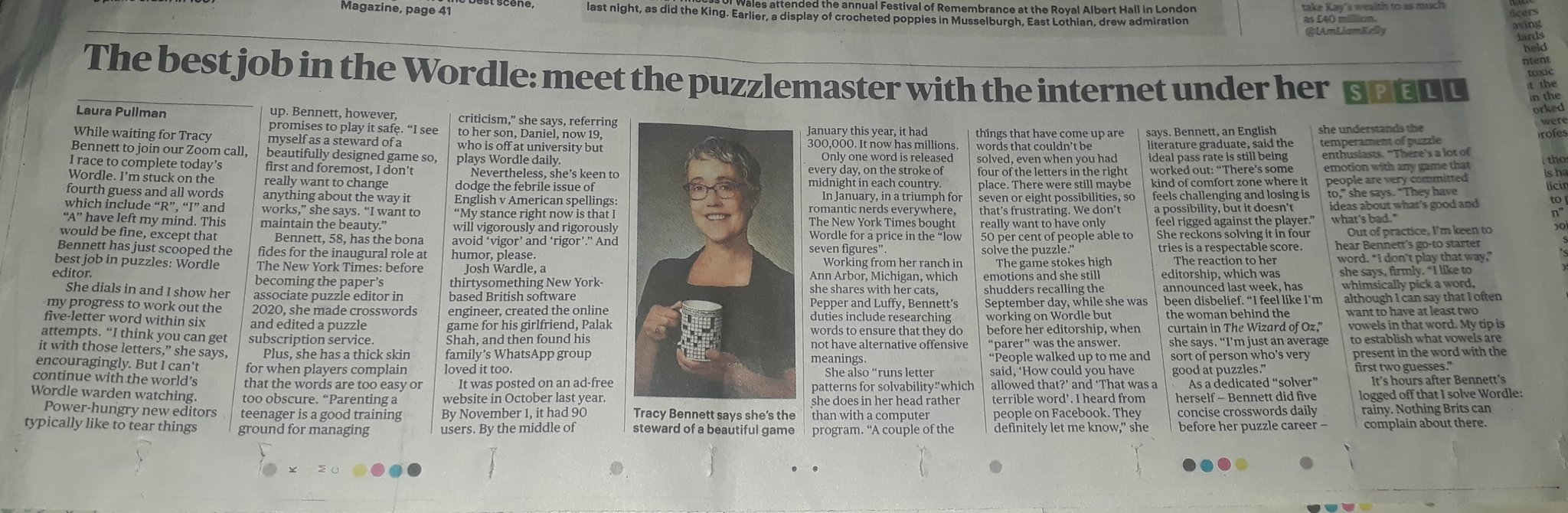
Tracy Bennett the person who runs Wordle for the New York Times has given an interview to the Sunday Times (13th November).
She has promised to avoid using words where the US and UK spelling differs, favour and favor for example. Further she notes that regular checks are made to ensure that the word set is not so difficult that is can’t be easily solved because even if you have four out of the five letters correct there remain seven or eight potential answers.
She also suggests that a reasonable Wordle standard is to solve the daily puzzle on the fourth line out of six.
From Thatcher’s Swamped to Theresa May’s Hostile Environment to Suella Braverman’s invasion:
The disgraceful conditions at the concentration camp for asylum seekers at Manston in Kent provide a focus to 40 years of Tory racism. With Suella Braverman as Home Secretary and a terrorist style attack on Manston by an individual with far right links the relationship between institutional racism and street racists becomes clearer.
When Enoch Powell made his rivers of blood speech in 1968 he was a senior Tory MP who found himself with no future in the party. This was the tail end of a period when the Government was welcoming migrants to fill, mostly badly paid, gaps in the labour force.
After the oil focused economic crisis of 1973 matters began to change. The racism inherent in much Tory politics began to be more openly displayed.
In the mid-1970s organised fascists regrouped around the National Front. It had some electoral success but also engaged in a series of highly provocative street marches in inner-city locations such as Lewisham and Wood Green. The NF was opposed by the Anti-Nazi League, Rock Against Racism and others and made little impact at the next Election
Before that 1979 General Election Tory leader Margaret Thatcher made a speech claiming that people felt ‘swamped’ by those of a ‘different culture’.
There was a discussion on the left as to how far street opposition to the fascists had achieved their demise compared to Margaret Thatcher’s promotion of State institutional racism, underlining that racists could feel comfortable both with voting Tory and the actions of a Tory Government.
Fast Forward several decades and the policy of former Tory Prime Minister Theresa May, architect, when she was Home Secretary, of the hostile environment towards ethnic minorities. It was a policy which led directly to the abuse of numbers of the Windrush generation, rightfully in the UK, but harassed by the authorities.
Those who had arrived without complete paperwork in the 1960s found themselves targeted for potential and sometimes actual deportation, splitting them from families who had been born in the UK. This example of institutional racism went in parallel with the rise of the English Defence League, identified with the fascist Stephen Yaxley Lennon. Again their trademarks were street marches and general thuggery. Again they found themselves opposed by anti-racists such as Stand Up to Racism and eventually like the National Front before them fell apart.
Now Tory Home Secretary Suella Braverman is talking the language of the far and fascist right about an ‘invasion’ of migrants into Southern England.
Braverman is a hard right Tory politician and the language is designed to provoke and stir racist sentiment. She stand accused on a dereliction of her duty as a Minister in respect of the situation at Manston, but there is considerable evidence that this was a deliberate act on her part rather than an oversight or incompetence.
She has doubled down on her plans to deport legitimate asylum seekers not only to Rwanda but to other countries.
It is a Tory policy that arguably goes further than the words that got Enoch Powell excluded from the Party. At the same time it is promoting a rise in street racism. The terror attack on Manston may be a sign of what is to come and underlines that far from it being one or the other, State racism and street racism go hand in hand.
Both needs to be opposed by anti-racists and the left. Racism is integral to a market capitalist society but how much it is promoted varies. The success with stopping the National Front and the EDL underlines how important anti-racist acivity has been and still is.