Third Times Editorial condemning Just Stop Oil: Protest and Survive
As a veteran protester I have a note of disagreement with Just Stop Oil. I don’t think that it’s the case that petitions, rallies and marches don’t work and direct action does. Rather it is a matter of horses for courses as it were. What the historical sociologist Charles Tilly called the repertoire of contention.
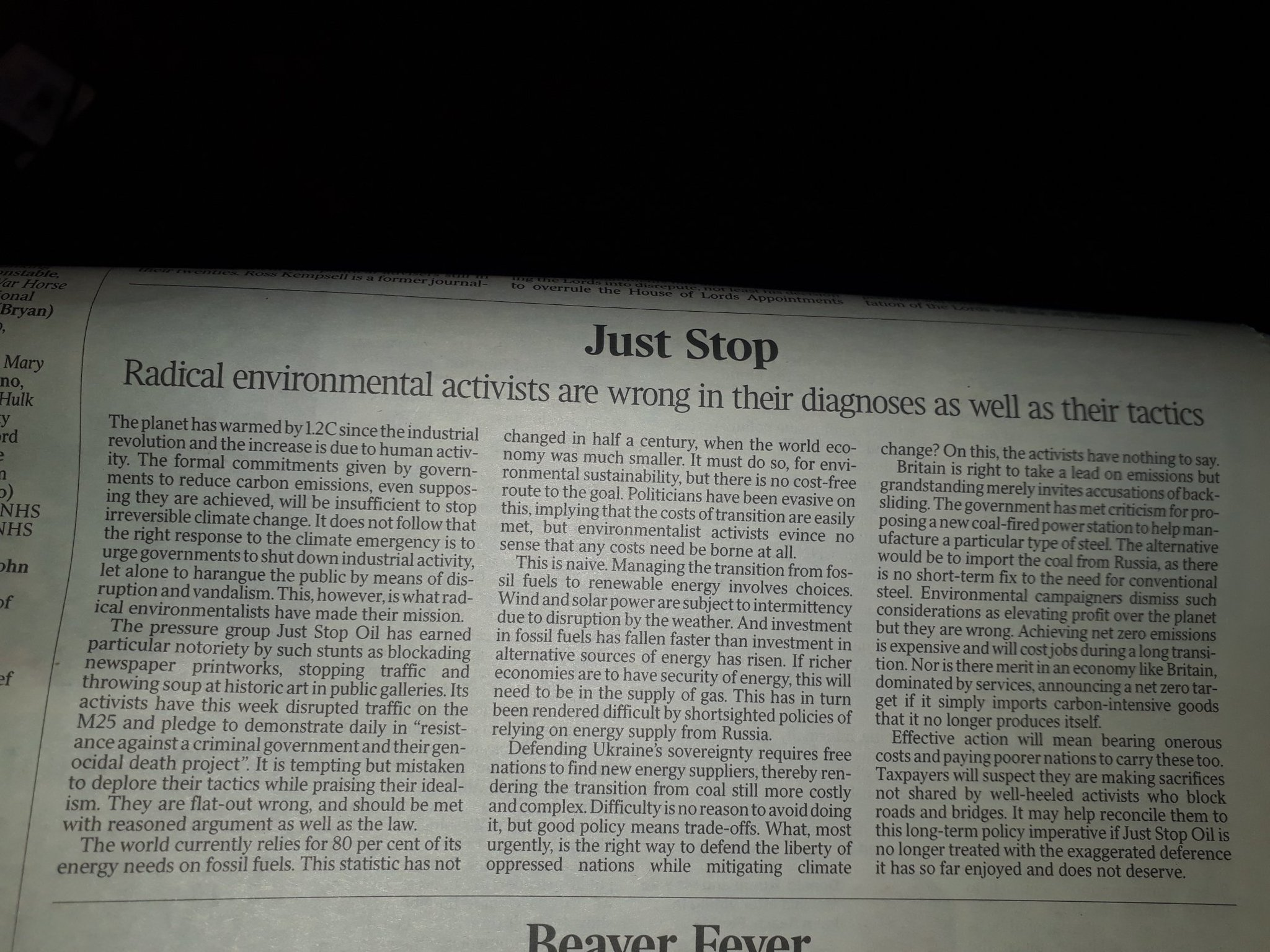
That said Just Stop Oil’s protests are making an impact. On 9th November the Times published its third editorial condemning them. It argued that the were ‘well heeled’ people committing acts of vandalism.
Whether it will be enough to get the Government to act is in the balance but Suella Braverman speaking to an audience of police officers has made her views clear again. She called protesters ‘Radicals, road blockers, vandals, militants, extremists’. Presumably all tofu eaters.
A demand for tougher action against protesters was met with a rebuke from the Met Police Commissioner who noted that it is not legal for the police to kill protesters. It is not legal for them to arrest journalists covering the protests either but that hasn’t stopped Hertfordshire polce.
Given the scale and likely impact of the climate crisis one might suggest that the scale of protest, and inconvenience, is modest by comparison. For those that don’t like direct action the issue is what they would do instead on the repertoire of protest
Cost of living crisis. Top Executives pay rises by 23%. Food prices up 14.7%. Pay rises??
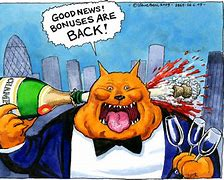
Not of course a media headline but a report in the Financial Times(7th November) shows that according to PWC the pay of executives in FTSE100 companies has risen by 23% in the last year.
The rise is largely due to an increase in bonus payments which stand at 86% of the maximum possible against the longer term average of 70-75%. This means that average top executive pay was up to £3.9m
What the report does not say is who makes the profit that allows such pay levels. The answer of course are lower paid workers who won’t be getting a 23% rise if the top executives can prevent it. They want the money for themselves
A report from Kantar (Times 9th November) shows that the annual cost of a food shop has risen by £682, with food price inflation at 14.7% in October. It is no surprise that nurses in the RCN have voted for strikes and teachers are balloting for them, with continuing disputes in the post, BT and on the rails.
If 23.7% is good enough for the bosses its good enough for the workers
Egg throwing: a great British tradition of protest from the London crowd of the 1790s to Charles & Camilla in York
Egging has a long tradition in political protest
While Charles and Camilla have been the targets in York today they can count themselves part of a long British tradition.
E.P Thompson in the Making of the English Working Class records that when a perjurer was placed in the pillory in the 1790s the London crowd pelted him with eggs. Yet when a political radical suffered the same fate a few days later the crowd brought him glasses of wine to drink.
In more recent times egg throwing has been officially recognised as a legitimate protest. An anti-fascist arrested for throwing an egg at a National Front march in Wood Green in 1977, known as the ‘Battle of Wood Green’, was acquitted as the judge noted that it was indeed a traditional form of political protest.
John Prescott, who also egged on the campaign trail, didn’t agree (he whacked the egg thrower) but ultimately a point is made and no harm is done beyond making the person egged look silly and a dry cleaning bill
Brewdog attacks Qatar World Cup. Also, Brewdog sells its beer in Quatar
With the men’s football world cup due to start in Qatar shortly Brewdog has issued a statement attacking the country’s record on workers and human rights. It’s right to point out how many workers died during the construction of World Cup facilities and to underline the Qatar Government’s appalling record on LGBTQ rights.
The Sunday Times(13th November) has reported that the Brewdog campaign was designed by Saatchi and Saatchi ‘best known for its links to the Tory Party
Brewdog said that profits from sales of its Lost Lager during the World Cup will go to human rights causes (unnamed).
Its Brewdog though. The Scottish brewer is hardly the Qatar Government but it might consider recognising a trade union itself before going on about others. Equally its record on employee relations might charitably be described as patchy and as the saying goes charity begins at home.
Again it being Brewdog, while they are against the Qatar World Cup (reasonably so) they will of course be screening the matches in their bars. They say this will promote the sales of Lost Lager (and all there other beers as well…)
Finally Brewdog beers are of course sold in Qatar. They don’t sell directly but through a regrater who deals with the Qatar Government which regulates all alcohol sales..
The Ambridge Socialist: Tribute to Graham Blockey, the voice of Robert Snell
9th November
The Ambridge Socialist has paid tribute to Graham Blockey who was the voice of Robert Snell in the Archers who has died.
Blockey was a GP in Dorking, retiring as recently as 2017 but has been the voice of Snell since 1986.
Robert Snell, partner of Lynda Snell was an independently minded bourgeois in a village dominated by the Archer dynasty. He ran an IT company but when that failed he helped to run a B&B operation at Ambridge Hall.
A keen twitcher, he acted as an advisor to Lynda adding a framework of reason to some of her more enthusiastic campaigns. In recent times he was one of the very few who saw through the modern slaver Philip Moss.
Its clear from the BBC’s comments that he won’t be replaced. We have lost a unique part of Ambridge life
David Butler (1924-2022) & E P Thompson on Ephology
David Butler who died at 98 was a key figure in how British elections were understood and analysed from the late 1940s on. He authored books after each General Election reviewing the results and was a familiar figure on BBC Election night programmes. In that sense he is part of Britain’s post-1945 social history himself.
Michael Crick’s biography reveals that Butler’s original interest was in cricket statistics but on returning from service in the Army in 1945 he found few matches being played and switched his attention to politics.
Psephology was and is not without its critics however
Below is a footnote that E P Thompson made to his A Psessay in Ephology about the 1959 General Election. It appeared in the last issue of the New Reasoner, No.9, Autumn 1959. It merged with Universities and Left Review to become the New Left Review in 1960.
The footnote, though over 60 years old, does seem to capture quite well the relation between the media, leaders debate and opinion polls currently:
A psephologist is a man employed by the mass media to research into what people think the mass media has told them to think. An ephologist is a man employed by the ‘Observer’ or BBC to interpret the results of psephology and who makes an ephing good thing out of it
Details of Boris Johnson’s resignation honours list have been leaked. The list is not yet agreed but it would be unusual for it to be blocked.
It elevates (of course) Nadine Dorries, a couple of (by House of Lords standards) youthful advisors to Johnson and someone who paid for one his numerous holidays.
Marina Hyde has covered the whole Tory story in the Guardian
She notes that Johnson will have nominated 86 of the 800 Peers currently sitting.
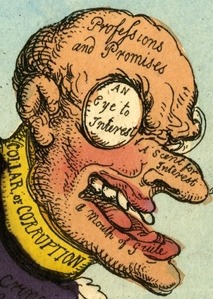
It is the politics of Old Corruption writ large. Before the 1832 Reform Act began the lengthy process of transforming Britain into something like a Parliamentary Democracy,Government positions and titles were handed out not on the basis of merit or ability to do the job but as patronage. Sinecures where friends of those in power were preferred and promoted while others did the actual work abounded.
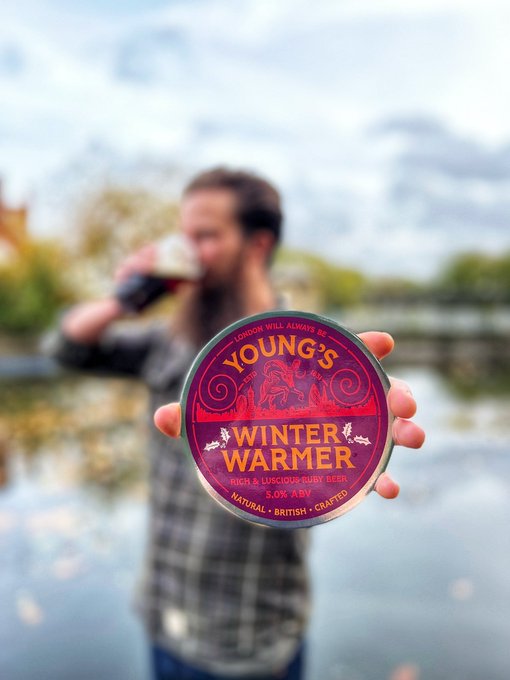
As Marstons sell its Bedford brewery will Youngs Winter Warmer survive?
Youngs Winter Warmer has been brewed again and can be found on the bar in surviving Youngs badged pubs. I have yet to sample the 2022 vintage but hope to do so in the next couple of weeks.
Whether we’ll see Winter Warmer in 2023 must be open to doubt. After Youngs left brewing, their beers were brewed at the Charles Wells brewery in Bedford. This became the Eagle brewery and was owned by Marstons until they sold it this week to Spanish lager maker Estrella. Marstons say the beers brewed at Bedford will be produced at their other UK breweries, although having just shut Jennings there are a diminishing number.
An equally imponderable issue is does Winter Warmer still taste as it did in the 1970s and 1980s. I’m not really sure how one judges that (beyond checking if the recipe has changed). In the 1970s I was a fan of Theakston’s Old Peculier. I still drink it occasionally but generally it’s a little too sweet for my taste now. The beer may have changed a bit but my taste in beer certainly has.
However the reality is that 2022 may be a last chance to check. When Big Beer moves production of beers around the country, anything beyond the core range- in this case Ordinary and Special- tends to get lost. Even there as Roger Protz noted on social media the idea and taste of Youngs as ‘London Ales’ is gone
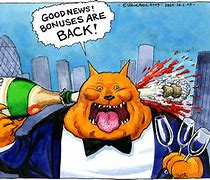
What cost of living crisis? Top Executives pay rises by 23%
Not of course a media headline but a report in the Financial Times(7th November) shows that according to PWC the pay of executives in FTSE100 companies has risen by 23% in the last year.
The rise is largely due to an increase in bonus payments which stand at 86% of the maximum possible against the longer term average of 70-75%. This means that average top executive pay was up to £3.9m
What the report does not say is who makes the profit that allows such pay levels. The answer of course are lower paid workers who won’t be getting a 23% rise if the top executives can prevent it. They want the money for themselves
The Splendid Mrs McCheyne and the East London Federation of Suffragettes
Handout for distribution to attendees of the Socialist History Seminar, 7th November 2022 at the Institute of Historical Research, School of Advanced Studies, London University.
Presentation by Jane McChrystal and Anne Padfield
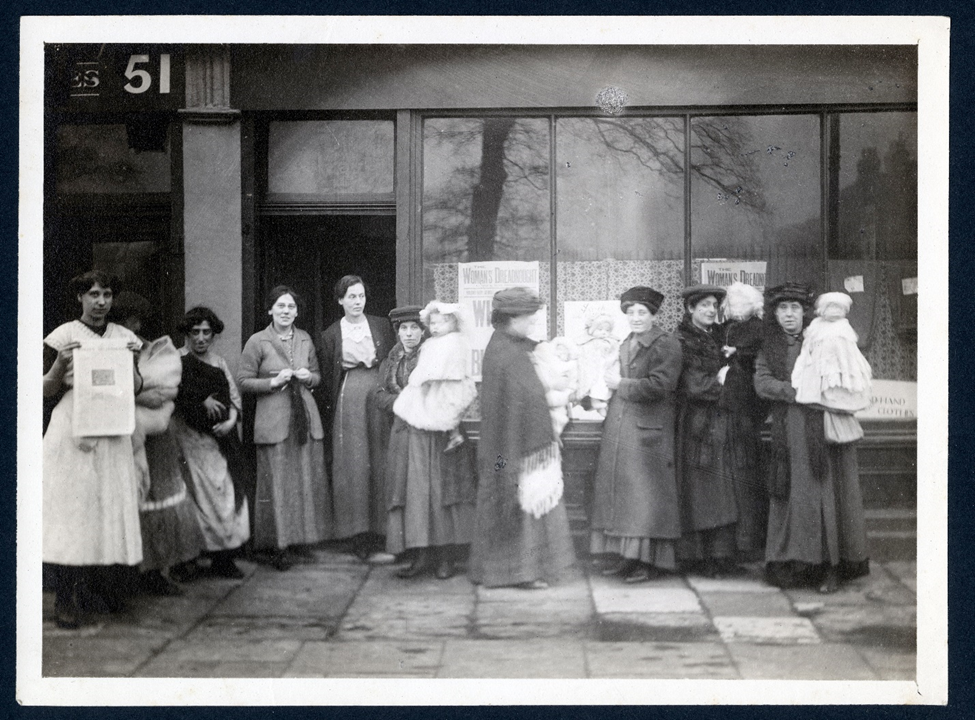
Mrs McCheyne appears on the right-hand side of the doorway outside the Mother and Baby Clinic she co-managed in St Leonard Street in Bromley by Bow
“Mrs McCheyne and Mrs Mantle have carried on in the most splendid way, the work of our Bromley Office and Baby Clinic at 53 St. Leonard Street, ever since these were started. Now we regret to announce that Mrs McCheyne is compelled to relinquish her work there as she is obliged to leave the district.
All the ELFS’* members know Mrs McCheyne, for she was one of our first recruits in East London, and has always been one of our hardest workers, having served on the ELFS Social Committees and in many other ways as well as Joint Honorary Secretary in Bromley.
We all thank her and hope that we shall see her from time to time.”
This tribute was almost certainly paid to Mrs Rosaline McCheyne by Sylvia Pankhurst, leader of the East London Federation of Suffragettes, or ELFS, in their official Newspaper Women’s Dreadnought in July 1915.
*ELFS, was the breakaway group founded by Pankhurst when she parted ways with the more mainstream Women’s Social and Political Union, or WSPU, in 1914.
The minutes of ELFS committee meetings show that Mrs McCheyne attended meetings regularly at their headquarters on Old Ford Road between February 1914 and February 2016. They report the many varied duties she carried out on behalf of the Federation.
As Joint Honorary Secretary of the Bromley district of ELFS, she was responsible for the day to day running of the office, recruiting new members and collecting subscriptions.
The Bromley district was particularly successful at selling copies of ELFS’ official newspaper, the Women’s Dreadnought, and sold a thousand copies one week in July 1915. No doubt this success was partly the result of McCheyne’s ability to organise their distribution and sales, administrative skills she would have developed before marriage in her position as post office clerk.
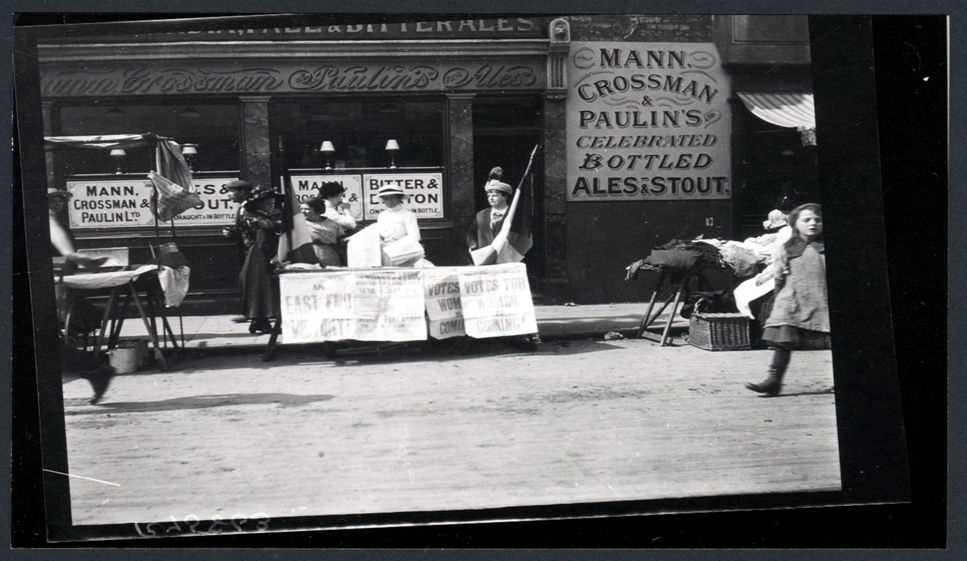
This stall was set up on the Roman Road, Bow every Saturday
One of the most challenging aspects of this task was finding pitches on the streets of Bow. While there was widespread support among the people of the East End for ELFS, especially among those involved in the labour movement, there was still a fair degree of opposition towards the women and their activism. Pitches needed to be in easy reach of shops and businesses whose employees would be willing to protect ELFS’ members from any local hostility.
Perhaps the most vital role she played was as joint manager of the St. Leonard Street Mother and Baby Clinic, where life-saving work took place as a response to the havoc the outbreak of war wreaked on the lives of the people of the east end of London.
Already amongst some of the capital’s most poverty-stricken inhabitants, they were hit almost immediately with unemployment and food shortages when the First World War began. Children and babies were particularly badly affected, with milk shortages bringing many of them to the verge of starvation.
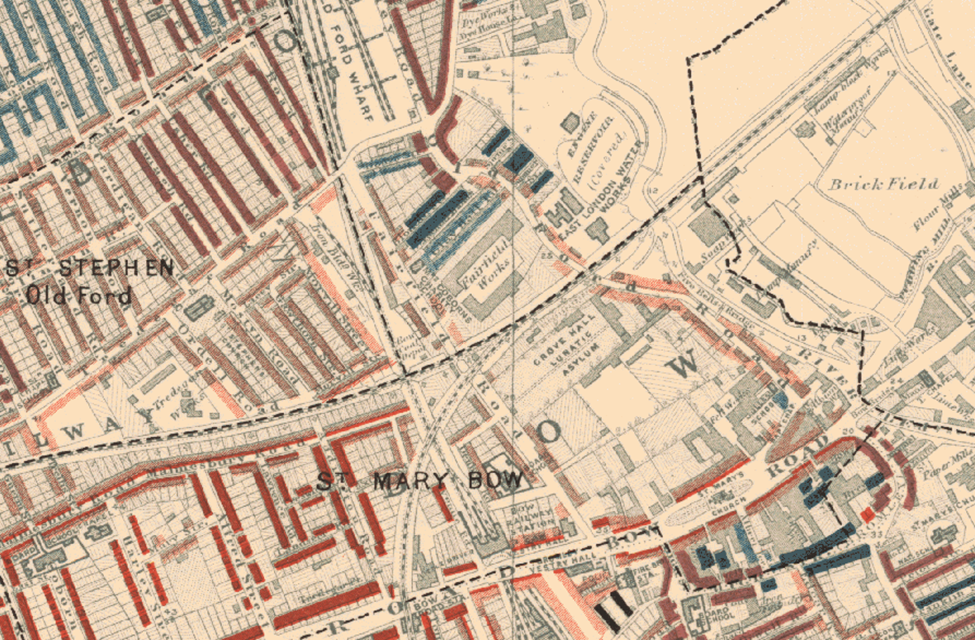
Charles Booth’s poverty maps of London (1898-1899) include this one of Bow which includes Old Ford and Fairfield Road where Mrs McCheyne lived with her family at number 55
ELFS’ reaction was swift and decisive. Milk distribution centres were set up around the East End, but it soon became clear that starving infants could neither swallow or digest the milk provided there. So, Mother and Baby clinics, like the one at St. Leonard Street, were set up to teach mothers the techniques they needed to feed their babies and distribute highly nourishing foods such as eggs and barley. Mothers were also provided with feeding charts and health information leaflets and free professional, medical treatment was made available.
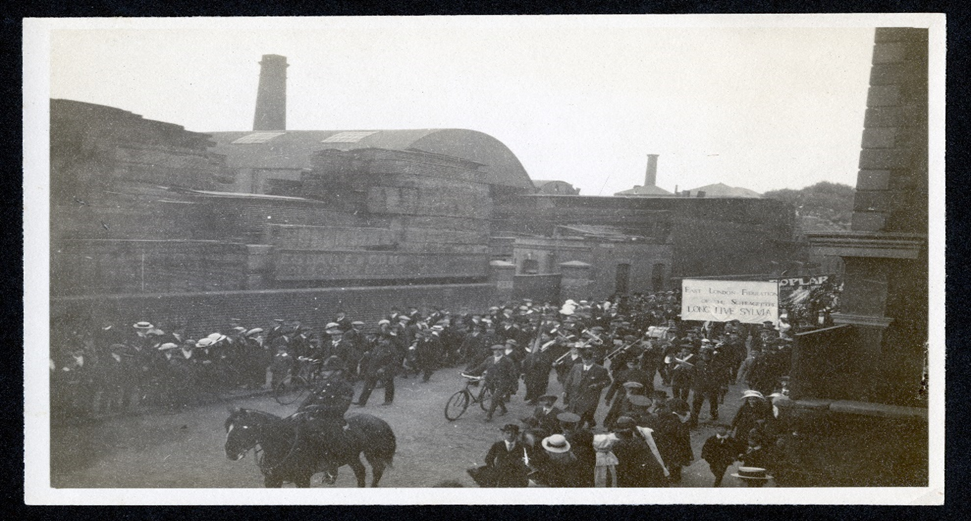
The Annual May Procession on Old Ford Road
Another responsibility McCheyne undertook was accessing ELFS’ funds to bail out any members who were arrested and taken into custody by the police. She was called upon to perform this duty on the evening of Sunday, 24th May, a date which marks one of the most notorious incidents in ELFS’ history.
During that day ELFS’ members and supporters had processed along Old Ford Road and joined the rally in Victoria Park to celebrate Women’s Day. Aware that the police would be waiting there to arrest Pankhurst and take her to Holloway prison, a number of them chained themselves together and formed a bodyguard, which the police broke up with extreme violence. Many arrests followed. The minutes of the next committee meeting duly noted her presence at Bow Police Station.
At this point it would be useful to consider the contrast between Rosaline and her fellow ELFS’ member Nellie Cressall, with a view to shedding light on why her name has lived on, while Rosaline’s had almost completely disappeared by 2018.
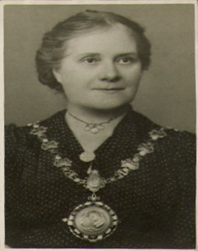
Cressall (left) like most other members of ELFS, was a working-class woman, while McCheyne belonged to the lower middle class, a difference which had a profound effect on the course of each woman’s life.
Note Cressall’s demeanour, and the dignity with which she wore the mayoral chain when she was elected to office in 1943.
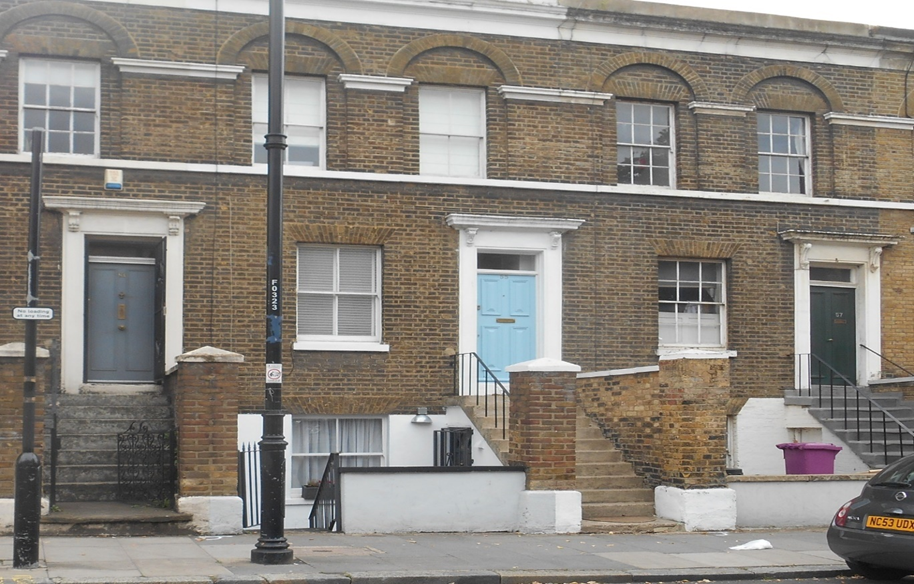
McCheyne lived with husband, Herbert, her three children and a lodger in a fairly substantial early Victorian three storey house at 55 Fairfield Road, Bow (Number 55 is the one in the middle with the pale blue door)
Cressall, husband George, and her burgeoning family rented a couple of rooms with shared toilets and a communal tap at six different addresses between 1904 and 1923, when the family of ten was relocated to the Isle of Dogs by Poplar Council, where they were allocated a house of their own with a large garden on the Isle of Dogs.
Like other members of ELFS, Cressall and her husband were keen supporters of the growing trade union movement and early members of the Independent Labour Party.
It seems reasonable to assume, then, that George approved of her activism, as many of ELFS’ members were married to men who were part of East London’s labour movement and could be relied on to provide support and protection at their processions and rallies.
Anne told me that McCheyne’s husband was a staunch supporter of the local Tory party. Now, we can only speculate about his attitude towards McCheyne’s involvement with ELFS, but he seems less likely to have been supportive than George.
McCheyne’s husband had steady employment in good conditions as a wood work instructor at a London County Council school. Men like Cressall were usually precariously employed on what we’d now call zero hours contracts in dangerous, dirty environments like the docks and local factories. Herbert’s job provided the family with social mobility and facilitated their move to the suburbs, first to Leyton and onto Upminster in 1925.
Cressall’s East End roots, socio-economic status and socialist convictions kept her in the East End until her death in 1973. She remained politically active all her life, going to prison in 1921 in protest against the rates levied by the LCC on Poplar, London Borough, becoming mayor of Poplar in 1943 and a highly respected figure in civic society in her later years.
Aside from their socio-economic differences, McCheyne and Cressall were two very different personalities.
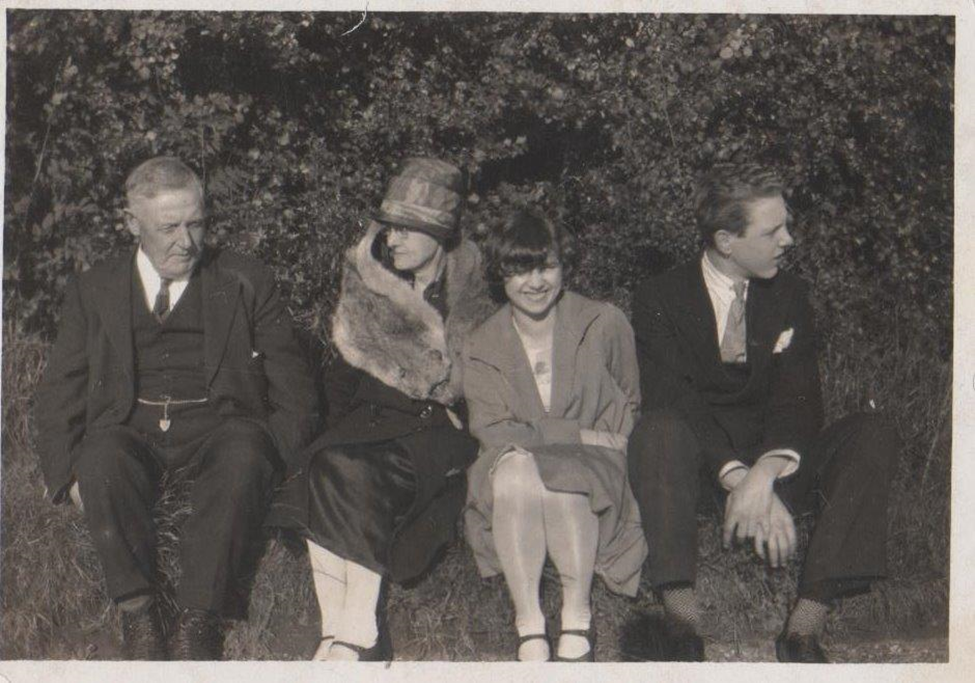
McCheyne was self-effacing, as the lack of mentions of her in the minutes of ELFS’ meeting attests. Photos taken of her by the pioneering woman photographer, Norah Smyth for the Women’s Dreadnought and the family photos in Anne’s possession show how she never looked directly at the camera, as can be seen in above photo of Mrs. McCheyne on an outing to Hainault Forest with her family. Anne’s scant knowledge of her relative’s activism is further evidence of McCheyne’s disinclination to draw attention to herself.
By contrast, Cressall was an impressive public speaker, a woman who was prepared to go to gaol for her convictions. We can still see her today in a 1962 film available on the BFI’s website, Post Script to Empire. She is filmed in a smart hat and coat, carrying a large handbag, the epitome of the proud working-class woman she was, as she debates with a local grocer who deplores the inward-looking nature and lack of aspiration among the local people. Cressall looks him steadily in the eye and talks about their community spirit and loyalty to each other, in calm, measured words.
So, how did my book, “The Splendid Mrs McCheyne and the East London Federation” come to be written?
It all began when Heritage Manager, Tamsin Bookey, decided to stage the Women’s Hall exhibition to mark the 100th anniversary of the Representation of the People Act in 2018 at the Tower Hamlets Local History Library and Archive
The exhibition would include a reimagining of the Women’s Hall, Sylvia Pankhurst’s home on Old Ford Road in Bow, and site of ELFS’ headquarters. A six-month programme of events celebrating the history of the Federation was to run alongside it.
The walls of the exhibition space were to be hung with a series of panels telling the stories of individual members of ELFS who made such a difference to the lives of the women, men and children of the East End.
Carrying out all the research needed for such an ambitious programme would demand far more work than the library and archive staff could hope to carry out in tandem with their daily duties. And so, the call for volunteers went out.
There was an enthusiastic response, especially from local people who attended an inaugural event and took part in an induction to the library and its resources, which highlighted materials like electoral registers and Kelly’s Directories of local shops, businesses, charities and other facilities.
Volunteers were also directed to the online resources held by the Institute of Social Research, Amsterdam where the collection of Sylvia Pankhurst’s papers is stored. The collection includes the handwritten minutes of the ELFS committee meetings and volunteer Rosemary Lucas undertook the painstaking task of transcribing them. The resulting transcript became the launch pad for many individual research projects, including mine.
As I scanned the minutes, I kept coming across the name “Rosaline McCheyne”, or slight variations on it, in the list of attendees. What really piqued my interest, as already mentioned, was how rarely she spoke at meetings, despite her exemplary record of attendance. The electoral register of 1915 for Poplar East identified 55 Fairfield Road as the home of Rosaline, Herbert and two sons, Donald and Robert, and a daughter, Georgina. I was on the road to what would become “The Splendid Mrs McCheyne” in 2020.
For me, the moment at which our paths crossed represented perfect timing as my mind was buzzing with questions about McCheyne and her family, which I had no way of resolving:
Where did she go and what did she do after her resignation from ELFS?
Did she live long enough to see the fruits of her activism?
What was she like in person?
What kind of life did daughter, Georgina, lead in the new world her mother helped to bring about?
Were Robert and Don ever conscripted to the armed forces and, if so, did they survive?
Was husband Herbert the kind of man to support her in her work for ELFS?
Anne’s arrival promised to unlock a treasure trove which, as we’ve seen, turned out to be exactly what happened.
For my part, I was able to fill out some of the social and political history of the East End of London, which formed the backdrop to McCheyne’s life and, maybe more importantly, tell her about the vital role she played on Women’s Day 1914 in securing the release of her fellow suffragettes from cells of Bow Police Station.
McCheyne’s involvement is ELFS is a salutary lesson in the need to acknowledge the contribution all those activists who work quietly in the background for all sorts of causes. These individuals weave the mesh which holds an organisation together and enable it to run day to day. Like McCheyne, they should be recognised and celebrated, with the same enthusiasm as their more vocal sisters and brothers.
From my own point of view, the serendipitous collaboration with Anne was one of the greatest pleasures of taking part in staging the Women’s Hall Exhibition and, as you can see, it continues to this day.
With thanks to Paul Isolani Smyth for granting permission to publish his great aunt’s photographs, which are held with Estelle Sylvia Smyth’s collection of papers at the Institute of Social History, Amsterdam. Tower Hamlets Local History Library and Archive, London Borough of Tower Hamlets provided the copies you see here.
I’m also extremely grateful to the staff of Tower Hamlets Local History Library and Archive for opening the door to the riches inside their building in Bancroft Road, to me and the other local residents who volunteered to do research for the Woman’s Hall Exhibition.