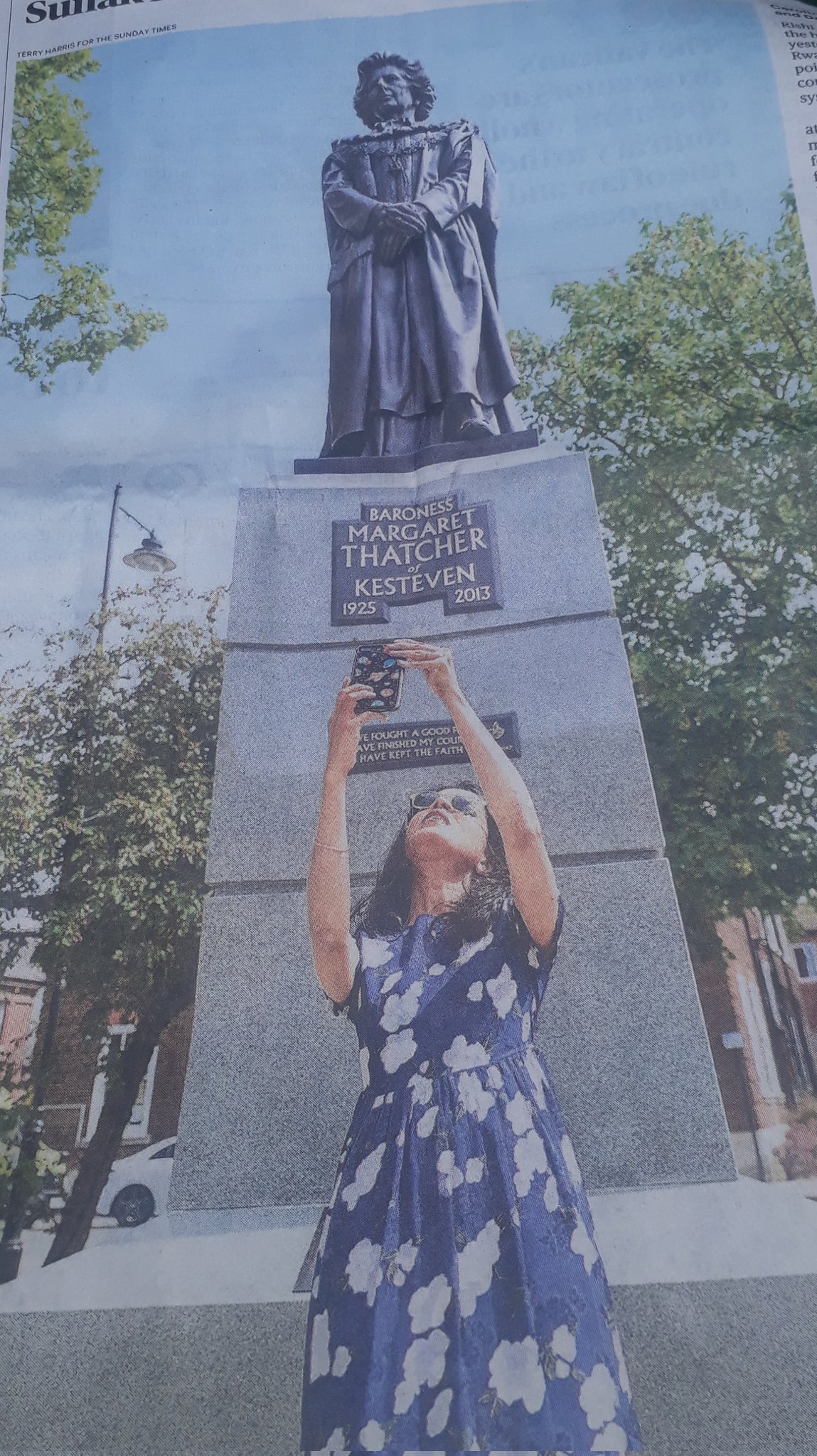
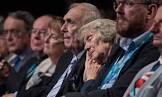
Rishi Sunak spoke to Grantham Tories on Saturday. At the same time his wealthy partner Akshata Murthy found time for a selfie in front of the controversial Thatcher statue in the town.
Johnson may be gone but his statue wars continue. Time for Liz Truss to be pictured in front of Churchill’s statue in central London, or better still by a hasta la vista erection of Boris
The jury is out on Oliver Sterling the Archers Anarchists favourite Ambridge character and he recognises it himself. He pondered why some in the village call him a fat cat.
The case for. Sterling has long been a friend of the Grundys allowing them to reoccupy the farm that they had previously had and he now owned. He kept Grey Gables going far longer than would otherwise have been the case subsidising it and jobs from his own funds. Generally he presents as a patrician, unusualin class struggle Ambridge.
The case against: He illegally shut Grey Gables and threw many out of work both directly and indirectly. He still doesnt seem to realise the impact on people’s lives his actions had
The Ambridge Socialist poll. Oliver Sterling-patrician or scab?
The Ambridge ruling class has two new members. Lets hope they both speak Welsh
Ruby Ruby Ruby
Lilian and Justin have moved into Ambridge Hall while they have a new kitchen fitted. The breakfast apparently is superb although its unclear if it includes Borsetshire black pudding.However Lilian’s dog Ruby has been found on Ardil’s bed. Ardil does not like dogs. Class war deflected
Brad Horrabin
The Ambridge Socialist welcomes our newest recruit
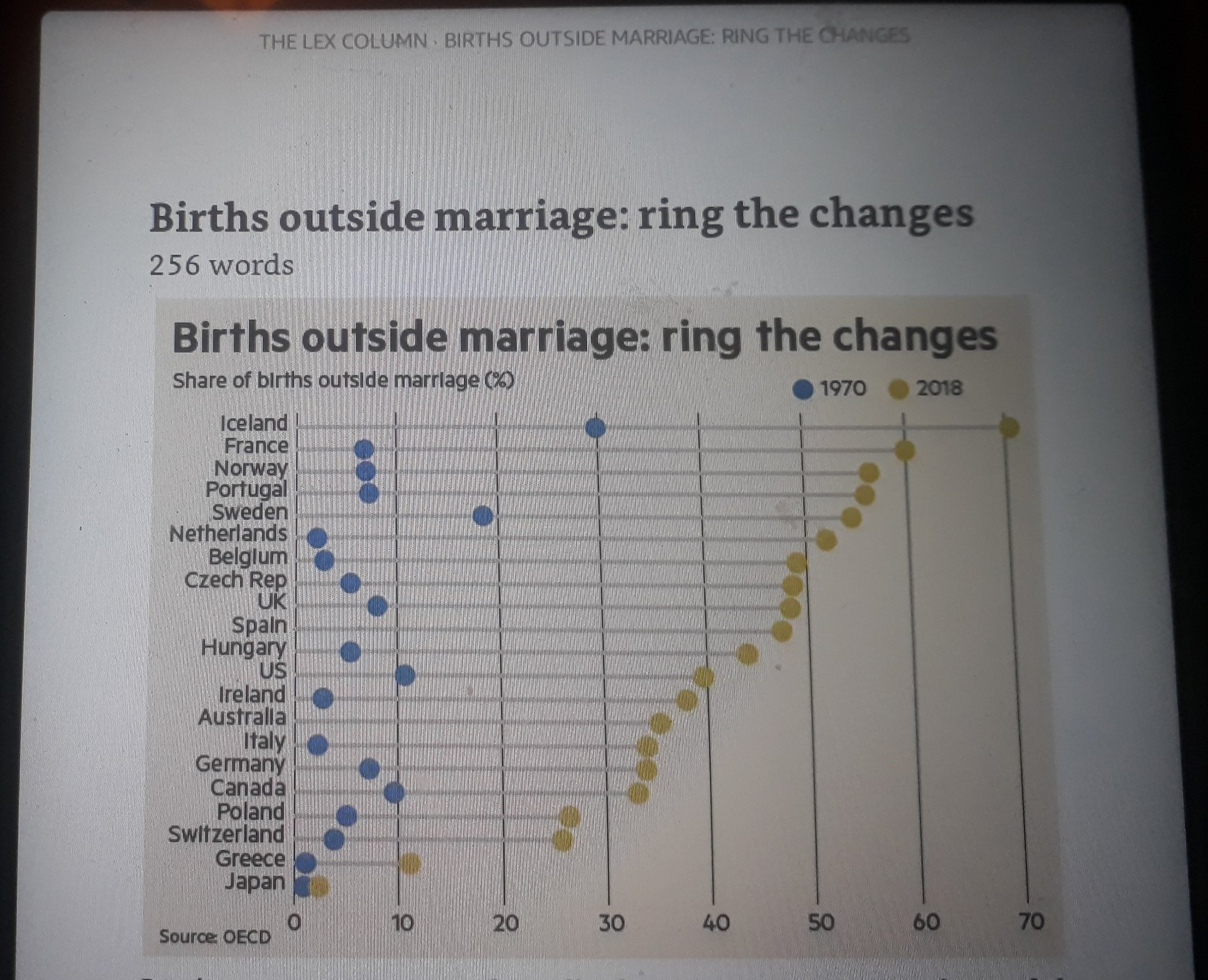
Perhaps the OECD graphic published in the Financial Times on 23rd July should be accompanied by a soundtrack of the Who’s My Generation.
It reveals a huge increase in births outside of marriage since 1970 in most OECD countries. As often the devil is in the detail. Couples are co-habiting and getting married later when legal issues (inheritance loom). In a few countries, Hungary,there are incentives to staying married and having 3 children.
A significant downside not captured are single parents families(obviously not always a downside) and then of course there is the world of LGBTQ. We need another chart..
We have been used to Tory Culture Wars over the last few years. British history,slavery, statues, Metropolitan Marxists and so on. All good knock about stuff aimed at pleasing a section of the Tory electorate. Not so much fun if you were in one of the target areas where funding and jobs might disappear.
There was also the wider issue of the targeting of minorities.Metropolitan Marxist was a term used by the Nazis to describe those they thought were left-wing Jews. In the current leadership contest the term ‘Trans’ has sometimes had similar connotations (obviously not religious ones).
However Johnson has gone-ish and the future of the Culture Wars is up for discussion. Hereto they have been entirely anglocentric. However an article in the Guardian (23rd July) suggests that with Rishi Sunak a candidate an international perspective may open up.
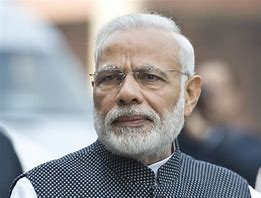
We may think that Sunak worships money but he is a Hindi. The question posed is whether he will be back far right to fascist Indian leader Modi. He probably will, as Johnson did, because despite what the Mail may think India is one of the world’s leading industrial powers.
The problem is that while Modi plays culture wars in his version people die, often quite a few of them
The moral economy was a term used by the late historian E P Thompson. It was focused on how local communities established a fair price for the staples of life in particular bread but also beer.
It applied in the later eighteenth century and relied on local ruling classes believing that while the system indicated there was rich and poor that did not mean the poor should exist in absolute poverty.
Hence local Assizes determined a fair price for bread, depending on the cost of wheat ,the quality of bread to be produced and a fair profit for the miller.
It was not a revolutionary process but one that sought an unequal social harmony within limits. Issues arose where millers sought to subvert the system and in particular where middlemen, regraters and forestallers appeared. They would raise the price of grain and take their own profit.
Thompson noted that on such occasions crowds might gather and seize the grain to make bread at a fair price. This was the exception not the rule.
He also argued that with the rise of industrial capitalism the concept of a moral economy didn’t work. He later relented and agreed that its application was so widespread as to be pointless to confine it to a specific time period.
The economist James Meadway has suggested that the cost of living crisis is a moment demanding the return of a moral economy. He has a point. Its not about national inquiries. It is about local organisation to make sure, for example, food staples are sold at affordable prices and protests where they are not. It is also about regional protests on energy prices. Of course the companies involved are global but cracks in the monolith can appear at its weakest point where people organise and push back
How it would work: mixing the methods of E PThompson’s Eighteenth Century with 2022
There are two key elements:
The Assize to fix a fair price-say for energy or transport. This might meet twice in a year (historically annually) including local councillors, trade unionists, community reps and where amenable representatives from the utility being reviewed. Historically it was a disputed but ultimately consensual process where a fair price and a fair profit were agreed
The pursuit of those that did not charge a fair price- often due to the intervention of middlemen- regraters. This was very much a ‘from below’ activity where protests might occur at markets, shop premises or HQs but with the framework of the agreed fair price.
At the moment legally balloted strike action gives those involved protection against dismissal and prevents employers from introducing agency or scab labour to do the work. Recently at P&O Tory Ministers condemned the breaking of this law. On 21st July Business Secretary Kwasi Karteng made it legal (possibly..)
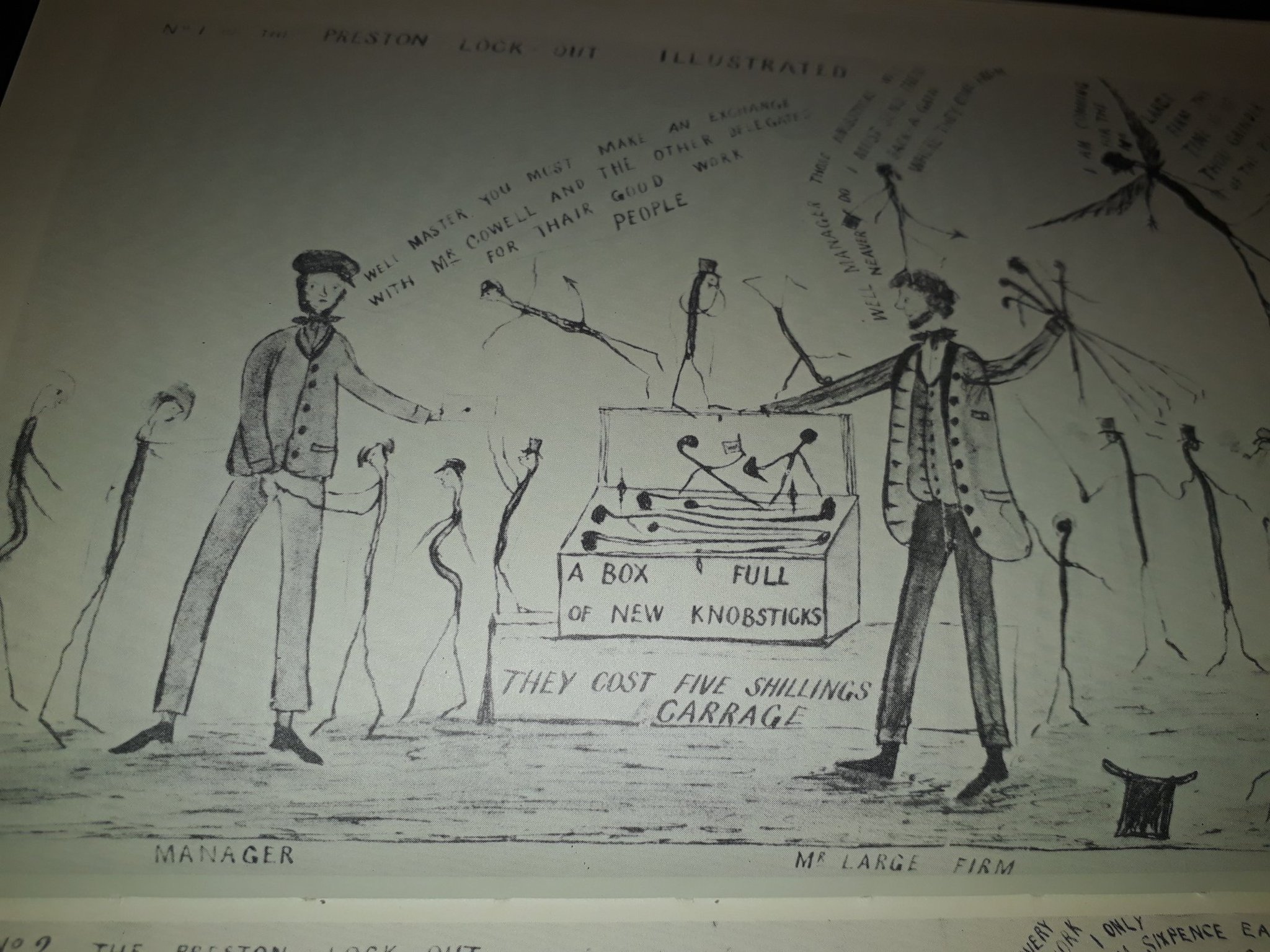
In the nineteenth century scabs were known as knobsticks. One notable dispute where they were used was the Preston lock-out of 1853/4 which features in Dickens Hard Times. Full details can be found in Dutton and King’s book on the dispute 10% and No Surrender. Suffice to say however that the strikers often turned knobsticks away when they realised they’d be strike breaking and those used were found to be ‘inexperienced and incompetent’.
LizTrusshas opined that economic policies over the last 20 years have not delivered economic growth. This takes us back to the second Blair Government. I’ll leave to economic historians the detail of whether Truss is correct, although the wider issues of the decline of British capitalism(much debated) and productivity are important.
However in Truss’s 20 year period we can find the world economic crisis of 2008/9. There was not consensus in the UK about what to do unless I misunderstood Cameron and Osborne. From 2010 the Government policy was one of austerity- in essence making the less well off pay for economic crisis while the rich protected their wealth.
The only economist Truss quoted was the veteran Tory Patrick Minford. I got caught in a research byway checking whether Minford and E P Thompson had ever crossed paths. It appears not but in the process I came across this line in the Making of the English Working Class:
Notions as to the traditional stupidity of the British ruling class are dispelled by familiarity with the Home Office papers.
Thompson was referring to the Luddite period of the 1810s but Truss seems to fit the mould 200 years on
183 years ago this week the world’s first working class party was founded in Manchester
The Griffin, (Land of Cakes)
183 years ago this week the world’s first working-class party was formed at a meeting in a Manchester pub
The National Charter Association, the first working class party anywhere in the world, was formed at a delegate meeting which began 180 years ago this week on 20th July 1840.
The NCA provided an organised structure to attempts to win the vote for working men around the Six Points of the People’s Charter.
It had an elected provisional Executive, and a branch structure with a paid membership. It lasted until 1860.
The concept of a trade union focused party came much later in the nineteenth century, although the NCA did work with the trade unions of the day which were often Chartist focused. The NCA did however encompass a wide range of views from moderate Parliamentary reformers to those who supported a socialist revolution such a George Julian Harney.
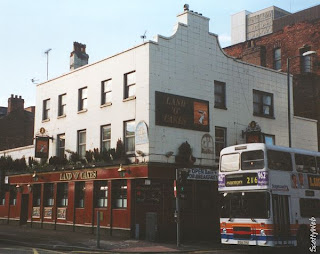
The meeting took place in the Griffin pub in Great Ancoats St, Manchester. The pub dated from 1791 and was closed in 2005 by which time it was known as the Land O Cakes. It is now the Bem Brasil restaurant*
Perhaps typically of how much of Britain’s working class history is either forgotten or not remembered at all I don’t believe there is any current plaque on or near the spot to mark the event.
*thanks to @gwilty200 for info on what the pub is now
Who attended (the conference started on a Monday)
Source: Manchester Conference 1840 | chartist ancestors
The following names are those of the delegates to that first Manchester conference (source: History of the Chartist Movement, 1837-1854, by R.G.Gammage ).
John Arran and Joseph Hatfield, West Riding of Yorkshire.
James Leach and James Taylor, South Lancashire.
J.Deegan, Staleybridge and Liverpool.
David John, Merthyr Tydvil and Monmouth.
J.B.Hanson, Carlisle.
W.Tillman, Manchester.
George Halton, Preston.
Samuel Lees, Stockport.
Richard Littler, Salford.
Mr Andrew, Glossop.
Mr Lowe, Bolton.
Samuel Royse, Hyde.
William Morgan, Bristol, Bath and Cheltenham.
James Cooke, Leigh.
George Black, Nottingham.
James Williams, Sunderland.
Thomas Rayner Smart, Leicester and Northampton.
James Taylor, Loughborough.
Richard Spurr, London.
Richard Hartley, Colne.
What the meeting decided
A NCA Executive Council, consisting of seven full-time, paid members, was responsible for the co-ordination of the national Chartist movement.
he general secretary was to be paid £2 a week, and members of the executive were to receive 30 shillings a week while they were sitting.The Executive Council was to be elected annually by a ballot of all NCA members with each county being able to nominate one candidate.Members of the NCA had to sign a declaration agreeing to the Association’s principles and buy a 2d quarterly membership card. Where possible members were organised locally into classes of ten under a class leader who was responsible for collecting each member’s 1d subscription.
Classes were grouped into wards or divisions and monthly ward meetings heard reports from class leaders.
There was to be a ‘collector’ for each ward responsible for forwarding subscriptions to the National Executive.The membership was divided into classes of ten, whose leaders fed into was, town, ‘county and riding’ that had its own councils with officers elected democratically.There were to be local branches, and an annually elected general council and an executive.Half of the money collected by local branches was to be at the disposal of the executive and plans were formulated to stand Chartist candidates at the next general election.
While the two Tory leadership candidates keenest on culture wars Suella Braverman and Kim Badenoch have been eliminated it doesnt mean that they wont feature over the summer election period. Neither Rishi Sunak or Liz Truss have record in this area of note. Sunak however as the Guardian revealed has some links to culture warriors par excellence Spiked. Truss is thought to have received transfer votes from hard right culture wars fanatic Badenoch. However behind her campaign was Gove whose motives are unclear.
Tim Bale who has studied party memberships at QMC (research by YouGov) notes in his 2019 book Footsoldiers:
“They’re socially much more conservative than [Tory] MPs but on basic economic underlying values they’re considerably more to the centre than [Tory] MPs, even though they’re not quite where voters are.”
Social conservatism equals culture wars its what Tory members want (see Daily Mail)
0.3% of the population will now vote for the next PM. Are they as nasty as we think?
Writing in the New Statesman Anoosh Chakelian has summarised the latest research on who Tory Party members are. The research is carried out under the direction of Tim Bale at QMC. Bale in my view tends towards the generous when assessing Tories and indeed LibDems. Chakelian concludes that Tory members are no worse than Tory MPs. I don’t find that reassuring
Some of the demographic stereotypes about this group of voters are indeed based in reality. They tend to be old, posh, white, male, southern and very Eurosceptic, according to 2020 research from the Queen Mary University of London and Sussex University Party Members Project.
“This is not a very representative sample of the British electorate,” says Tim Bale, professor of politics at Queen Mary, who has been studying UK party members since 2013.
Tory members skew older than the general population: 39 per cent are 65 and over, and 58 per cent are aged 50 and over. They are overwhelmingly middle or upper class, with 80 per cent in the top ABC1 demographic grade compared with 20 per cent C2DE; 42 per cent live in the non-London south. They tend to be concentrated in safe Conservative seats rather than marginal constituencies; there are not many Tory members in the Red Wall seats, for example.