Joint Beard of the Year 2020 Michael Sheen given Lifetime Achievement Award though not eligible for 2021 vote
The Beard Liberation Front, the informal network of beard wearers, has confirmed that Joint Beard of the Year 2020(with Michael Rosen)Michael Sheen was not eligible for the 2021 vote which concluded on Christmas Eve.
Sheen shaved his award winning beard in the summer and he appeared clean shaven in a new film Last Train to Christmas which premiered on 18th December.
However it has been agreed that Michael Sheen should receive a Lifetime Achievement Award for the positive promotion of facial hair in the public arena over a sustained period.
The campaigners say that Sheen’s bearded image has become iconic and his decision in 2021 to become a not for profit actor has underlined the positive impact of his beard power.
BLF Organiser Keith Flett said, the annual Beard of the Year Award is given to someone who has consistently worn a beard during the calendar year. For professional reasons Michael Sheen hasn’t been able to do that. However with the Lifetime Achievement Award we have resolved to recognise the significant positive impact his beard has had on the appreciation that facial hair can be a force for progress in society.
Notes
Michael Rosen retained his Beard of the Year title in 2021 becoming the first person ever to win the Award in consecutive years:
Michael Rosen becomes first person to win consecutive Beard of the Year titles
The Beard Liberation Front, the informal network of beard wearers, has said that in winning the vote for Beard of the Year in 2021 Michael Rosen has become the first person to win consecutive titles.
In 2020 Rosen shared the accolade with actor Michael Sheen.
The late Frank Dobson MP won the first award in 2000 and its normal for a new winner to emerge each year. Previous winners have included musician Robert Plant, cricketer Freddie Flintoff and Eurovision winner Conchita Wurst.
Michael Rosen secured 41.8% of the vote while England cricketer Moeen Ali was runner-up with 30.8% of the vote. Just over a thousand people voted.
BLF Organiser Keith Flett said, Beard of the Year is all about people who have promoted a positive image of the hirsute in the public eye during the year. Obviously this differs over time but Michael Rosen has been able to do this consistently again in 2021 underlining both the gravitas and resilience that his trade mark beard brings to his work.
English cricket: origins of the present crisis, a matter of race & class?
The capitulation of the England cricket team in the current Ashes series has made for depressing watching and listening. Fortunately these days there is lots of other cricket in various formats, mens and womens, that can be engaged with instead.
I’m far from a gung ho England cricket supporter. What I enjoy is the ebb and flow of a competitive cricket match- best seen at a Test match, though shorter form games can sometimes also provide it.
The Ashes has not been even slightly competitive however. England’s bowlers have had some decent moments. The same cant really be said about the batting. I don’t think the players can be blamed. I’m sure they try hard in what are currently difficult and less than ideal circumstances. Whether all the players are of a Test standard is another matter.
As several others who write far better on cricket than I’ll ever do- Duncan Stone and Jonathan Liew for example- have argued the problems in English cricket go far deeper and goes back far further than the current Ashes debacle.
It’s a matter of race and class and the connections between them. Lets consider two points. Firstly that a substantial majority of the England Test team have been educated at public schools. A lot more gentlemen than players then. In a sense this is not surprising. Many State schools don’t give that much time or resource to cricket, whose season comes towards the end of the school year and for older pupils in the exam period too. As it happens I did play for the (State) school cricket team back in the day, but I was of course useless.
Even so this public school background means the Test team is drawn from a very narrow layer of potential and misses out not just many working class youths from all communities interested in cricket but also specifically large numbers from the Asian and Caribbean communities who do actually play cricket competitively.
That is where the race element of the race and class question comes in. The reality is that the ruling body of English cricket the ECB was complacent about racism at Yorkshire cricket club and indeed institutional discrimination across the game. Occasional fine words and policies were produced but nothing was done.
The Yorkshire scandal eventually made national headlines earlier this year. One suspects that even if there were paths to get more involved in England cricket to representative level many from ethnic minority backgrounds might very reasonably wonder what they would be letting themselves in for.
Analysing the problems is one thing working out the key point- what is to be done- is rather different. You’d hope that the England captain, coaches and those in charge at the ECB would step down. Given current public culture in the UK I’d be slightly surprised if they do although no doubt a scapegoat or two will be found, while meanwhile nothing changes.
Expecting change from the top is unlikely to work. It will require a campaign and pressure from below. Normally I’d look to the relevant union- in this case the PCA- to be central to that but the Yorkshire situation suggests it may well be compromised. Perhaps I’m wrong.
Rather I think it will need to come from supporters of cricket, commentators and writers and hopefully at least some senior ex-players.
And don’t get me started on The Hundred. Enjoyable in itself the ECB’s obsession with it has clearly started the process of undermining the County game and hence the Test team. The reality is however that until access to England cricket at representative level is widened that remains a secondary issue.
Jeremy Corbyn’s Haringey years have led to lasting respect in the area
I last saw Jeremy Corbyn in person just before lockdown in early March 2020 when he delivered the 20th anniversary Bernie Grant lecture at the Bernie Grant Centre in Tottenham. His speech that day ranged across issues from anti-racism, the history of slavery and the rise of Black Sections in the Labour Party. David Lammy who has now distanced himself from his earlier decision to nominate Corbyn for the Labour leadership in 2015 was also there and spoke. Its true as David Lammy says that no one including Jeremy Corbyn himself I suspect expected him to become Labour leader but that is another matter.
Corbyn has always been up front about his politics and his staunch anti-racism
We were both young men with beards in the North London labour movement in the 1970s (and we still are except not young) even if we had diverging views on the best way to achieve socialist advance.
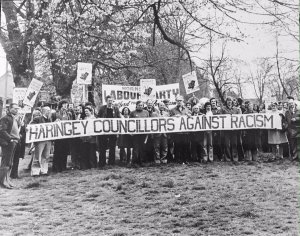
Corbyn played a key role in the Battle of Wood Green on 23rd April 1977, one of the landmark battles which grappled with the rise of the fascist National Front, eventually successfully:
Corbyn was the organiser of that demonstration. He made sure that Councillors of all parties were on board and managed to unite those who wanted a peaceful protest and those who wanted to confront the fascists as well.
The local Hornsey Journal paper had the following quote from him:
From Haringey Councillor Jeremy Corbyn on behalf of the organisers of the counter-demonstrations ‘Why did the police allow the National Front to march through the busiest shopping area of North London, an area populated by several of London’s largest immigrant communities? It must be clear from Saturday’s demonstration that there is the widest possible opposition to these modern day fascists. How much longer must it be before fascism is banned from our streets?’
Since then Corbyn has continued to be an anti-racist activist. Some politicians as they progress through their careers prefer to play down or rewrite their past. By contrast Corbyn is always prepared to remember what he did on that April day in 1977 and was the keynote speaker at the 40th anniversary event in 2017.
Jeremy Corbyn’s Haringey years are still remembered and respected by many in the Borough as is of course is his friend and political ally the late Tottenham MP Bernie Grant.
Michael Rosen voted Beard of the Year 2021 as he shaves opponents
The Beard Liberation Front, the informal network of beard wearers, has said that the Final Follicle Fight poll has seen author and broadcaster Michael Rosen win the coveted Beard of the Year title for a second year.
Michael Rosen secured 41.8% of the vote while England cricketer Moeen Ali was runner-up with 30.8% of the vote. Just over a thousand people voted.
Two earlier Beard Off rounds saw Michael Rosen, Moeen Ali, Richard Osman and Benjamin Zephaniah go through to the final
BLF Organiser Keith Flett said, of course Michael Rosen doesn’t have a ZZ Top style beard but Beard of the Year is not about how long or bushy the beard is. Rather it is about the positive image that the beard wearer gives facial hair in the public domain. Here Michael Rosen continues to be an excellent ambassador for the hirsute and its fitting that he has retained the title.
One item that has characterised Christmas 2021 has been the continued rise of pigs and blankets. they have been around while, cocktail sausages wrapped in bacon, but they have been omnipresent in 2021
Large packs of pigs in blankets crisps, available in Lidl and Aldi (of course) and M&S don’t seem to have developed much this year.
The same is true for supermarket sandwiches, usually termed pigs under blankets, which are universally available.
Obviously pigs in blankets are not for non-meat eaters but I didn’t stop that many vegetarian or vegan versions around in 2021. Supply chain issues (etc) has led to a narrowing or ranges and they may be victims.
There were however still some outstanding examples. Lidl’s foot long pigs in blankets worked well, but the stand out were Aldi’s chorizo pigs wrapped in pancetta with a honey glaze. They were still beard friendly too. Expect to see them in M&S and Waitrose in 2022.
There were of course also the less satisfactory pigs and blankets items. Pigs in blankets humous sounded like and was food culture wars.
What this all this says about Britain at Christmas 2021 I’m not yet sure but pigs in blankets have certainly become a core part of the national cuisine.
Christmas Day riots 1647 & the Freeborn Englishman
As is (hopefully) fairly well known Parliament attempted to ban Christmas, a law of June 1647 forbade its celebration. This was not entirely successful but there were reasons. Christmas was associated with Catholicism, and in effect the ‘old’ ruling orders, while the Parliamentary majority now represented the Puritan ascendancy that disliked the traditions and ideas of the Catholic church.
The Puritans were also concerned, at an official level and certainly amongst local ‘activists’ that Christmas was a time of dissolute behaviour which they felt was ungodly.
Parliament was certainly not totally successful in banning Christmas activities, partly because the less well off in society liked to mark the occasion, if and where they could, their lives being quite tough enough at other times, and also because celebration was associated with the Royalist cause and in the 1650s a symbol of attempts to overthrow the Commonwealth.
At Christmas 1647 a number of Church Ministers were jailed for attempting to mark the occasion.
Down below Christmas 1647 saw a number of riots in defence of celebrating the day.
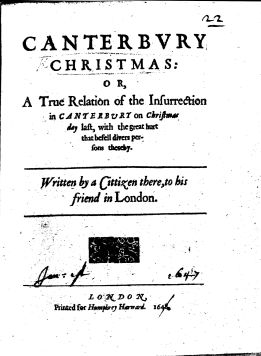
The most significant disturbances of all took place at Canterbury, where a crowd of protestors first smashed up the shops which had been opened on Christmas Day and then went on to seize control of the entire city.
There is some interesting new-ish research on this here:
As with the Gordon Riots in London in the 1780s we need to be careful in applying modern labels of ‘reactionary’ or ‘progressive’ to such events. They may well have been Royalist influenced, and hence in the context of the 1640s counter-revolutionary, but once they were in progress they became a force that could challenge the existing order, whoever was in charge of it. They were in effect protesting defence of their own December customs and of being left alone by Government to mark them as they would. It was a defining feature of what was known in the early nineteenth century as the Freeborn Englishman, someone likely to resist overbearing interference by the State in their lives, whichever quarter it came from. It can be seen that depending on the issue or the context that might fall in modern terms on either the right or the left.
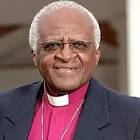
Archbishop Desmond Tutu, the veteran campaigner against apartheid and oppression has sadly died at 90.
The ‘great and the good’ have wasted no time of course in praising his life, rightly so. In some cases the praise has been a little been one-dimensional. Tutu opposed the Iraq War in 2003 and was a long time supporter of Palestinian rights, being critical of the activities of Israeli Governments in this respect.
These last two points are important because they underline that Tutu’s concern for human rights, and justice while rooted in the fight against apartheid far from ended there.
Tony Benn recorded in his diary a number of meetings and exchanges with Tutu, where they shared some common political aims. Both of course were Christians, but Benn was no more an Archbishop than Tutu was a member of the Labour Party NEC. They worked together around specific issues and injustices.
Benn recorded a discussion he had on Radio 4’s Start the Week programme with Tutu on Monday 16th February 2004. Benn noted ‘It began with Archbishop Desmond Tutu describing truth and reconciliation, talking in that way he does. He’s such a lovely guy, so funny. I said what should I call you? I suppose it will have to be Archbishop, it cant be Desmond! In the Independent he suggested that Blair and Bush should apologise for the war, and it gave me an opportunity to talk about morality in politics-not being successful or profitable but being right…Tutu was an absolute charmer. I got a photograph with him afterwards..
The Bank Holidays Act of 1871 introduced four Bank Holidays in England and Wales Boxing Day, Good Friday, Whitsun and August. Christmas Day and Easter Sunday were already recognised as religious holidays.
The reasons for the Act are not particularly easy to discern, except for the point that the UK in general had fewer such holidays than the rest of Europe- which is still true. Part of the reason may have been to try and counter the continuing practice of Saint Monday, where workers extended the weekend by a further day.
Parliament later determined that if Christmas and Boxing Day fell at the weekend then the following days would be Bank Holidays, meaning in 2021 27th and 28th December.
Boxing Day was mentioned by Dickens in the Pickwick Papers but not in a Christmas Carol (1843) where Scrooge’s clerk was reluctantly given the whole of Christmas Day off but told to be at work early the following day.
However a check on the New Year edition of the Chartist paper the Northern Star for 1852 (its last year of publication) reveals Boxing Day crowds at London theatres. In addition there was Boxing Day entertainment at O’Connorville, part of the Chartist Land Plan on the outskirts of Ricksmanworth (now expensive housing..)
Perhaps in 1871 Parliament bowed to the inevitable
Northern Star 3rd January 1852
Christmas Amusements
Drury Lane
Mr Bunn once more lessee of this theatre commenced on his new course of management on Boxing night. The house was filled to overflowing with a holiday audience
Astleys (225 Westminster Bridge Rd)
Holiday nights are always bumpers at this theatre and Boxing night was no exception to the rule. The audience was as numerous, as patient, and although noisy, as good humoured as any manager could desire.
Christmas at O’Connorville (Ricksmanworth)
A tea party, soiree and ball was held in the School Room on Boxing Day, on which occasion a goodly number of allotees, their wives and families assembled to take part in the entertainments provided.. singing and dancing were kept up to an early hour in the morning
The early modern origins of Boxing Day. A matter of class
The origins of Boxing Day are in 2021 perhaps obscure. It was not, despite it now being a major sporting day, traditionally a time for boxing matches for example.
Rather the early modern traditions of the day go back to the 1660s (just after the period when Christmas had been officially banned) where Christmas gifts (usually money) were left in a box by the better off for those who had done work for them during the year.
Hutton in Stations of the Sun notes that Samuel Pepys recorded putting money in five or six such boxes on Christmas Day 1667 to allow the recipients to have a more enjoyable festive season.
The following year Pepys was complaining (December 28th 1668) : “Called up by drums & trumpets; these things & boxes having cost me much money this Christmas.”
The wealthy being what they are complaints were not slow in coming. In 1710 Jonathan Swift complained that he would be ‘undone’ by the giving of Christmas boxes and in 1756 Sir John Fielding that the total cost of such boxes could amount to £30 (when the average wage was around £1 a week).
The Daily Telegraph, which knows about these things, has noted:
British servants to the wealthy in the 19th century were given time off to visit their families as their services had been required for the Christmas Day celebrations of their employers. They were therefore allowed the following day for their own observance of the holiday; each servant would be handed a box to take home, containing gifts, bonuses and sometimes leftover food.
As Hutton underlines the practice of the Boxing Day ‘box’ was not easily given up by the less well-off and in 1871 Boxing Day itself became an official day off, a Bank Holiday.
In modern neo-liberal times, COVID restrictions notwithstanding, the pressure particularly in retail and services is making Boxing Day a working day again. The only effective break here is trade union organisation.