Articles

The Ambridge Socialist: The Bull must revert to its real name as a mark of respect to Lynda Snell

In Uncategorized on March 15, 2020 by kmflett

The Ambridge Socialist

15th March

The Bull must revert to its original as a mark of respect to Lynda Snell

The Ambridge Socialist has called for the B@Ambridge to revert to its traditional name of The Bull after the explosion at Grey Gables last Sunday night.

Lynda Snell who was caught up in the explosion and lies seriously ill in hospital had campaigned against the name change and while the Ambridge Socialist has disagreements with Ms Snell and The ReBulls over tactics it is surely time now to abandon the name change as one way of marking the impact that the veteran campaigner has had in Ambridge.

An initial report has suggested that the explosion was caused by the ignition of petrol being used to take up kitchen tiles by a workman. However responsibility and culpability are different matters. Was the workman, the seriously injured Blake, told to do this by Gavin who was meant to be supervising the job?

Ambridge Socialist Editor Keith Flett, aside from paying respect to Lynda Snell, we await the outcome of investigations into the explosion at Grey Gables by the HSE and the police and for prosecutions to follow. There must be no repeat of the disgraceful situation in January 2011 when Nigel Pargetter ‘fell’ from the roof of Lower Loxley and nothing at all transpired in terms of official action

You, the Jury

Who should be prosecuted over the Grey Gables explosion

In Other News

Tbh there is no other news. Ambridge is flooding and coronavirus free

Most annoying person of the week

Call Me Russ packing up his latest ‘works of art’ at Lower Loxley

Coronavirus

COVID-19 presents a number of logistical issues for the BBC’s reports from Ambridge and we can only hope that all concerned stay well. Were it to appear in the village however our money is on Toby to spread it without developing any significant symptoms himself

 

Articles

Last weekend to vote for Beard of Ireland 2020. Closes midnight Sunday

In Uncategorized on March 14, 2020 by kmflett

Beard Liberation Front

Press release 14th March

Contact Keith Flett 07803 167266

LAST WEEKEND TO VOTE FOR BEARD OF IRELAND 2020. CLOSES MIDNIGHT SUNDAY

The Beard Liberation Front, the informal network of beard wearers, has said that there is record turn-out in voting for the Beard of Ireland 2020.

This weekend is the last chance to have a say.

The vote will close at midnight on 15th March with the winner announced on March 17th, St Patrick’s Day

The 2017 winner was politician Colum Eastwood who bearded broadcaster William Crawley for the annual Award.

In 2018 the DUP’s Lee Reynolds shaved writer Dominic O’Reilly for the honour with Colum Eastwood in a steady third place.

In 2019 Lee Reynolds retained the title

The BLF says that while traditionally a land of predominantly clean-shaven cultures, Ireland has in recent times become something of a centre for stylish and trendy beards.

Contenders for the title in 2020 include a diverse range of the hirsute- actors, comedians, political activists, journalists and rugby players.

The campaigners say the poll is specifically about the impact the beard of an individual has made in Irish public life and no other factor.

BLF Organiser Keith Flett said, hairs are being split in the poll, but votes in the final weekend could be decisive

Steve Agnew, Renewable Energy Administrator

Bundee Aki, rugby player

Gerry Carroll, politician

William Crawley, broadcaster

Stuart Dallas, footballer

Colum Eastwood, politician

Sam McBride, journalist

Damian Mackle, WWE performer

David Norris, politician

Lee Reynolds. Politician

Peter Coles, academic, Maynooth University

Shane Lowry, golfer

Aodhán Connolly, Businessman

Rob Herring, Rugby player


Articles

Socialist history seminar: Rhys Williams on Tom Mann in Australia, cancelled (16th March 2020)

In Uncategorized on March 14, 2020 by kmflett

London Socialist Historians Group

14th March

contact Dr Keith Flett 07803 167266

The London Socialist Historians Group, which organises the socialist history seminar at the Institute of Historical Research, University of London has said that its final seminar of the Spring term, due on Monday 16th March, has been cancelled as a precaution in the light of the spread of the coronavirus.

The historians say that encouraging people to travel to central London when they may not otherwise have had a reason to be there, and meeting in the relatively confined space of a seminar room, was not felt to be a sensible thing to do.

It is hoped that the seminar will now take place later in 2020 and this has been discussed with the speaker.(the paper was delivered via Zoom with the speaker in Australia in October 2020)

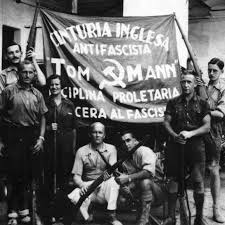
Rhys Williams was due to speak on research that he has been doing on Tom Mann in Australia.

A brief summary of what he is covering is below. Questions and comments on this are welcome and will be passed on to him

Tom Mann in Australia – 1902-1909

My paper is a study of Tom Mann, the great British socialist and trade unionist, and his involvement in the Australian labour movement between 1902 and 1909.

My paper explores Mann’s experience in Australia, his role in the building of the Australian Left, and the impact of Australia on his politics.

My paper particularly engages with Mann’s involvement in the Australian Labor Party (ALP), the Victorian Socialist Party (VSP), and his role in the great Broken Hill Strike of 1908-1909.

Articles

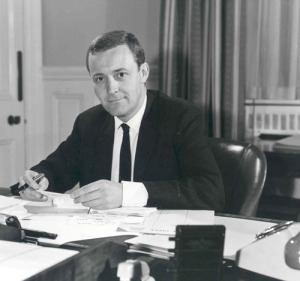
Tony Benn 3 April 1925-14th March 2014: History Man

In Uncategorized on March 14, 2020 by kmflett

Tony Benn 3 April 1925-March 14th 2014. History Man

Tony Benn died 6 years ago on 14th March 2014.

His published Diaries remain an important historical resource. The eleven published volumes represent a fraction of his total archive. It is to be hoped that just as the papers of Mrs Thatcher are being deposited in an academic archive and made available on-line by the Thatcher Foundation, so Benn’s equally if not more important- not least for its longevity- documentation can be made accessible to the public in its entirety.

Tony Benn was a rarity among modern politicians in that he also had a sense of history and specifically labour and democratic history.

Media commentary after his death suggested that he did not have a grasp of historical perspective when was a Labour Minister in the 1960s. Rather his experience of power led him to reflect on lessons that might be learnt from a study of the past.

Benn was not an historian, and nor did he claim to be.

He did not spend his time researching matters in archives or wondering if a study of history might throw up distinctly awkward questions for present practice.

He did understand the historical context he which he operated.

I’m grateful to Professor Owen Ashton, the Editor of the invaluable Merlin Press Chartist Studies series, for reminding me how much Benn focused on the Chartist movement.

Ashton has argued that Benn was in the tradition of dissenting ‘Gentleman Leaders; who were radical ‘Friends of the People’. In the nineteenth century one might look to figures like Henry Hunt who spoke at Peterloo, William Cobbett and the great Chartist leader Feargus O’Connor who became MP for Nottingham, as broadly comparable figures.

Benn himself saw the Chartists in the context of a broad democratic heritage including the Peasants Revolt the English Revolution of the 1640s and the Suffragettes of the early years of the twentieth century. It was an historical list he often spoke about and recounted in a 1999 article for History Today

He became he a regular attender at the TUC’s Tolpuddle Festivals in July and that was very much part of his awareness of labour history. He was also to be found often at the Durham miner’s gala for the same reason

His Diaries also contains several references to the Chartists. He wrote in 1981 about Paul Foot’s book Red Shelley and argued that Shelley’s influence on Chartism and the working-class movement had been all but hidden.

More poignantly in his General Election defeat in Bristol in 1983, on changed constituency boundaries, he nevertheless paid tribute in his after-poll speech to the Chartists and the suffragettes, who had fought for the democracy that had allowed him to stand.

Historians can argue that Benn’s understanding was too uncritical perhaps even to a degree hagiographic. Yet that itself misses the times in which Benn was active as a leader of the labour movement.


Relatively few other Labour MPs or Union leaders knew much if anything about labour history and even fewer made any reference to it when they spoke in public.

The importance of Tony Benn as an educator of the labour movement should not be overlooked. When he spoke at large public meetings and rallies about the Chartists or the Levellers he inspired numbers to go away and find out more about who those people were, why and how they fought and what they did and did not achieve.

Articles

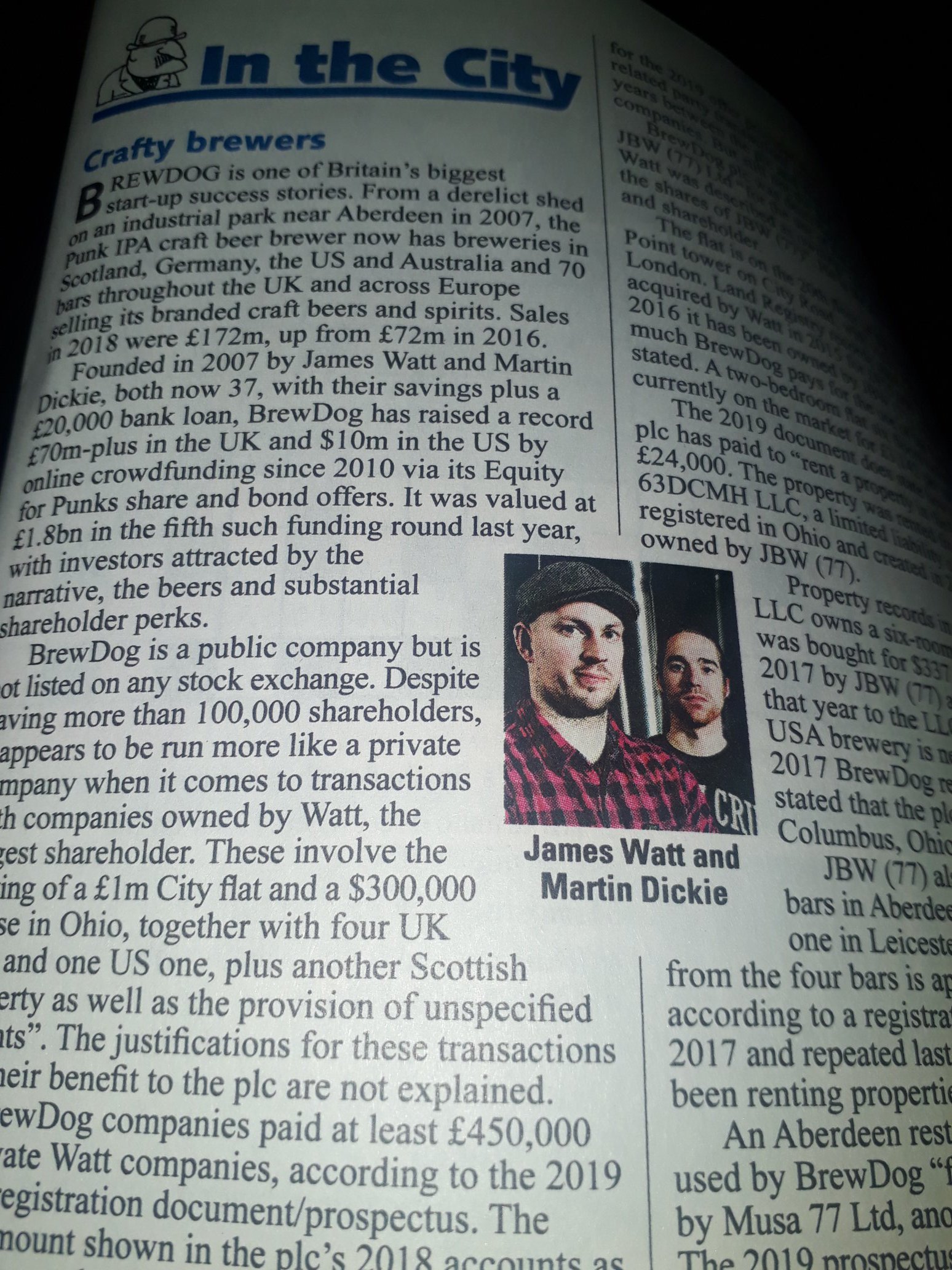
Private Eye’s analysis of ‘Crafty Brewers’ Brewdog

In Uncategorized on March 13, 2020 by kmflett

Private Eye’s analysis of ‘Crafty Brewers’ Brewdog

Update

Radio 4’s Food Programme (10th Jan 2021) has run an entire edition on Brewdog:

https://www.bbc.co.uk/sounds/play/m000r318

Hosted by brewer Jaega Wise (WildCard) with commentary by beer writer Pete Brown and containing a Zoom interview with Martin Dickie and James Watt it was decently balanced on the impact Brewdog has had and some of the issues- sexist advertising stunts for example. Pete Brown underlined that Punk is not the complex beer it once was. The financial structure of the Company and the EFP schemes didnt get much scrutiny, probably reasonably enough as it was the Food Programme. That said the post below summarising a piece from Private Eye in March 2020 still gets regular hits.

One wonders if Brewdog will end 2021 as an independent brewer..

The current issue of Private Eye (1517) carries a lengthy analysis of the structure and finances of Brewdog. Private Eye generally eschews such new-fangled things as the interwebs so you’ll have to buy a copy. It costs rather less than half a pint of Punk IPA.

The piece is interesting because Brewdog is far from transparent about how it works despite its Equity for Punks ‘ownership’ scheme.

The nub of the Eye’s analysis is contained in these sentences

‘it is not suggested that any of these transactions are illegal or improper. The question is whether they are appropriate for a company with 100,000 other shareholders’

Of interest it notes that while a profit of £3.8m was made in 2016 this had reduced to £1.4m in 2017 and by 2018 had become a pre-tax loss of £576,000

It also notes:

When the  private equity deal with TSG was announced in April 2017, it was stated to have involved a total of £213m, including £100m for new shares to fund Brewdog. The normal private equity playbook would look for an exit by sale or listing within five years

The Eye analysis focuses on a Company named JBW77 that appears to be linked to Brewdog founder James Watt and various holdings, transactions and deals that it has been involved in. As a union official that deals with very large companies (which Brewdog is not) I’m not sure there is anything hugely unusual about it.

The issue of course lies between how Brewdog markets itself, as a sort of rebel against the traditional beer industry, and the reality of the business it carries on which might well be described as traditional.

Perhaps in the end it comes to down to whether you think the beer is any good or not. My view, hardly secret, is that this varies between types of beer. The imperial stouts are generally very good as are the stronger IPAs. The core range is perhaps less distinctive.

If you are looking to give two fingers to market focused brewers though, look elsewhere.

Articles

Boris Johnson, Other Countries COVID-19 policies & Mr Podsnap ‘Not English!’

In Uncategorized on March 13, 2020 by kmflett

I posted this one year ago on 13th March 2020.

On the anniversary of COVID being recognised as a pandemic I’m re-posting it.

Michael Rosen tweeted at the time (13th March 2020):

The reason why the UK is not doing what other countries are doing is because we know more about everything than foreigners.
He almost certainly had contracted COVID by this time underlining Boris Johnson’s disgraceful (at best) lack of action a year ago

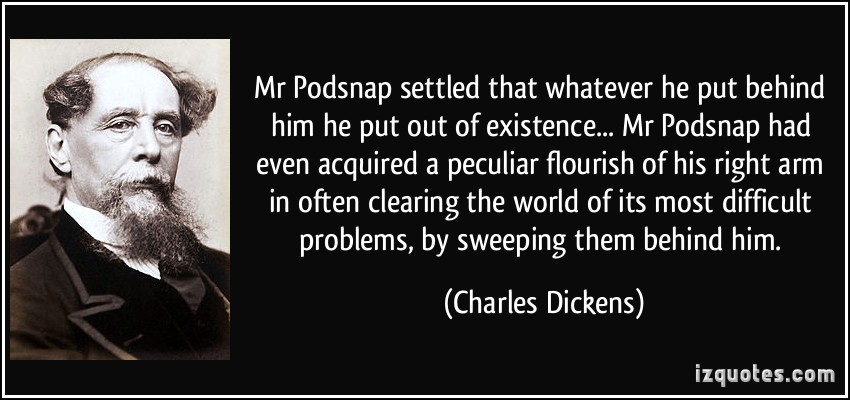
Whatever one thinks of Boris Johnson’s statements on the coronavirus they are notable for how they differ from more or less every other European country. One senses a perspective of Podsnappery (a character in Charles Dickens, Our Mutual Friend) who would dismiss ‘Other Countries’ and being ‘Not English!’

Mr Podsnap’s world was not a very large world, morally; no, nor even geographically: seeing that although his business was sustained upon commerce with other countries, he considered other countries, with that important reservation, a mistake, and of their manners and customs would conclusively observe, ‘Not English!’

Articles

John Heffernan plays Gareth Stedman Jones in Misbehaviour

In Uncategorized on March 12, 2020 by kmflett

John Heffernan plays Gareth Stedman Jones in Misbehaviour

I’ve had disagreements with the socialist historian and theorist Gareth Stedman Jones over the years, in particular his approach to Chartism in Languages of Class.

Time moves on and on the odd occasion when I’m in the same space as him- invariably socialist history related occasion- there is no longer a need to revisit the disputes of decades ago.

In that context however I was fascinated to see that Stedman Jones, as played by John Heffernan (details below) features briefly in the new film, Misbehaviour, which opens on Friday March 13th.

The film is NOT about male socialist historians, although it is certainly about some men behaving very badly indeed.

It’s about the disruption of the 1970 Miss World contest, compered by Bob Hope, by a group of feminists. One of them was Sally Alexander, also a well-known socialist historian and theorist, currently based at Goldsmiths.

Gareth Stedman Jones was Sally Alexander’s partner in 1970 but the cameo in the film which involves a discussion between them about the protest didn’t actually take place. Details are here:

https://www.theguardian.com/world/2020/feb/26/i-heard-the-signal-and-threw-my-flour-bombs-why-the-1970-miss-world-protest-is-still-making-waves

Keria Knightley plays Sally Alexander which rightly is the leading role

It is an interesting reflection that the socialist history and activism that my generation were involved in, in the 1970s is now being retold as popular history itself. More interesting of course remains the struggle now

John Heffernan

https://www.imdb.com/name/nm3467387/bio?ref_=nm_ov_bio_sm

Articles

Yet another clean-shaven Tory Budget dodges shaving tax

In Uncategorized on March 11, 2020 by kmflett

Beard Liberation Front

Media Release 11th March

Contact Keith Flett 07803 167266

YET ANOTHER CLEAN-SHAVEN TORY BUDGET DODGES SHAVING TAX

The Beard Liberation Front, the informal network of beard wearers, has said that yet another clean -shaven Tory Chancellor Rishi Sunak has dodged the chance to be innovative in the Budget and announce a tax on shaving.

The campaigners say that while there has been a significant growth in beards, in reality they still represent a minority in the country compared to the clean shaven.

The BLF says that shaving is environmentally unfriendly and a Shaving Tax would do a good deal to address carbon reduction targets by reducing use of electric shavers and power used to make shaving products.

Those currently employed in the shaving industry can easily be re-deployed into the beard care area of the economy, a growing sector.

A Shaving Tax could be levied at £100 a year for all those who did not have a beard at the beginning of the financial year- April 1st. It would hit popular targets such as clean-shaven bankers in the City who would have to grow a beard or pay up.

BLF Organiser Keith Flett said, Rishi Sunak remains resolutely clean shaven but he could have boosted his popularity and the Exchequer’s finances considerably by implementing an innovative Shaving Tax.

Articles

Tories, the Workers Party. A brief history

In Uncategorized on March 11, 2020 by kmflett

Tories, the Workers Party. A brief history

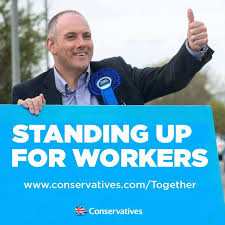
Suella Braverman has claimed the Tories are the trade union of the British people.

The Tories have occasionally used slogan that the Tories are the Workers Party in the past

They do not mean one presumes Sinn Fein which in recent times has used that name, but some attempt to get away to shift the image of the Tories as a lot of very wealthy Old Etonians (which mny of the leadership are)

I have been a trade union activist for 40 years and I can well remember a time when Tory trade unionists had a reasonably serious presence as activists in the movement. They would traditionally oppose the involvement of Unions with ‘politics’ and were often to be heard saying that they wanted lower taxes because they could decide themselves how to spend money.

There is a well-known study of the working-class Tory voter by McKenzie & Silver, Angels in Marble (1968):

https://books.google.co.uk/books?id=XNg3AAAAMAAJ&source=gbs_book_other_versions

This is often seen in the same framework as the deferential voter and until the 1950s the Tories controlled some large northern cities such as Liverpool (the last time was 1972)

Some trade unionists still do vote Tory, perhaps a few more did in 2019 than at recent Elections but to find an activist is quite rare. Hats off [on this issue] to Robert Halfon the Harlow MP, a trade union member, who is I think the only Tory to speak up for trade unions in the Commons on a an occasional basis. He tweeted the workers party line in the past.

Most recent Tory thoughts on unions have been around issues like raising the bar on how many must vote for strikes or bashing the facility time of union representatives in the public sector or making sure that workers have no employment rights until they have done two years in the job

Several Tory leaders ago there was some attempt to engage with genuine representatives of workers in the form of trade unions

Even before he came to Office David Cameron appointed Richard Balfe [a former Labour politician turned Tory MEP] as the Tory trade union envoy.

Mrs Thatcher who was a trade union member herself when working in industry had pursued a similar angle but the approach had lapsed.

Balfe was of course not universally popular in the labour movement. The link here gives a flavour of his views:

http://www.conservativehome.com/platform/2011/06/richard-balfe-we-shoulds-not-demonise-the-public-sector-unions-but-continue-negotiating-with-them-in.html

Balfe is now a Lord and the role of trade union envoy appears long defunct, although Ministers still do talk to unions from time to time.

Perhaps one of the ideas of the Tories as the workers party is that they aim to represent those [far too substantial] sections of the working class who are not trade unionists.

In reality the workers party boast in 2023 is just an empty slogan. To give it any substance the Tories would need to address the issue of (the lack of) rights at work. Given that the current Tory leadership, elected or otherwise, sees one of the key reasons for leaving the EU, as a chance to have a bonfire of what employment rights there are, it seems an unlikely scenario

Articles

50 years on from Warwick University Ltd, UCU strikes challenge the business university

In Uncategorized on March 11, 2020 by kmflett

50 years on from Warwick University Ltd, the UCU strikes challenge the business university

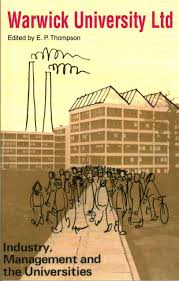
In the late 1960s students at Warwick University uncovered and published a number of documents that related to the links between the University and local business. At the time the idea that business should be able to significantly influence the priorities of what took place in an academic environment was regarded as very concerning.

It is still very concerning 50 years on but is now commonplace. If it is not direct business influence then certainly the influence of the ideas and practice of business, focused on profit and the market.

The late historian E P Thompson who was Director of the Centre for Social History at Warwick in the late 1960s edited a Penguin Special paperback, published in 1970 which have significant details and insight into what had happened at Warwick:

https://kmflett.wordpress.com/2020/02/20/why-warwick-university-ltd1970-remains-relevant-to-the-ucu-strike-of-2020/

Below are some lines to E P Thompson’s conclusion to Warwick University Ltd

And what is wrong again is the whole system of values- the entire ordering of human priorities- of  this insistent managerial propaganda. It is sad to see even scholars themselves hesitate in their work and wonder about the use of what they are doing. Even they begin to feel, defensively, that a salesman or an advertising executive is perhaps a more productive human being than an actor, or a designer or a teacher of English.

E P Thompson, Warwick University Ltd