
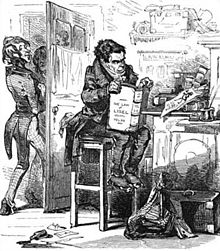
William Benbow caricatured in an 1848 edition of Punch
The Grand National Holiday: when the pubs shut to bring down capitalism
August is a peak month for holidays. School is out in many areas of the UK, official institutions such as Parliament and the Courts take a break, and the weather is supposed to be decent.
Historically in many northern manufacturing districts- at least before Mrs Thatcher got to work- this was also the period of Wakes Weeks when factories and mills shut down for a fortnight.
There is nothing particularly radical about any of this except of course that the right to paid time off had to be fought for by trade unions and the labour movement and did not become an established feature of working life for many until the 1930s and often later.
Yet there is also a radical tradition of ceasing work associated with August, the Grand National Holiday.
The ‘Holiday’ was an idea promoted by William Benbow (1784-1864). Like many radical activists in the nineteenth century he ranged across a variety of occupations, from pornographer to coffee house keeper to grocer and journalist, to survive.
Benbow was influenced by the radical ideas of Thomas Spence, and he popularised the idea of a people’s jubilee, or open-ended cessation of work, with the plan of ending capitalism.
He had been pushing the idea of a ‘Sacred Month’ for decades in radical circles with no great immediate impact. He did however publish it as a pamphlet in the early 1830s and this was widely read.
Benbow’s plan might well have stayed simply an interesting idea were it not for the fact that the Chartist Convention of summer 1839 adopted it as policy and determined to put it into operation in August of that year, starting on the 12th of the month.
We are familiar with General Strikes around the world which are in protest at something or which are demanding specific things. The Grand National Holiday was neither of these. It simply planned to disengage from capitalism until the system stopped working.
This meant that not only was no work to be done, but that supporters of the Sacred Month should withdraw any savings they had in banks or other institutions. They were also required to abstain from all excisable articles such as drink and tobacco. On 12th August 1839 in many, mainly northern areas, the pubs were shut.
It was argued that aside from anything else this prevented any disorder and drunkenness as the month got underway.
How was the call for the Sacred Month implemented?
The weekly Chartist newspaper The Northern Star for the 17th and 24th August 1839 reported meetings across the north, often with very large turnouts comprising a majority of the working population of particular areas, which then proceeded to march to surrounding locations to pull others out in support of the popular Jubilee.
There is not a uniform picture of how long people stayed out for- some days in a number of areas- but not the whole month. The practicalities were complicated.
Perhaps some had small holdings that allowed them to survive without wage labour, possibly being only recently agricultural workers. This was part of the project that became in the later 1840s the Chartist Land Plan.
Even in areas where the strike did not take hold there was at least symbolic support. In London on 12th August there was a mass Chartist meeting on Kennington Common for example.
Almost 180 years on the events of August 1839 have a strikingly modern feel. A People’s Jubilee against not this or that aspect of capitalism but the whole system.
This post first appeared in the Morning Star 21st August 2017


[…] https://kmflett.wordpress.com/2017/08/22/august-1839-not-a-bank-holiday-but-a-grand-national-holiday… […]
[…] https://kmflett.wordpress.com/2017/08/22/august-1839-not-a-bank-holiday-but-a-grand-national-holiday… […]