
The left & the Royals
It’s the twentieth anniversary of the death of Princess Diana on 31st August. The media are making a good deal of it.
At the time Diana was dubbed the ‘People’s Princess’ and the newly elected Labour Government under Tony Blair made much of the changing times.
Tony Benn’s diary for the period makes interesting reading. He noted on 31st August that he had refused interview requests because ‘there is nothing whatsoever to be said’. The following day he notes that the Guardian had 14 pages on Diana’s death.
However a few days later he noted the mood had changed as the Royal Family were seen to be reluctant to mark the death of Diana. He wrote on 4th September ‘People are angry with the Royal Family. Blair is trying to cash in on it..’ After the funeral he wrote ‘Tony Blair has come out of it very well because he is supposed to have told the Palace how to handle it’.
There were other views on the left, and indeed beyond. W H Smith refused to carry the Diana edition of Private Eye, far from a publication of the left, but very much anti-monarchist. Its edition 20 years on carried a similarly irreverent front page.
There is a sense in which England was the original world leader in anti-Royalist sentiment. On 30th January 1649 King Charles 1st lost his head and a period of Parliamentary Government, the Commonwealth under Oliver Cromwell was established.
Official British society still struggles to come to terms with his period, as can easily be seen by a visit to the churches which Parliamentary forces visited, which often contain little or no reference to the period.
The monarchy was restored in 1660 but the ‘Glorious Revolution’ in 1688 laid the basis for the system still in place today, a constitutional monarchy, where the King or Queen has a role but policy is determined not by ‘God’ via the monarch but by Parliament.
After the French Revolution of 1789 a new tradition of anti-monarchism arose.
There was less objection to the monarch as such, but a great deal more to the cost of the Royal Family, the Royal hangers on and the privilege of the aristocracy in general.
William Cobbett’s attacks on Old Corruption in the 1820s and 1830s set the tone for a popular mood that ‘Royal Flunkeydom’ needed to be reigned in.
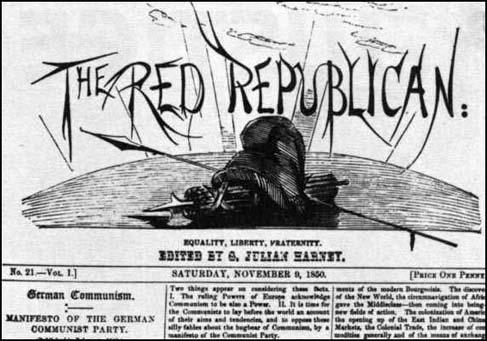
The revolutions of 1848 posed again the issue of monarchy or popular Government across Europe. The left-wing Chartist, George Julian Harney, published in the period around 1850, the Red Republican, in which famously the first English translation of the Communist Manifesto appeared.
Harney set the tone for another left-wing tradition. For a socialist society, the monarchy would have to go, but this was only part of a much wider change in power relations that was required not the key bit of it.
The second half of the nineteenth century saw a combination of the traditions of Cobbett and Harney. Reynolds’s News, the most popular Sunday paper of the period, owned by the Chartist GWM Reynolds, relentlessly attacked the Royal Family and its privilege. The Social Democratic Federation, Britain’s first Marxist party, adopted a similar tone but combined with socialist politics.
Both traditions were subsumed by the rise of the Labour Party which in the main accepted the Royal Family, as a fixed thing, while it got on, or not, with trying to reform capitalism for the better.
As Tony Benn’s Diary noted, Tony Blair attempted to put a new spin on this. 20 years on it will be interesting to see if anything of that has endured.
This post appears in the Morning Star 31st August 2017


Leave a Reply