
Labour & the polls
Owen Jones has written in The Guardian about why Labour is not further ahead in the polls.
His key points are perfectly reasonable ones. Namely that the lead would be higher if more Labour supporting young people actually voted and if a few less people over 60 voted Tory.
Reasonable enough points but as pointed out in a recent Morning Star article there is also an historical dimension (below).
The post attracted a fair bit of critical comment mainly from Corbynphobes who suggested that if someone else was leader (without a beard obviously) then the Labour lead would be of soaraway proportions as it was under, er, Ed Miliband…
I cant obviously be sure what moves the polls but I do think that there is some evidence that there are particular events which change people’s minds on a long-term basis, as Black Wednesday seems to have done in 1992
Blair, Poll Ratings and 1992
Tony Blair, not for the first time, has opined that Labour should be further ahead in the polls from the Tories than they are.
His drift is clear enough. Despite the fact that Jeremy Corbyn won 40% of the vote in a General Election as recently as June, he is not the person to lead Labour to an Election victory in the way that Blair did.
Here he is doing two things. Firstly he is avoiding actual consideration of why the Tories also regularly score around 40% in polls given the political debacle Theresa May is presiding over. Secondly he is deliberately delving in the twilight zone of the 1990s, a period that is not yet quite history.
He is reckoning on people remembering or knowing about his landslide victory of 1997 but with little or no knowledge of the context of the years between 1992- when Kinnock lost to Major- and 1997.
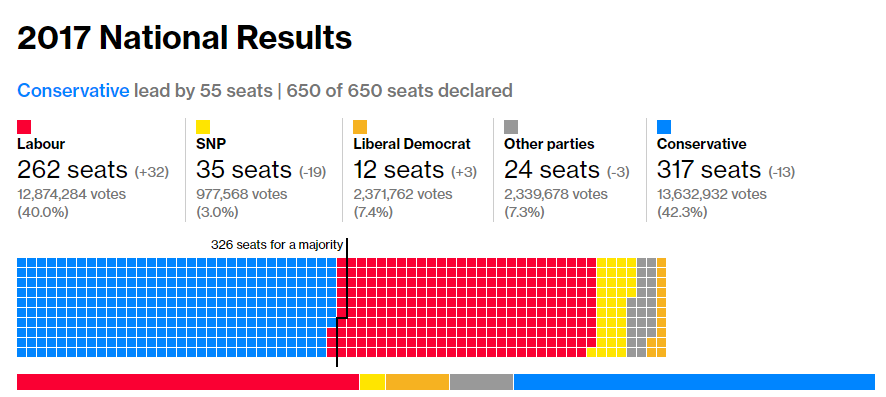
Let’s remind ourselves of the June 2017 General Election result.
Despite predictions that Corbyn was leading Labour to electoral disaster, Labour won 12, 878, 640 votes. Its 40% share of the vote was 9.6% up since the 2015 General Election and one of the best Labour performances since 1945.
The follow-up to this has become the ‘Peak Corbyn’ idea. Namely that Jeremy has done well but in order to beat the Tories a new leader is needed.
This leaves the real question of how the Zombie like Tory administration can poll roughly the same figures as Labour, or certainly why Labour doesn’t have a 10 point plus lead.
Here there are two answers. One current and one relating to the history of the 1992-97 period.
The current issue is that the vote of UKIP has collapsed. It got 12.6% in 2015 and 1.8% in June. A good deal of that (but not all of it) has gone back to the Tories. Secondly the LibDem vote remains very low around 6-7%. Given the virulence of LibDem attacks on Corbyn its safe to say they understand that some of their vote has also gone back to the Tories.
But to fully understand the Tories 40% poll rating we need to look back to 1992.
By 1992 Thatcher had been forced to resign over the Poll Tax debacle and was replaced by John Major. Major, unexpectedly and quite narrowly, beat Labour, led by Neil Kinnock, in a General Election on 9th April 1992. For the few months afterwards the Tories led Labour on average by 5 points in the opinion polls.
Then came Wednesday 16th September 1992, ‘Black Wednesday’. On that day the Tory Government withdrew the pound from the European Exchange Rate Mechanism (ERM). In order to protect the pound Chancellor Lamont raised interest rates from 10% to 12% in the morning, and then up to 15% in the afternoon.
The following day interest rates returned to 10% but the damage was done in terms of electoral standing. Voters with mortgages, perhaps more inclined to vote Tory, had seen the spectre of the cost rising by 50% in a day. If it had happened once clearly it could happen again.
By November 1992 polls were showing ratings of around 30% for the Tories and 50% for Labour. They changed little until the eventual election in 1997. Labour’s lead was nothing to do with Blair, who wasn’t Labour leader in 1992, but with an event so potentially cataclysmic in its impact that it stuck in voter’s minds.
The May Government hasn’t yet managed a similar episode, hence its ratings are holding up. However the potential for it to do something similar to Black Wednesday is massive.


Leave a Reply