
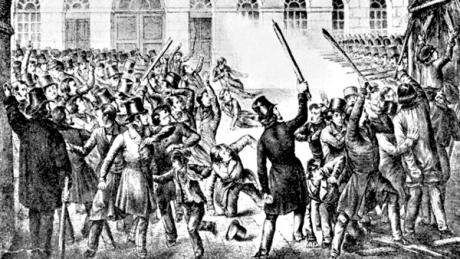
On 6th March 1848 a protest against the new income tax was called by Sir Charles Cochrane was called for Trafalgar Square, then still under construction. The meeting was banned as it was within a mile of Parliament while the House was sitting. However it went ahead with the novelist, and later Chartist leader, GWM Reynolds chairing it. Speeches were made in support of the Charter and of the French Revolution of 25th February.
In the mid-afternoon the police became involved in scuffles with protesters and this led to 3 days of marching, protesting and smashing of windows and gas lamps in central London. I will write more on that but here is a picture said to depict the events of 6th March and a summary of a contemporary account
Keith Flett is the Editor of a History of Riots (CSP)
- The first two pages of a letter from 8 Barbican, London written on March 9th 1848. In the letter is a description of the riots caused by the proposal to introduce Income Tax. The following is an account taken from the internet:
‘The disturbance took took place at Trafalgar Square – then still under construction, with newly laid roads and hoardings around Nelson’s Column. A planned protest against the then relatively novel idea of income tax had been called by Charles Cochrane for Monday 6 March 1848. Under pressure from the police, however, he reluctantly withdrew and made efforts to cancel the open air meeting. London‘s workers were having none of it, and a crowd estimated at 10,000 strong gathered anyway; the journalist and relative newcomer to Chartism GWM Reynolds took the chair. Though observers later commented that barely a man in the crowd would have been liable to pay income tax, the meeting duly condemned it, congratulated the French people on their efforts to overthrow their government, and made clear their support for the People Charter. By 4pm that afternoon, the police were in control of the square. But as they withdrew two hours later, the crowd flocked back in, pulling down the wooden hoardings around Nelson’s Column and arming themselves with granite blocks from the new roads. The fighting continued until late into the evening, with parts of the crowd heading off to smash the windows of the gentlemen’s clubs in Pall Mall , breaking into bread shops to seize loaves and – shortly after midnight – moving into Grosvenor Square. It was 1am before peace was restored, and by 9am the following morning, March 7th 1848, the crowd was back, erecting a barricade in Charing Cross next to the statue of Charles I. All that day and into Wednesday 8 March the fighting continued. On the Monday, there had been just 1,189 police on duty or reserve in London; two days later, there were 2,460. Despite the continuing excitement, the police regained control during the course of the Wednesday and the rioting began to subside. This, however, did little to prevent 700 rioters heading for the City by way of Temple Bar and Fleet Street. After a Chartist meeting on Stepney Green that evening, the crowd once again broke windows in the City and along Regent Street . This, however, was to be the end of the tumult for now’.
The letter offered here, dated March 9th (Thursday) 1848, is an extremely rare survivor written during the time of the Income Tax riots and the only one we have seen or indeed can trace. When we obtained it, there was a note saying that the letter was from a H Bliss to his uncle W Bliss of Chipping Norton but the two pages of the letter are all that remains.
The descriptions in the letter very much reflect those in the article but are in parts more detailed.
An interesting comment by the writer: ‘They are also commencing to follow our example in GLASGOW and GERMANY’.


Leave a Reply