
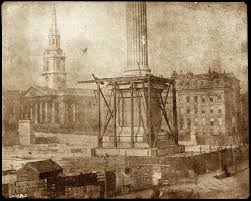
Trafalgar Square was still under construction in March 1848
On 6 March Charles Cochrane called a rally in Trafalgar Square against income tax. The square was not yet completed but Cochrane’s call elicited the first ever police ban of a demonstration at the venue. The first ever traditional response followed on as Cochrane withdrew but maverick Chartist, journalist and best selling novelist GWM Reynolds stepped in to chair it.
A sketch from 6 March shows the square packed with protesters and in the foreground police officers grappling with them. A Chartist rally of around 10,000 was about to dissolve peacefully when, the Northern Star reported, some provocative remarks by an anti-Chartist bystander caused a scuffle.
Matters would probably have gone no further than that were it not for the fact that the police made an ill timed intervention into what was after all a banned protest. By 6pm police reinforcements had gained control of the square and withdrew. At that point the crowd that had been dispersed into surrounding streets returned. Again, in what was probably a first, the crowd took down wooden hoardings from around Nelson’s Column and proceeded to use them to defend themselves.
During the evening of 6 March a group broke away from the crowd at the square and, raising the cry “To the palace”, headed towards Buckingham Palace, smashing windows and gas lamps as they went.
There was a second day of rioting on 7 March from as early as 9am, and disturbances in the Trafalgar Square area and the West End of London continued for a week. Goodway reports that by 8 March well over 2,000 police officers were deployed to contain the rioters. That day there were further marches and window smashing in central London including plate glass windows in Swan and Edgar’s shop in Regent Street and other establishments.
After this the disturbances melted away as suddenly as they had arisen. They were clearly partly politically influenced by Chartist and other radical demands, but the fact that on occasion bakers were forced to hand out bread suggests other more immediately material demands were also at work. Goodway’s summary of the 127 arrested during the week of riots shows that 61 were less than 20 years old.
Extract from Keith Flett I Love the Sound of Breaking Glass, Internationalism Socialism 130
I love the sound of breaking glass: the London crowd, 1760-2010
A summary of those arrested in central London 6-8th March 1848
Under 16 7 people
16-19 54 people
20-29 55 people
30+ 11 people
Source David Goodway, London Chartism, from MEPO 2/64


[…] https://kmflett.wordpress.com/2018/03/10/the-start-of-the-british-1848-6-8th-march-central-london/ […]