
The importance of Blackfriars Bridge for the Chartists and the Government on Monday 10th April 1848
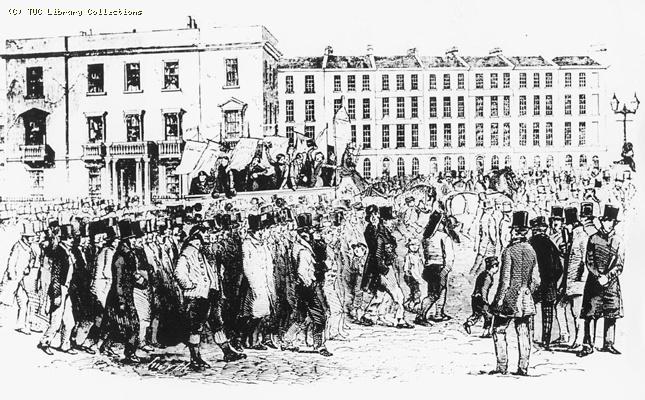
Blackfriars Bridge 10th April 1848
Why was Blackfriars Bridge such a focus before and after the Chartist rally at Kennington Common on 10th April 1848?
Firstly of the four main meeting places for the rally only one, Peckham, was south the river. The others, Stepney, Clerkenwell Green and Russell Square were north. That meant that a bridge had to be crossed, but which one?
Waterloo and Hungerford bridges were at that time subject to a toll and therefore out of bounds. Westminster was not but it was not only the most heavily guarded but also the bridge more likely to have been used after the rally if the plan to march with the petition to Parliament had been carried through.
After the rally, as indicated in the report below, there were considerable struggles at Blackfriars Bridge. Some may have been planning to march on Parliament, most however were probably simply planning to return home.
The story associated with press coverage on or just after the day that heavy rain showers in the afternoon dispersed people is not mentioned here. I will post further on the weather on 10th April 1848.
The decision to meet south of the river was discussed in the days immediately after 10th April at the Chartist National Assembly in London (a gathering of 49 delegates the maximum allowed by law). Ernest Jones who was to become the post-1848 leader of left-Chartism argued that the decision to meet in South London had been a mistake because of the issue of crossing the bridges. Yet it remains unclear where else the Chartists could have met, given the size of the rally, within reasonable marching distance of Parliament given that the Royal Parks were all out of bounds to them.
BLACKFRIARS. (report from the Illustrated London News)
“Part of the procession sketched at Blackfriars Bridge”, from the Illustrated London News of 15 April 1848.
The bridges were the chief points of defence, of which Blackfriars-bridge appeared to be a sort of centre, as it had the strongest force. The proceedings in its neighbourhood were nearly as follows:- By ten o’clock a considerable crowd had collected in Farringdon-street and New Bridge-street, and at the point where Fleet-street and Ludgate-hill join this line of street. The stable-yard of the Rose Inn, in Farringdon-street, had previously been occupied by a body of cavalry. Special constables were also mustered in great force by the authorities of the ward, but kept out of sight. Soon after ten the crowd assumed a “processional” shape, and by half-past ten began to pass over the bridge. Men who had been talking together in groups joined arm-in-arm, and the march commenced. From half-past ten till half-past eleven one continuous stream of people crossed the bridge – the pavement on the east side being occupied by the more systematic procession, and the roadway being thronged by a closely-packed body. At the latter hour vans, decorated with flags, and containing some of the leaders of the “demonstration,” made their appearance, and passed on without any appearance of confusion. With the exception of a few closed shops, there were, in this locality, no signs of alarm, and no symptoms of disorder.
After the meeting on Kennington-common had dispersed, an immense crowd on their return straggled irregularly along Blackfriars-road. Upon arriving at Stamford-street, they of course came face to face with the mounted police, who refused them passage, and ranged themselves across the road. Together with these were the police and special constables. Many strenuous attempts were made by the Chartists to get across the bridge. As fresh numbers arrived from Kennington-common, those in advance were pushed forward, but were immediately driven back by the horse-patrol without drawing their sabres. The metropolitan police made use of their staves, and, from time to time, repulsed the crowd, which grew thicker and thicker every minute. In about an hour and a half, however, the mob, which, by this time, reached as far down as Rowland Hill’s Chapel, made many vigorous attempts to force their way through; and, notwithstanding the cool steady courage of the police, the latter were, at intervals, separated. The special constables at these times were very roughly handled, a great many of them having their hats broken and being deprived of their staves. Showers of large stones were every few minutes thrown on the bridge, and the police received many severe blows, but gave more than equivalent in return with their batons. A great number of men who were seized by the police for throwing stones were rescued, and the yells and shouts were deafening. At half-past three o’clock the pressure of the concourse was so great that the line of police was forced, and a great many of them carried with the throng over the bridge, holding their staves up as they were borne along. On the City side of the bridge a great many arrests were made, and the mob, which seemed inclined for a minute to make a stand, were uniformly repulsed by the horse patrol, the sight of whose drawn sabres, wielded over the heads of the mob, soon put the more noisy and impudent to flight. Both on that and the other side of the bridge there were numbers of men with their heads bleeding, who were led away by their friends.


[…] https://kmflett.wordpress.com/2018/04/10/10th-april-1848-the-importance-of-blackfriars-bridge-for-th… […]