
Why Alan Rusbridger is right & Daniel Finkelstein is wrong on the importance of Peterloo
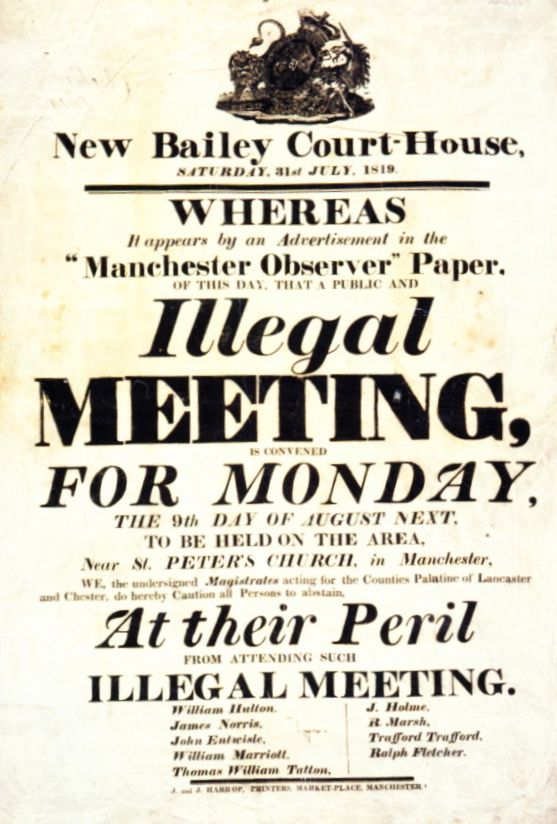
On, more or less, the 199th anniversary of Peterloo Danny Finkelstein has written about its importance in The Times. He was querying whether his son had been taught about it at school, which indeed he had, following the suggestion by Mike Leigh that many had not heard of Peterloo. Recent correspondence in The Guardian has also confirmed that many were taught about it, as I was myself. However that is rather different, as Finkelstein notes, from making it an essential part of the school history curriculum because it was (or was not) one of the events that made modern Britain.
Finkelstein does not in anyway underplay the significance of what took place in central Manchester on that August Monday in 1819. He does however suggest that it was a one-off with no further real significance.
Here I think he is wrong but fortunately former Editor of the Guardian Alan Rusbridger has already made the point, correctly, in my view, quoting EP Thompson. Thompson wrote about the importance of Peterloo in the Making of the English Working Class and was a robust pursuer of those who sought to downplay or revise what had happened.
The political repression of the Six Acts which followed Peterloo meant it was unlikely the event would or could be repeated. However when it came to 1832, and the first changes in the electoral system that led to Britain’s modern democracy, the Great Reform Act, the Government conceded the change rather than face down protesters. They did so again with the Second Reform Act in 1867 when the Army were called to deal with reform protesters in Hyde Park but did not act. Rather the Home Secretary resigned and further reform was carried.
That surely is why Peterloo deserves a place as core British history. It made the point that democratic protest needs to be dealt with democratically not by the armed force of the State.
——————————————————————————————————————————–
Daniel Finkelstein, The Times 21st August 2018 (extract)
Peterloo was a tragedy, an outrage and an emblem of the repressive conservative obstinacy of a privileged elite. What it was not, was a turning point in British history. You can argue that it should have been, or that you wish it was. But it wasn’t.
THE TIMES AND THE TRUTH ABOUT PETERLOO The Times August 23rd 2018
Sir, Daniel Finkelstein is dismissive of the argument that Peterloo was a turning point in British history. That was not the view of the great historian E P Thompson, who wrote in 1963: “Never since Peterloo has authority dared to use equal force against a peaceful British crowd.”
That the state in general dared not violently put down peaceful protest in this country after Peterloo was partly due to the press in general, and The Times in particular. “Peterloo,” wrote Haslam Mills in his centenary history of The Manchester Guardian in 1921, “is the debut of the reporter in English public life.” The Times’s own reporter at the event, John Tyas, ended up in jail that night. A Manchester businessman, John Edward Taylor, realised the authorities were likely to publish fake news about what had happened and wrote a full account of events, which he sent by night coach to The Times. The truth appeared in print within 48 hours of the massacre and, says Mills, was “never overtaken by the official version”.
Reading The Times’s extensive coverage over subsequent days, one is struck by admiration for the determination of the Times editor, Thomas Barnes, to establish the truth in the face of what might today be termed “alternative facts”. Taylor, too, saw the necessity of placing on record “facts, undeniable and decisive . . . truths which are impossible to gainsay”. The events of August 16, 1819, led him to found The Manchester Guardian 18 months later.
Peterloo is as telling an illustration as any of why good journalism is necessary. That seems to me an important thing to remember — and to celebrate.
Alan Rusbridger
Principal, Lady Margaret Hall, Oxford


[…] https://kmflett.wordpress.com/2018/08/24/why-alan-rusbridger-is-right-daniel-finkelstein-is-wrong-on… […]