
Cheese, radicalism & the cheesemongers who rode with the Yeomanry at Peterloo
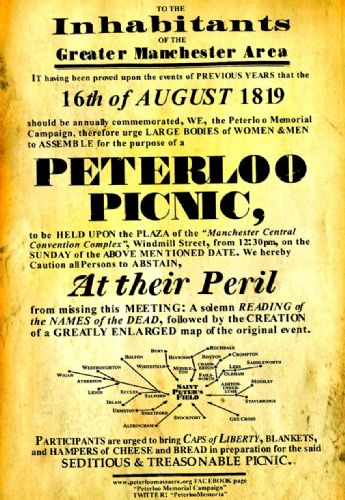
I’ve been pondering this subject for a while but it remains work in progress.
Of the tradesmen who rode with the Yeomanry at Peterloo there were two cheesemongers listed:
Joseph Anthony 32 Deansgate (also special constable)
Heyward St Mary’s Gate
Why they rode on that August Monday (16th August 1819) I still don’t know. Manchester by 1819 was the centre of a significant regional cheese market but why a cheesemonger should so dislike their potential customers as to participate in an attempt to cut them down with sabres is less clear.
We can say that cheese was an important part of early nineteenth-century proletarian culture.
Samuel Bamford in his Passages From the Life of a Radical for example noted:
‘a decent wedge of cheese with bread to it and a quart of ale’ (while held prisoner before Peterloo)
‘oat cake cheese and ale.. our ale was eight-penny and of prime tap’
Meanwhile EP Thompson in the Making of the English Working Class reported that:
The southern rural labourer refused to abandon his diet of bread and cheese
While a term of abuse in the North-West of England from a Macclesfield radical was that their opponent might be a ‘borough-monger, whore-monger or cheese-monger’
Wiiliam Cobbett amongst other things a chronicler of rural life around the time of Peterloo noted in his Rural Rides that;
‘before we got to Petersfield we called at an old friend’s and got some bread and cheese and small beer which we preferred to strong’.
So we can see that cheese was central to working class diets and culture around the time of Peterloo. Engels in his The Condition of the Working Class (1844) makes reference to bacon and cheese for dinner if things were going well for a family. If not the meal might be old cheese, soup and bread. Old Cheese was acceptable according to Engels because even if it couldn’t be eaten directly it could be grilled or heated and consumed melted
What the motivated the cheesemongers to ride with the Yeomanry we still don’t know. It may be that they sold a relatively expensive food item that nevertheless was seen as essential to working-class diets and in that equation class tensions arose.
The food riots over the price and quality of food that formed the core of E P Thompson’s concept of an eighteenth century moral economy (riots were few, it was the threat of them that produced results) were most frequently over bread or the wheat to make bread with. Whether cheese ever formed part of the direct action that the crowd took requires further research…


Leave a Reply