
The importance of speaking out against racism and fascism. Unity on 17th November
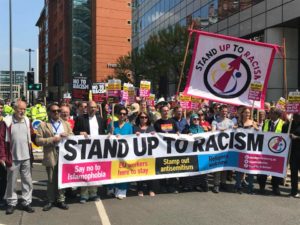
The official political year is set to re-start from what traditionally was a summer break with Parliament in recess. I’m not sure that the political break applies anymore but at its beginning I caught Jeremy Corbyn and others speaking in Tottenham on the need to fight racism and fascism.
All kinds of talk about Corbyn being a ‘racist’ can be found in the mainstream media and it is in my view dangerous talk. Actual Nazis are marching again in Germany in numbers, and in Britain the release of Yaxley-Lennon (perhaps temporarily) from jail has given confidence to a resurgent far right.
Hence we find the far-right and fascist attack on the Bookmarks, the TUC’s bookseller, in early August and every weekend racists, fascists and Islamophobes of various sorts are mobilising in places around the country (always opposed of course).
Corbyn’s record is not just to verbally oppose racists and fascists but also one of activity. He was one of the key organisers of a pivotal event in April 1977 in North London that helped to turn-back the rise of the fascist National Front.
I’m posting details of this and the late July event again because the more people that can get beyond the bluster and understand that, like Corbyn or not, there is a really serious job to turn back a rising tide of racism and fascism the better and that effort needs to be a united one, beyond factional sniping.
There is a national unity demonstration in November:
____________________________________________________________________________
At an event to mark the re-launch of the Marcus Garvey public library on 27th July 2018 Jeremy Corbyn MP was one of a number of speakers including Tottenham MP David Lammy and the widow of the late Bernie Grant MP, Sharon Grant.
The event was primarily about how the Friends of the Library had managed to save it from a mindset of austerity and cuts and now launch what is hopefully a bright future for it.
My late father was Chief Librarian at the old Tottenham library a few minutes walk from Marcus Garvey (now flats). I was interested to learn from David Lammy that he had spent time studying in that Library as a young man.
The origins of the Marcus Garvey library were touched on, and here Jeremy Corbyn recalled his time as a Labour Councillor, chair of the planning committee, working with another young Councillor Bernie Grant to get the Marcus Garvey project underway.
Corbyn underlined how important it was to have a library named Marcus Garvey in Tottenham and the significance also of recalling the fight against racism and fascism in the area that underwrites this. In doing so he pointed specifically to the 1977 Battle of Wood Green, the details of which are below
It’s a summary of events that actually took place and which I personally was at:
On 23rd April 1977 the National Front decided to march from Ducketts Common by Turnpike Lane tube in North London down a busy London High Road packed with Saturday afternoon shoppers. There were several thousand fascists but they were outnumbered by opponents, including many people out shopping, appalled that fascists were marching, quite deliberately, close to the anniversary of Hitler’s birthday.
The National Front were an avowedly anti-Semitic party the direct descendants of Mosley’s British Union of Fascists.
It would be bad enough now but this was a mere three decades after the end of the Second World War and numbers who had been actively involved in fighting Hitler were no doubt around on that Spring day.
In reality only a small part of the NF march made it to a concluding rally as it was broken by protesters.
40 years on 23rd April 2017 that day was marked with a festival to celebrate diversity and oppose racism on the very same Ducketts Common. The fascists never returned in any numbers to the Borough, but the fight against racism always needs to be maintained in each generation.
One of the keynote speakers on 23rd April was Labour leader Jeremy Corbyn. It was of course the kind of event that one might expect he would attend, but it is little bit more specific than that.
In 1977, before he became the long serving MP for Islington North, Corbyn was a trade union official and Labour Councillor in Haringey for the area adjacent to Ducketts Common. He is still remembered for the hard work he did then.
Part of that was to act as the co-ordinator for all of the local Haringey Councillors, including Tories on 23rd April.
The Councillors had called for the National Front march to be banned, recognising the provocation it was designed to be. The police had declined. On the day all of the Councillors assembled on Ducketts Common, before the fascists marched, holding a giant banner making clear they stood firm against racism.
But there was another group of people, anti-fascists, trade-unionists, socialists, who were determined that the National Front would not march. The main aim was simply to stop them by force of numbers but some physical engagement with the fascists was envisaged.
Using his influence Jeremy Corbyn was able to act as the spokesperson for both groups of people, presenting in effect a unified protest against the NF. Indeed the following week he was quoted in the local Hornsey Journal paper in just this role.
That day was one of the occasions that led to the formation of the Anti-Nazi League and the first huge Carnival in conjunction with Rock Against Racism at Victoria Park in May 1978.
Corbyn’s role in some of the events that led to the birth of the anti-racist and anti-fascist movement that did much to stop the National Front from becoming, as it threated to in the late 1970s, a major political force, should not be forgotten.
Given that it is not unknown for labour movement leaders to develop hazy memories of how they came to be leaders in the first place, it’s also good that the current Labour leader has not forgotten those days either and indeed on the evidence of that Friday night in July is happy to continue to refer to them.


Leave a Reply