
The 1977 Bullock Report, Industrial Democracy & John McDonnell
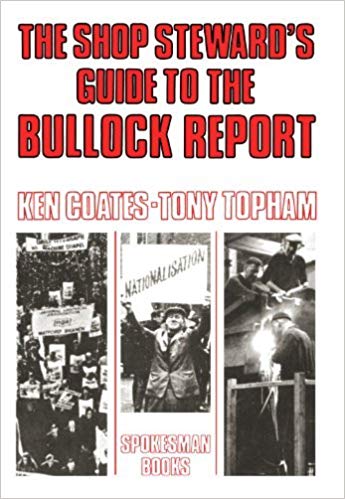
Shadow Chancellor John McDonnell has made a number of important announcements at the 2018 Labour Party Conference on the subject of industry. He has said that Labour will give workers in the private sector shares in their business, limited to £500 personally, the remainder to be used to invest in public services. He has also argued that there should be workers on company boards.
Given the unfortunate decline in trade union influence (by no means irreversible) and the power of the large private sector companies like Amazon and Google, McDonnell’s policies if radical by recent standards are also modest.
However having recently called for more histories of the present:
https://kmflett.wordpress.com/2018/09/20/lehmans-10-years-on-writing-histories-of-the-present/
it would be remiss of me not to offer some context.
Readers of a certain age may recall names such as Michael Barratt Brown, Ken Coates, Stuart Holland and indeed the Institute For Workers Control who agitated for a more democratic industrial set-up, where workers and unions had more influence in the 1960s and 1970s.
Indeed the 1974-79 Labour Government set up a National Enterprise Board, promoted partnerships and planning in industry and sponsored the 1977 Bullock Report on industrial democracy:
https://en.wikipedia.org/wiki/Report_of_the_committee_of_inquiry_on_industrial_democracy
Not all of it worked and it certainly didn’t bring about socialism but it was a template that offered perhaps a way forward,although there were certainly other ways as critics noted at the time.
While the Tories briefly styled themselves the ‘workers party’ and Theresa May talked about industrial democracy of course nothing has happened.
However there are some outposts of the 1970s period still around. As a manager in one of the UK’s largest private sector companies I have been collecting (free) shares since the mid-1980s and now have quite a shareholding. Occasionally I have pitched up as a shareholder at the AGM of the Company and asked a question. The answer is invariably, ‘thank you Mr Flett, we are aware of the trade union view’.
That is the point surely. As a trade union officer I cant recall any of the managers and professionals I represent suggesting that the way to challenge decisions of the Company is to act as a shareholder. They rightly seek trade union influence.
So would workers be on the board work? It might work but care is needed. Firstly simply asking trade union board members to back ‘difficult’ decisions (job cuts) is not a way forward. In reality for the idea to work on any level more is needed. Namely measures that the 1997 Labour Government said it was going to look at but didn’t. That means widening the legal scope of Company Boards beyond a duty to make profit for shareholders and providing a duty to look at impact of their actions on jobs and the wider community. It also means narrowing definitions of what information is held to be commercially confidential or shareprice sensitive which currently mean that even if workers were to sit on boards they couldn’t say much about what was discussed let along do anything about it.
Socialism or workers control it is not. It would be a modest re-balancing of a worker-employee playing field that has been tilted a long way, one way, since Thatcher came to office.
Keith Flett is a socialist historian and trade union officer in the private sector based in the City of London


Being of a certain age, it’s good to see Coates and Topham come round again! The reasons why Bullock failed are quite clear, but – with a fair degree of hindsight – Bullock offered the opportunity for the introduction of a German-style codetermination system which wouldn’t have prevented TU action on issues of direct importance to workers (as you rightly point out) but might have offered a path to a degree of influence which a TU movement at the end of the 1970s might have considered a good way forward given the relatively strong position of power it held at that point. A Labour Director (though there would need to be two…) would offer a degree of insight, although a large amount of training (for all board members) would be required. Mind you, being a Labour Director is also a thankless and frequently soul-less task for committed trade unionists.
We do have some experience of worker directors in the Post Office and British Steel and, although it is not a happy one, someone needs to review the lessons that arose from these. Both ideology and practicalities have a role to play in that sort of review, too.
Entirely agree. Lessons of those worker Directors of the late 1970s would repay a critical review 40 years on
I know Eric Batstone did a decent job in the early 80s (?) on the PO scheme and some of that material at least in raw form may well be available next time you take a trip Sarf.