
From Peterloo to the Anti-Corn Law League and a People’s Vote
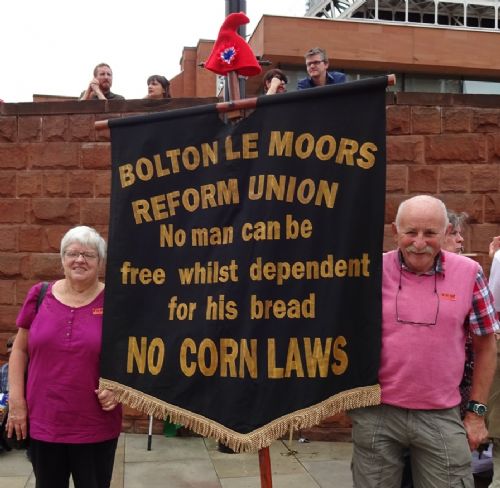
The demand for cheaper bread was raised at Peterloo but there can be few that think that this was the fundamental reason why thousands gathered in central Manchester on the August Monday in 1819. Bread was a staple of the working-class diet (as it still is in some areas of the world) and its cost was a symbol of wider system of oppression in which change was demanded. The change was around democracy and the vote.
Yet while Chartism was the main successor to the democratic demands of Peterloo there was another, the Anti-Corn Law League, founded and based in Manchester. Well know ACLL activists had been at Peterloo so they could reasonably claim a connection. The ACLL also had some branches of ‘operatives’- workers. Yet it was primarily an organisation of industrialists, well-funded and effective. So effective indeed that it won the battle to repeal the Corn Laws (taxes on imported wheat) splitting the Tory Party in the process.
Cheaper bread certainly followed on but so did something else- reductions in wages as employers reasoned that workers could now live more cheaply and so required less pay. That arguably was the bottom line of what the ACLL were after.
To underline their connection to Peterloo they constructed the Free Trade Hall on the site of St Petersfield. It’s now a Radisson hotel but the façade still stands.
What is the connection with a People’s Vote and indeed the march for it in London on 20th October?
I voted ‘remain’ in the EU Referendum, not because I have any regard for the neo-liberal institutions of the EU (or the UK for that matter) but because it was obvious that a ‘leave’ vote was and would continue to stir up racism and reaction. Of course the argument on the left (some of it) was that a leave vote would create such a crisis in ruling class politics that it would lead to a Labour Government. The first bit of the statement has been proven correct, the second part, remains a possibility.
The connection with Peterloo and the ACLL is that people no more voted to leave because they wanted to ‘take back control’ than people at Peterloo just wanted cheap bread. Many voted leave because they were fed up with the impact of the austerity politics with which those who advocated remain were most closely identified.
Having a People’s Vote on whatever terms, if any, the Government comes up with for Brexit is a principle I agree with and hopefully trade unions on the march will make the point. If you vote for something to happen you expect to get a say on whether the eventual outcome is good enough. If not the negotiators are sent back to try again.
If on the other hand you say, as some on the London demo clearly do, that there should never have been a negotiation in the first place and that those who voted for it need to vote again then what is really required is not a ‘second Referendum’ but a General Election to change the political landscape.
The fundamental point is that narrowing the issue of Brexit as to whether or not people voted the ‘right’ way serves an agenda of those (the few) who have existed quite comfortably despite austerity. For those who haven’t , as with those who protested at Peterloo, a wider change is required that addresses not just Brexit but austerity.


Leave a Reply