
Once Again on the size of protests: the People’s Vote march 20th October
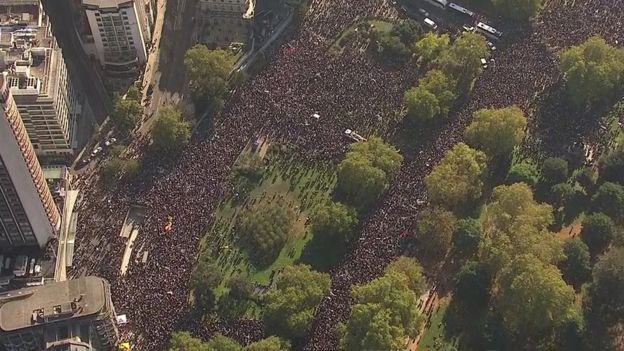
BBC. 20th October 2018. Marchers assembling
As an historian I have a professional interest in the size of crowds that goes back to work on the Chartist demonstration for the vote on Kennington Common on Monday 10th April 1848. It was the first to be captured photographically and the first where the size was deliberately underplayed by the media and the authorities. It was agreed in advance to report 20,000 had attended and that was duly done. The actual attendance was upwards of 150,000 although certainly not the 500,000 claimed by Chartist leader Feargus O’Connor.
As an activist as well as an historian I also go on marches. I was on the Stop the War march in 2003 and indeed one of the (many) organisers. That was well over a million and so large that two departure points were required. It was said, I think broadly accurately (although there is always scope for research) that anywhere certainly in England and Wales if someone had not been on the march themselves they would have known a friend or work colleague who was.
I was not of course on the Countryside Alliance march in 2002 which apparently had 400,000 people on it but I think it fair to say that the number was impressive because not that many would have come from London. Indeed there is still no Tottenham hunt to this day.
Traditionally the police underestimated the size of protests and organisers overestimated (see the Chartists above). The police have given up estimating size probably because they no longer have the resource to do it. In addition it is a fiendishly difficult job. Not everyone who starts a march finishes it (some go the pub etc) while not everyone at the finish will have marched the whole way.
Any really large protest in London (but see the Countryside Alliance above) draws most of its support from London. There is a limit about how many people coaches and trains can bring into the Capital on a weekend. The People’s Vote twitter account (which has tweets from some of the people I have the least regard for in politics and some who are much better) notes that ‘100s’ of coaches brought people from outside London to the march. Assuming they were full (50 seats) that might account for 10,000 people. Trains will have brought more but this still leaves the bulk of the 750,000 (the organisers estimate seems to have finally been 570,000)) making it from around London.
As with Kennington Common in 1848 disputes arise about precise numbers attending. It clearly was a very large march. One social media comment suggested that the most Parliament Square (the end point for the march) could accommodate at any time would be around 220,000 people. Quite possibly, but they would not of course have all been there at the same time. Marches are about people moving not remaining static (that’s a rally). That said for the maximum photographic impact of such a march the end point of Hyde Park would have worked better. The route is however a matter for the organisers and the police depending on a number of variable contingencies.
One person commented on social media that the turn-out was a million. See Feargus O’Connor above.
Given that the biggest Remain votes were in London (Tottenham voted 76% remain as did I) I think its fair to say that the protest underlines that the Capital remains ‘remain’. I’m not sure it tells us that much about the rest of the country. Arguably there would need to have been rather more than ‘100s’ of coaches from outside London for such a large march to underline that. I will be keeping a close eye on reports to see if there is evidence of larger out of London attendance. It would be interesting for example to know how many coaches came from Manchester, Leeds, Norwich etc etc.
Checking media reports (mainly from the pro-Remain Guardian/Observer) and social media its clear that numbers on the march had rarely or never marched before, always a sign of a large march. Evidence of significant out of London attendance remains (so far) limited. Clearly individuals and small groups from all over the country were present but that doesnt make that much demonstrating weight in a crowd of three quarters of a million or so. Thanks to Christine Howell who tweeted me that 5, 50 seater coaches had come from Stratford Upon Avon and Warwick.
We do know that elsewhere in the UK Farage addressed a gathering of 1200 leavers today. While even the broad nature of the People’s Vote march certainly did not represent all those who voted remain, Farage appears to represent only a small fraction of leavers. An alternative register might suggest that there is serious engagement around the politics of austerity and a General Election to be pursued here.
A note also of caution. The impact of marches often takes a good while to play out. The 2003 anti-Iraq War march that one of those involved in today’s march Alastair Campbell ignored at the time is still working its away through political culture.
I wasn’t able to be in London today but if I was I’d have been at the Stand Up to Racism conference looking at how to organise against a rising racist tide which is both partly a result of Brexit but also happening across the EU itself because of austerity politics. Credit to my MP David Lammy who both opened the Stand Up to Racism conference with a rousing speech but also went on the People’s Vote march. Just now we need unity against the racist right and neo-liberals. That is my personal view though not my historical judgement.
Update 21st October
A few points picked up from useful discussions on social media:
1 The above is not trying to argue that the march was entirely made up of Londoners and therefore unrepresentative. It is trying to discover how large the non-London presence was and therefore what the impact of the march across the UK might be.
2 It is difficult to grasp how many came from out of London. The point has been made that numbers came by train or by commercial coach. The usual benchmark however is hired coaches since demonstrations are organised things and those attending often like to travel in groups
3 Several comments noted that some who attended on 20th October had been on protests before but often not for a while. This is an indication of the reach of the march- attracting those who might usually be aware of a protest but not actually go


I haven’t marched since Glasgow Stop the Poll Tax in the 80’s. I marched beside a lady who hadn’t marched since Greenham Common.
The inverted commas and false equivalence Harrogate -London protests
Not entirely sure what point you are tryimg to make but the comment is up for any responses
Typo – you can delete ! I lost the end !
Ok. Thanks
…in the BBC report were inexcusable.
It must be hard to estimate the number because it’s not all that well defined. Some people would have marched only some of the way, others would have joined after it started, etc. While the main body could have contained 600,000 at any one time, there could easily have been many more people involved over the whole day.
For the record, I wasn’t there. I was here in Ireland.
Last year’s Anti-Brexit march we had 2x coaches from Norwich.
On Saturday we had 5.
Similar anecdotal stories from friends in the Midlands (3 last year, 6 on Saturday) told me that it was at least 2x as big.
I can easily believe it was at *least* 300,000 as a result. Then when we finally made it to Whitehall (because Parliament Square was full & it was backing up), we had other friends who were *still* at the start at Hyde Park Corner.
Given that I can easily see how it was nearer the half a million mark.
The Brexiters will of course try to talk it down and rationalise (- I’ve seen comments saying Parl. Sq can only hold 20,000), but when you’re there and seeing it, you know the truth.
I travelled from France to be in the march. The the3million and British-In-Europe assembled at Speakers Corner at 11 am before joining the main body of marchers. We were certainly many hundreds.
To assist in estimates for the 23 March 2019 march I was told that 6 coaches came from Leeds arranged by Leeds for Europe. They said that the University had arranged two more, and that they were aware of 19 in West Yorkshire. The Leeds coaches had people from Bradford and the surrounding area also.
I would guess from discussions with people in nearby seats that about a fifth of them knew people travelling independently, most making a long weekend trip to London (I asked about 29 people so it is obviously to small to extrapolate an actual number from, but indicates that there were a number who did not use coaches)