
The size of the crowd: how marching has made a difference
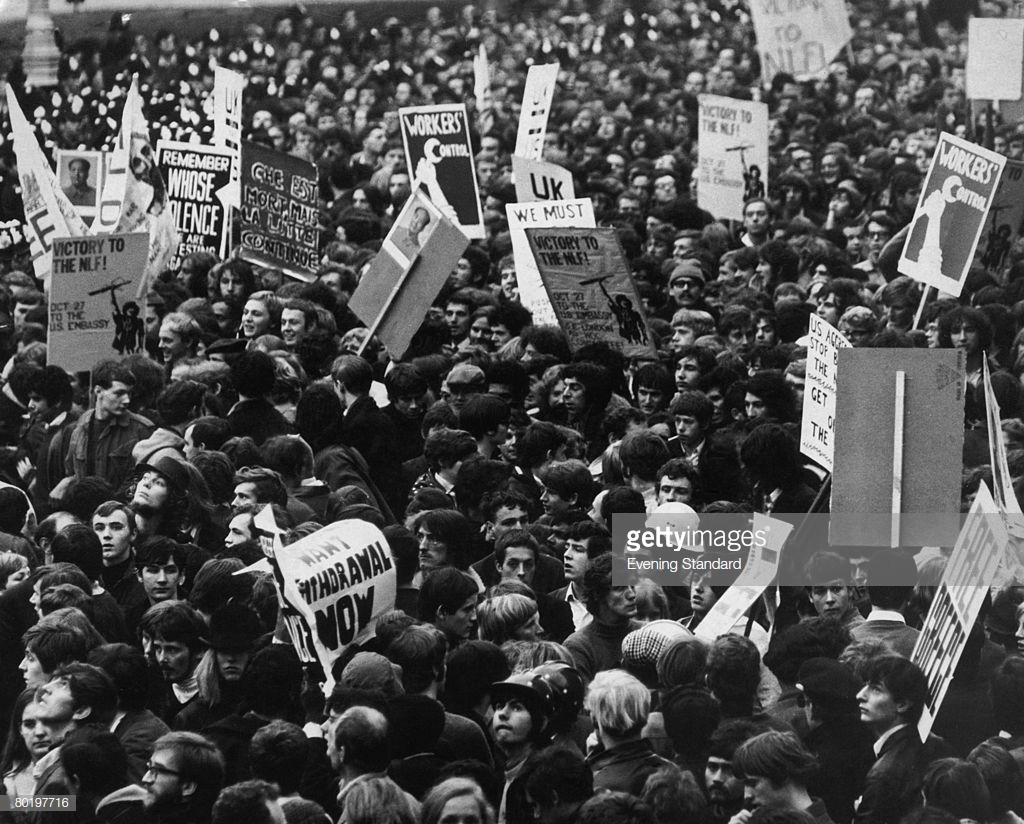
A demonstration in Grosvenor Square against the Vietnam War, 27th October 1968. (Photo by Evening Standard/Hulton Archive/Getty Images)
On Saturday 20th October as many as 700,000 people marched in central London on the issue of Brexit. The march was headlined on being around a People’s Vote on the terms of Brexit but it’s clear that numbers of participants including LibDems and hard-line anti-Brexit New Labour supporters simply wanted another Referendum so that people who voted the ‘wrong’ way last time can have another ago. That doesn’t strike me as being either liberal or democratic but the march also raised some wider points.
The size even prompted the BBC News website to a rare moment of historical reflection on how big the march was compared to previous ones.
It didn’t say so but there is a fundamental point. All the largest marches in British history have taken place in the last 50 years.
The original benchmark was the anti-Vietnam War march to Hyde Park (and the US Embassy) on Sunday 27th October 1968. That gathered an estimated 100,000 people (the police claimed 25,000). That would be a sizeable march in 2018 but nothing too much out of the ordinary. At the time it was certainly the largest post-1945 march in London.
The biggest ever march so far in British history was that against the Iraq War on 15th February 2003. Up to 2 million marched on that day, requiring the march to have two distinct assembly points.
Given the population of London, particularly if the weather is good, or at least not wet, a large march can be assembled consisting largely of participants from the Capital and environs. I suspect that was true of the People’s Vote march. Numbers did come from outside London but given that most of the large ‘remain’ votes were in London Boroughs there is nothing surprising about it.
2003 by contrast was drawn from across the UK and it was said that if someone had not been on the march themselves they were certain to know either a friend or workmate who had been.
The wider issues raised here are important ones for the left and they are threefold. Firstly how is the size of a protest worked out? Secondly how important is its composition? Thirdly and most importantly why are turn-outs on protests rising?
We can’t really say how many were at Peterloo in 1819 but the Chartist demonstration in Kennington on 10th April 1848 was photographed and historians are still debating exactly how many were there (almost entirely from London). The authorities pushed a figure of 20,000 but the Times reporter privately thought it was about 10 times that many.
Such disputes on how big a protest is continue, so perhaps the question of composition is equally important. The Chartist protest in 1848 was entirely made up of working men and women and they didn’t stop campaigning for democracy, many still being active when the 1867 Reform Act was passed.
Much more recently the Countryside Alliance put around 400,000 on the streets of London in defence of fox hunting. A very different kind of crowd. The official impact was limited but who can doubt that it helped organise rural resistance to the ban on hunting.
The final issue is why the size of protests in general is now much larger.
This surely represents a change in the way that people understand politics and change. They no longer rely just on voting for a Councillor or an MP to represent them and do things for them (or not). Rather there is an understanding that to get change you have to organise and do it yourself from below. That is the real impact large protests have had.
An earlier version of this post appeared in the Morning Star


[…] https://kmflett.wordpress.com/2018/11/19/the-size-of-the-crowd-how-marching-has-made-a-difference/ […]