
How broad is your demonstration?
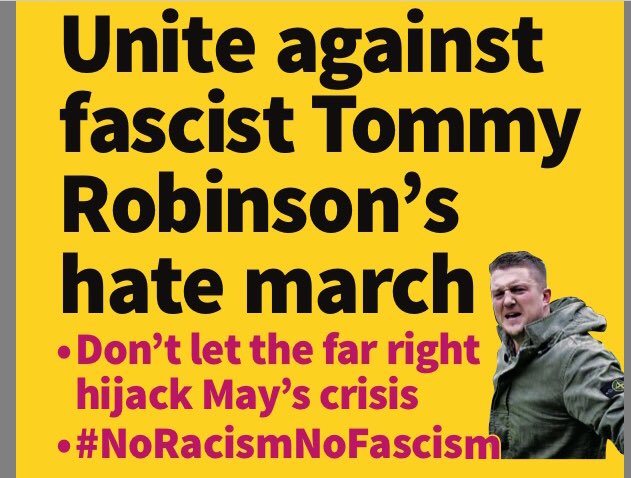
This is the second of three posts on the nature of demonstrations. The first covered size and the third will cover repertoires of protest. Hopefully the demonstration against fascist Yaxley Lennon and his new special friend Batten on Sunday 9th December (Portland Place 11am) will combine size with breadth
The size of the recent People’s Vote demonstration was disputed but it was certainly several hundreds of thousands strong. There were however very few trade union or political party banners to be seen. A social media joke suggested it could be compared to a giant queue at a Waitrose supermarket.
That was both inaccurate and unkind but like all effective jokes it had just enough of reality about it to hit home. Probably the march did raise the profile of a ‘People’s Vote’ on Brexit but I doubt few took anything from that beyond it was a large gathering of people who had originally voted remain.
A few weeks later on November 17th an anti-racist unity march took place in central London backed by Stand Up to Racism, Love Music Hate Racism and with the support of the TUC. It was nowhere near as big as the People’s Vote march. Estimates varied from 30,000-40,000. However there is a case for thinking that due to the composition of those marching the impact may be rather greater and deeper.
I was on the protests against the National Front in the 1970s and the BNP in the 1980s and after and I recognised numbers of fellow activists on the march who had also been there. Part of the point of the day was to bring together veterans of that period, which had seen unity to push back fascists, to underline that whatever differences there were 40 years on, the need to come together to stop racists and fascists was not one.
But if the march was simply a gathering of people in their 60s and 70s it would of course have made a point but would have been unlikely to have much further impact.
Here the composition of the march rather than the size, decent though it was, was the key thing.
The march was notable for a swathe of trade union banners (and giant balloons from the likes of UNITE, CWU and the UCU) local Labour Party banners and so on. I noted also several union General Secretaries on the march, as opposed to just turning up to speak at the end.
That was what one might call the ‘official’ end of the demonstration. But then were also large numbers of young people, black and white, women and men, some identifying as Muslim or Jewish.
A decent crowd danced there way along on the march behind the Love Music Hate Racism float, which the police had to be pressured into allowing, and the whole thing was periodically covered in red smoke from a section of the crowd who let off flares.
It would be difficult to find a more representative cross section of British society and that underlines the point that its not just how many people turn up for a protest, but what their composition is and what they represent.
If we follow the work of the Marxist historian George Rude who did considerable research into the history of crowds, the composition of a demonstration is a key issue.
From those who attended the anti-racist unity march on 17th November we might expect for example some organisational structure in workplaces and localities from trade unions and Labour Party branches, together with some financial input. We might also expect another important part of building a successful movement, activist input from many of the younger people attending attracted by both the politics and culture of the day.
Once we look at the size of protests in this perspective we can understand why historically and in the present day its not just how large they are but who is on them and what they then do that matters.


[…] https://kmflett.wordpress.com/2018/12/08/how-broad-is-your-demonstration/ […]