
Referendums in British politics
With the narrow failure of a vote of no confidence in Theresa May’s Government on 16th January the issue has again, for some, become focused on the need for a second referendum on the EU. Leaving aside the People’s Vote campaign, another referendum if its not possible to get a General Election is Labour policy. Of course it may be argued that in reality May’s Government is tottering and an Election remains likely.
In the meantime though its worth reflecting on what the precise status of Referendums is in a democratic process.
Switzerland has been keen on them and while the June 2015 one was called by a Tory Government, Tories have generally not been enthusiasts. However in the constitutional crisis of 1910/11, over the role of the House of Lords and its ability to block measures agreed in the House of Commons, they did suggest one.
On the left historically speaking the referendum was much more popular.
The view of Britain’s first Marxist organisation the Social Democratic Federation in the 1890s and beyond was that ‘issues of principle would be put to a direct vote…legislation could be drafted in line with referendum results’. That suggests something quite like the High Court decision on Brexit.
The SDF also supported the ‘right of initiative’ which meant that a ‘certain proportion should be able to refer a legislative proposal to the general vote’.
The SDF General Election Manifesto in 1895 attacked what it called ‘Fabian Caesarism’ where experts (think Sidney Webb who co-wrote the 1918 Labour Party Constitution) decided on laws rather than the people voting in referendums.
The SDF was critical of what it called the ‘impudence of the official’ or what Michael Gove might call an ‘expert’ perhaps.
The matter was hotly debated on a spectrum between absolute support for decisions being made in Parliament to important matters being decided by a Referendum. Politically this ranged from support for a politics of Parliamentary democracy, with the left standing in Elections to an anti-Parliamentary position, where elections were shunned.
The latter was espoused by William Morris’s Socialist League which had split from the SDF and contained a current of anarchists.
These different positions on the importance of Referendums or Parliament represented a deep rooted strategic political debate about what mechanism would be the most effective in achieving change for working people.
But there was much broader terrain to the debate than just the British left. While George Bernard Shaw memorably argued that referendums led to disaster they remained the policy of the (Second) Socialist International.
In 1900 it declared that socialists should ‘acquire and maintain everywhere the referendum and initiative as the prerogative of popular sovereignty’.
This is an important point because it underlines that support for the idea of popular democracy or sovereignty was something shared across at least the European left in the period before World War One.
Until the 1970s the idea of Referendums seems to have disappeared on the left. Why is not completely clear but there are some material factors.
Firstly until 1924 it was not thought possible that there could be a Labour Government that might be able to legislate directly in the interests of working people. Secondly organised labour- trade unions- grew in strength and effectiveness meaning there was another strategy of pursuing change as well.
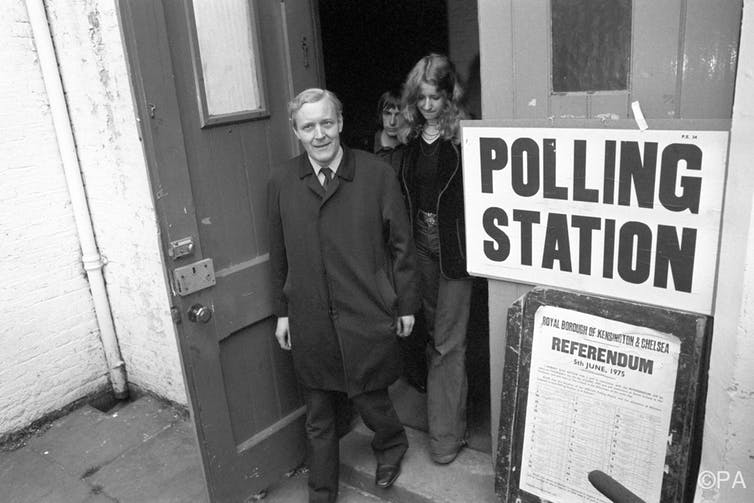
The 1970s saw an upsurge in class struggle and with it the idea that other forms of democracy than Parliament had validity, whether workers direct action or Referendum. Tony Benn successfully lobbied for the first Referendum on EU membership starting in 1970. It was eventually held in 1975
Pandora’s Box had been re-opened and remains open still.


Good to have the political context. I’m generally not in favour: we have a representative democracy (or, better said, sets of representative democracies); and referendums are incredibly divisive – the defeated side (in an emotional context – I’m leaving aside the 2011 electoral reform one, where the issues appear to have just disappeared) just bides its time and waits its turn, so the current words about ‘getting on with healing the nation’ is a load of guff and I don’t think it happens. And thirdly, of course, you have to be clear about will happen in the worst case scenario, especially in the politics that we now have.
About a(nother) EU referendum, there’s perhaps a slightly different set of arguments based on the flaws in the 2016 one which indicates that a ‘people’s vote’ (using lower case for obvious reasons and wishing I’d done the same in my own piece!) – and it needs to be seen as a new vote on *something* to do with the terms of departure not as a 2nd vote – might be a valid way of cross-checking whether the people still want to leave now they know what they know. The deadline of 28 March is key, however, since it sets no deal as the default. This option of the EU offering a ‘safety net’ extension of one year on the grounds that currently we don’t know what we’re doing and a year might (or might not…) give us chance to sort ourselves out away from the panic of an approaching deadline might have something to offer. Clearly, though, there are some strategic dangers in that, too.
But, to return to your theme, the sooner the referendum evil gets put back in its box, the better, I think. (And I’m generally not keen on ‘citizen’s initiatives’ either, for pretty much the same reason.)
Interesting points. General Elections are quite crude tests of views but Referenda even more so I think
Agreed: general elections are necessarily about a broad platform of approaches to policy, but referendums are necessarily single issue and it seems impossible to get a definitive resolution of the issues raised.