
From Saint Monday to ‘National Sickie Day’
The first Monday in February is apparently when most people call in sick from work. That is of course unless you are on a zero hours contract or a freelancer in which case you simply take an unpaid day off.
I’m not sure how far the statistics that apparently prove this can be verified (but it does seem to be slightly more based in fact than Blue Monday). The origin of the day rests with a firm of lawyers in 2010 but in 2025 it seems to mainly interest HR managers focusing on getting people into the office
Given that February is quite a depressing time of year weather wise and is in the middle of a long gap between Christmas and Easter Holidays its not surprising people decide to stay in bed though.
When I started work in the late 1970s there was an informal culture of ‘taking a Whitley’, that was being off sick, on occasion. The modern equivalent is probably the duvet day. Whitley Councils were joint management/union negotiating processes that arose after the First World War which included things like sick absence.
You were expected to take your Whitley days or you’d be letting the side down as it were.
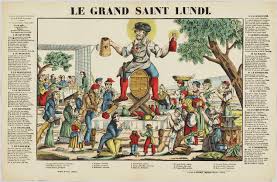
The whole tradition can be traced back to what was known up at least until the 1871 Bank Holidays Act as Saint Monday
The daily routines of working life are well-known and they date back to the imposition of industrial disciplines on what had been previously an agricultural workforce during the nineteenth century.
Labour was required to work machines and if it wasn’t available money was being lost.
There was a battle over hours and time (there still is of course) and artisanal and craft working practices were only slowly given up.
EP Thompson in the Making of the English Working Class records employers complaints about the working practices of weavers. They did not work on Sundays, or Mondays (Saint Monday) or often on Tuesdays either. Towards the end of the week and on to Saturday they worked ferociously hard.
Saint Monday was a day of leisure to rest and to drink.
Thompson speculates in his essay Time Work Discipline that bursts of hard work followed by periods of idleness and drinking, while not what employers want, may well conform to a much more natural working pattern than the daily grind of economic reality most now experience.


Leave a Reply