
Before the Revoke Article 50 petition, how the Government reacted to the Chartist petition of 1848
The Revoke Article 50 petition is now the largest ever in Parliamentary history. It has the advantage of course of people being able to independently e-mail their support rather than to having to physically sign it. Likewise the organisers don’t have to check or count the support. This is done automatically by the petitions system
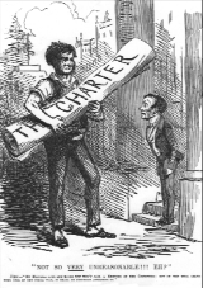
The previous largest petition in Parliamentary history, that of the Chartists on 10th April 1848 had none of these advantages.
Signatures had to be collected, and often from people who were not used to signing their own names. The Parliamentary authorities in 1848 took a dim view of women (who did not have the vote) signing at all.
The Chartist leader Feargus O’Connor MP claimed the petition contained 5,706,000 signatures. Given that the total population of the UK in 1851 was a little over 15 million this was a huge number.
It was disputed by the House of Commons authorities. A special team had been set up in November 1847 to review petitions presented to the House and in this case 13 clerks had been employed from April 10th to April 13th to count the signatures.
Mr Thornley for the Committee reported that they believed the petition contained 1,975,496 genuine signatures.
In the Chartist Northern Star of 22nd April O’Connor underlined that the Parliamentary authorities claim to have scrutinised the petition thoroughly did not stack up.
He noted that the 13 clerks had worked a total of 17 working hours from the presentation of the petition on 10th April at 5pm to the Commons debate on 13th April at noon. This would have required each clerk to count 8,860 names in an hour, that is 150 every minute.
In short the Petition was misrepresented and left to lie on the table (that is not debated at the time).
These days the Government can send a direct response to petition signers and it has: everyone who has signed has received an e-mail stating that there is no intention to revoke Article 50.
It may be gathered that Governments do not like the expression of democratic sentiment that very large petitions represent.


Leave a Reply