
Is E.P. Thompson’s Making of the English Working Class still relevant on the 50th anniversary of the publication of the paperback edition. Part 1
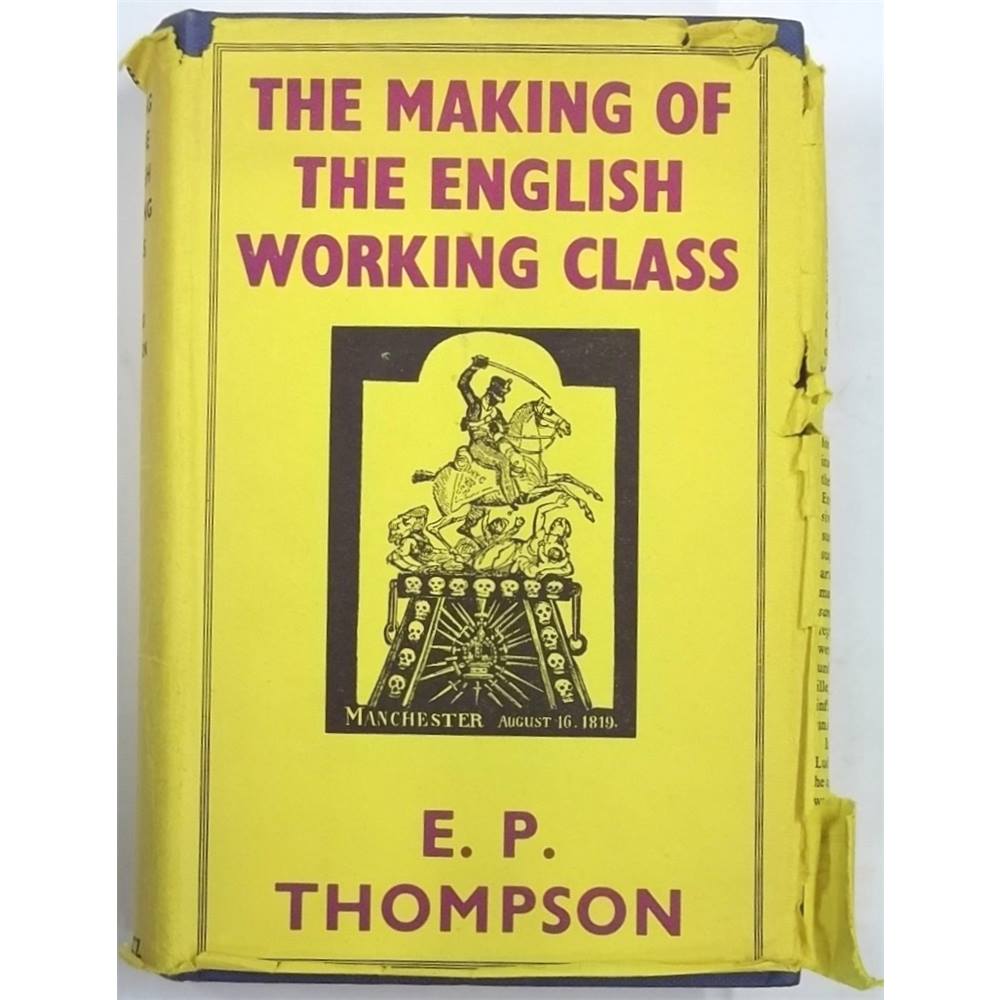
Summary of paper given by Keith Flett at the Institute of Historical Research on Monday 3rd December 2018 (prior to the IWGB boycott)
At the end of September 1968 Pelican published the 1000th volume in their paperback series. The book they chose was E P Thompson’s Making of the English Working Class. The book retailed for a then weighty 18 shillings (90p). The book remains in print but now costs rather more.
A review in The Times (pre-Murdoch) of the paperback edition concluded by calling Thompson ‘a magnificent, lucid, angry historian’.
The book remains hugely influential not just in the UK but across the world. In a sense there is no need to give a seminar paper on that particular point. One can simply Google ‘E.P. Thompson+news’ to find a string of journal articles and magazine pieces referencing Thompson’s work, usually The Making or related to the Making
The issue for this seminar is to address the question of how relevant the book is 50 years after the paperback appeared in the turbulent academic autumn of 1968, in respect of some of its key themes, while noting on the way, some other parts of the book that are perhaps now less relevant.
The key issues identified as being raised by the book include the moral economy, winners and losers in history, how classes are made and interact with each other and the traditions of the British working class, peaceful or otherwise.
In his 1968 postscript Thompson focused on two areas of the 1963 edition. What is known as the standard of living controversy and the question of the Luddites and an armed tradition in British radicalism.
Thompson was not an economic historian or indeed originally an historian at all (he taught literature[i] He felt he should challenge the right-wing orthodoxy about the impact of market capitalism in the first decades of the nineteenth century. Not least perhaps, although he doesn’t explicitly make this point, because if he had not done so it would have weakened his work on the moral economy. Even so he didn’t feel that the result was all that satisfactory. In the decades after 1968 a good deal of further research moved orthodoxies away from Thompson’s ‘culturalist’ approach. That is Thompson focused on the impact the rise of market capitalism on people’s experience. Subsequently a more mixed picture emerged suggesting some workers standard of living improved while others did not. More recently there has been a shift back to the Thompsonian approach- to a degree- with a recognition that whatever the specific economic impact there was also the wider question of how people reacted to it.
Thompson also spent some pages in the 1968 postscript dealing with critics who had argued that his suggestion of a Luddite tradition was overplaying what the sources indicated. Thompson was able to underline that on the contrary there was a genuine Luddite presence around the period 1810-12.
In doing so he raised an interesting wider point about the relevance and impact of the Making 50 years on (not obviously that he knew that in 1968). Thompson’s point was that there was an armed tradition in early English radicalism and that his painstaking research in West Riding archives and the PRO demonstrated that this was the case. Yet this was not Thompson’s politics, based as they were on the popular frontism of the Communist Party in the 1930s. Thompson saw a peaceful road to socialist advance and saw this as a strand in the history of the English working-class too.
Thompson of course broke politically with the CP in 1956 when his research for the Making must have hardly started (if indeed it had). That didn’t mean however that he broke from all of the underlying ideas of the CP.
The difference between Thompson’s political views and the outcome of his archival research presented in the Making is important.
Firstly it made an important point about Thompson’s research methods. He did not start with a preordained framework or assumptions but went where evidence led him and then tried to make sense of what he found.
Secondly the fact that Thompson’s political position in 1968 was not one of uncritical sympathy for the second new left and student protests, some who read the book felt that it did not perhaps inform the current struggle in the way they had hoped. The late Alun Howkins, a student in 1968, and latterly a leading figure in History Workshop was certainly in this area.
But when we consider the impact of the Making 50 years on it is not of course Thompson’s own political position that is the big issue. It may be known in outline to a few who come to the book in 2018 but mostly it will not be.
Likewise while the Making was influenced in significant but not decisive ways by Thompson’s own popular front politics it carries another important area of his own experiences that have less relevance today. The discussion of Methodism and its impact on working class politics in the 1820s and 1830s which Thompson was very critical of, and was controversial in 1963 but perhaps less so by 1968, is of much less interest to most 50 years on I would suggest.
The issue of relevance in 2018 for the Making then is around whether the key themes of the book (with the arguable exception of those mentioned above) still have a currency and influence. In addition, although a secondary question, there is also the matter of whether Thompson’s approach also echoes across the decade.
For example while the book certainly draws quite extensively on examples of London radicalism, Thompson was not a great enthusiast for the Capital, preferring, as his essay Homage to Tom Maguire (1960) underlined the Provinces. His research for the Making as indicated above focused a good deal on the West Riding and associated areas of the North of England where, after all, he was working as an adult education tutor while researching the book.
[i] Thanks to Logie Barrow for reminding me of this point at the seminar


Leave a Reply