
Trade Union Membership rises: an historical perspective
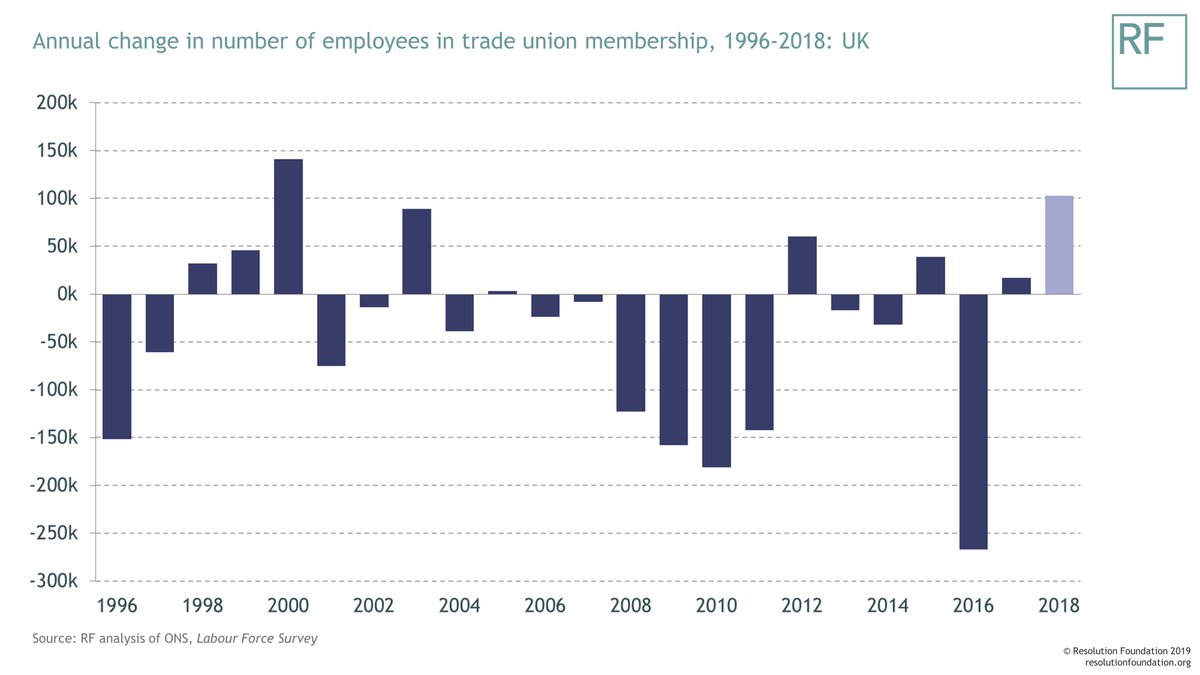
The Government has published the annual figures for trade union membership. They are for those concerned with workplace organisation (I’m a trade union officer in the private sector based in the City of London) mildly encouraging. Membership has risen by 100,000.
As ever there are challenges and the TUC’s useful analysis is here:
Some of the challenges are highly relevant to the areas I’m involved in broadly telecoms and the wider connected world.
Union membership in the private sector has fallen slightly and the numbers of younger workers (under 35) is still far too low.
Of course an organising agenda can address this and as the TUC blog makes clear has successes. Aside from dealing with issues for existing members and negotiating with employers I’m out every week recruiting new members.
It is world where they understand very well the issues they have- job security, the cost of living such as housing and transport, and whether they can expect regular pay rises. It is also a world where many don’t really understand how useful being a union member can be to them. People I speak to are often surprised by how much I know already about the matter they’ve raised with me and also how much I can do about it with colleagues. Of course satisfaction is never guaranteed but getting the issue addressed and answered definitely is. As individuals they just don’t have that clout.
There is a wider picture however that the TUC blog doesn’t mention- reasonably enough since it is specifically about the 2017-18 figures.
Strikes are at or close to an historic low so the visibility of what unions can do, if need be, is low to both members and potential members. Even if a strike is defeated (by no means an unusual event unfortunately) it shows that collective action is possible.
Here there are two issues that need to be looked at.
One reason often given for the low level of strikes is that people are waiting for a Labour Government to change Tory laws which deliberately make taking legal industrial action difficult. Indeed the 50% minimum turn-out of those eligible for a legal strike ballot applies nowhere else in British public life. Likewise the ban on e-balloting is specifically designed to frustrate turn-out in ballots and cause the minimum figure not to be achieved.
Labour is committed to changing all this but when it is elected even when it does it won’t make an automatic difference. The balance between political and industrial activity reflects weakness where rather doing things for themselves people look for politicians to do the job.
It’s a question of looking at how waves of unionisation took place in the past. We can look back to the new unionism of the 1880s and the dock strike and to the unionisation of the new technology of the 1930s, the care industry.
It was a tough struggle but it was done.
The equivalent today are the Googles and the Amazons and unions are on to it. Union recognition campaigns at TFI Fridays, Picturehouse and Uber underline that it is possible to organise but also inevitably that success can remain elusive.
A success in one of these areas would be totemic in terms of people not currently in unions understanding both why they should be and what it could mean for them.
In short, it can be done.


Leave a Reply