
Clock Time, Industrial Capitalism & the decline of the Railway Clock
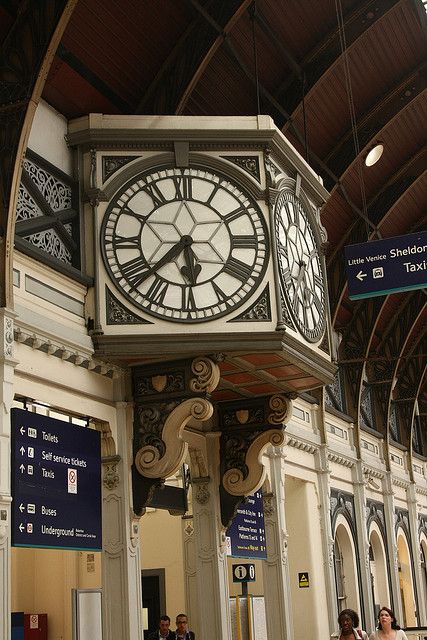
I use Paddington station frequently travelling between London and Cardiff. While waiting (as often) for the platform to be announced for the train earlier this week I glanced at the imposing station clock on Platform 1. Dotted around the station are also electronic digital clocks. The striking thing was that the time on the station clock was a couple of minutes in advance of the others. Once on the train (one of the newish 10 carriage Hitachi units) the on-board clock was of course showing a slightly different time.
I’ve struck by this reference to the rise of clock time
The advent of the mechanical clock provided an authoritative measurement of time duration, which in turn led to the creation of time-rate wage, resulting in serfdom and slavery giving way to worker choice, and transforming in a fundamental way the economic institutions of the Middle Ages.
E. P. Thompson, in his classic 1967 essay “Time, Work-Discipline and Industrial Capitalism,” wrote that with the industrial revolution, “time is now currency, it is not passed but spent.”
https://www.todayonline.com/commentary/understanding-complexities-time
The point is that in 2023 time is not authoritative. Sitting at various mainline rail stations waiting for trains to depart at advertised times I can merely note that its never that clear whether they do or not since every measure of time one looks at (often nowadays digital) shows something slightly different.
Does this matter much in the grand scheme of things? Probably not that much. It is however a sign of the times. As the BBC blog post from 2012 relates (below) the original GWR was the first to introduce railway time to standardise clock time across its network. Until then local time had varied considerably and the tradition, sort of, lives on in places like Bristol.
As E P Thompson underlined in Time Work Discipline (Past and Present December 1967) the purpose of standardising time was central to the rise of industrial capitalism. The idea of the working day, the working week, clocking on and off, not something to be found in artisanal and agricultural traditions, was vital to production in mills and factories.
One wonders if, with this apparently relaxed attitude to the precise time what is currently known as the GWR is moving into the post-industrial age.
If so why can’t we move back to localised times, varying slightly from area to area. Hence my call for a North London time which will obviously be a bit ahead of the times
BBC Blog
In November 1840 GWR announced that a standardised time – railway time as it was called – would be observed at all their stations. Several other railway companies followed suit and on 22 September 1847 the Railway Clearing House decided that GMT should be adopted as the standard time on all railway stations across the country.
The process was fraught with difficulty as, to begin with at least, towns and villages saw no reason to change their traditional means of telling the time. The ludicrous situation arose where the town railway station at, say, Cardiff, Bridgend or Neath kept one time, and the towns themselves kept another.
As late as 1845 the company was forced to put an addendum on its timetables stating that while London time – as dictated by the Royal Observatory at Greenwich – would be observed at all of its stations, the time in the towns would be different. So the time in Reading might be 12 noon but on Reading station it was 12.04. Confusing, or what?
At some stations such as Bristol clocks were even erected showing two separate times, railway time and local time.
Clearly the situation could not last. Local officials in towns and cities across England and Wales realised that the change had to be for the good of all and by 1855 it was estimated that 95% of towns and cities in Britain had altered their time to the standard GMT.
It was 1880 when government legislation finally settled on a single standard time zone for the country but by then most towns had seen the writing on the wall and had already made the necessary changes. And it was all thanks to the GWR – God’s Wonderful Railway.
Phil Carradice, BBC Blog, 5 September 2012


Leave a Reply