
The Size of the Crowd: some important questions
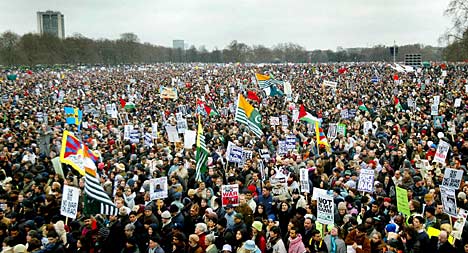
Hyde Park 15th February 2003
Does the size of the crowd matter and is it possible to work out what it what is any way?
These are some of the points addressed in an on-line seminar paper from Keith Flett, convenor of the London Socialist Historians Group on Monday.
Questions about how big a crowd was are relatively modern dating back to the 1950s. Before then crowds were mostly seen as ‘mobs’ and it was their intent not size that mattered.
Yet in the UK, with the exception of the Chartists on Kennington Common on Monday April 10th 1848, every demonstration of 100,000+ people has taken place since 1968 and every one has been in London.
This can be explained partly by the increase in the UK’s population and the well-known if not well-loved London centric nature of the UK.
Perhaps a key post-1968 point is that the large demonstrations are held in the main to be ‘peaceful’ (an exception might be the London anti-poll tax protest on 31st March 1990 where numbers were estimated to be between 180,000 and 250,000). Hence it is not the element of disruption caused, or riot in some registers, but how many people a particular issue could put on the streets that is important.
Historical interest in the size of the crowd remains limited and often confined to sociological estimates of how many people could possibly fit into a particular space, computed one must suppose by those who have never actually been on a demonstration.
Yet for those who organise and participate in protests, the matter is an important one. What can we learn from the history of the size of the crowd?
Details of the on-line seminar on Monday 17th June:
London Socialist Historians seminar Monday 17th June 5.30pm. *On-Line only*


Leave a Reply