
Once again on Rees Mogg, History Man
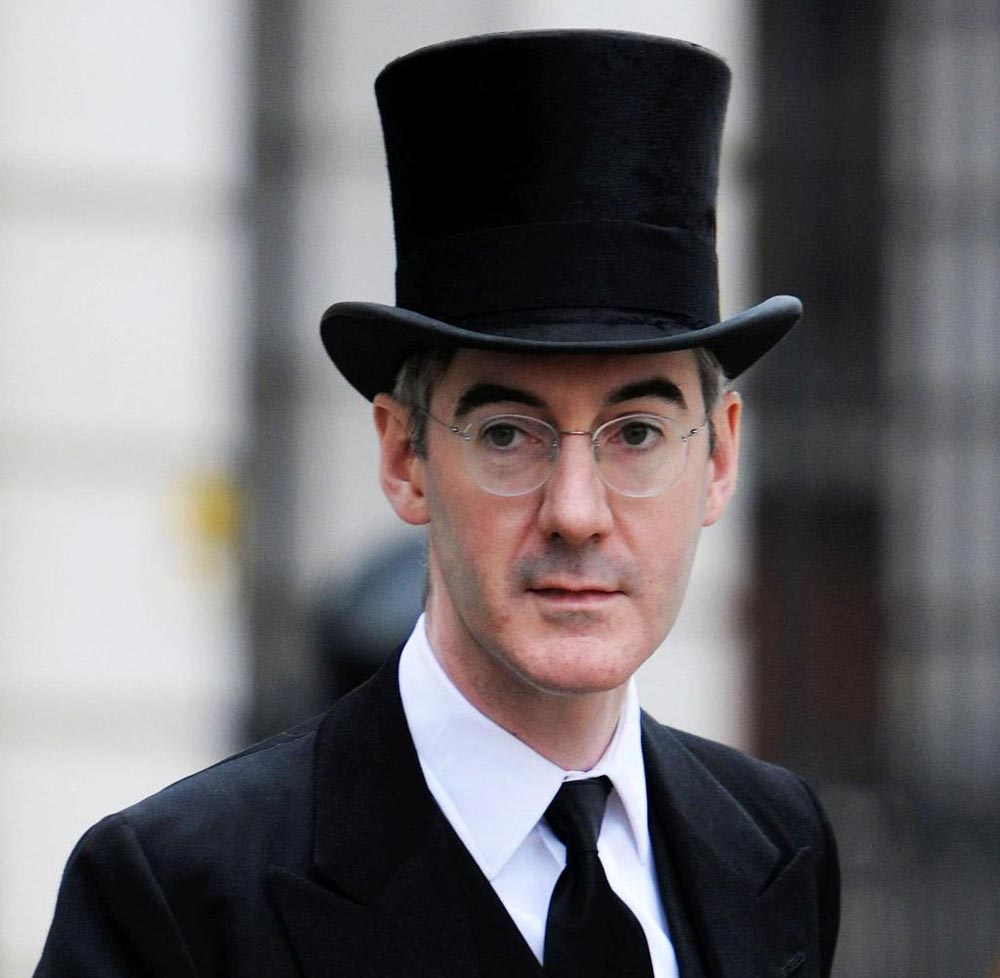
Jacob Rees Mogg has been appointed by Prime Minister Johnson as Leader of the Commons. His qualifications for this role appear to be non-existent.
In his opening foray in the House of Commons on 25th July however Rees Mogg did remind us of something that he is supposed to be qualified to opine on, British history.
Mogg has a history degree and has published this year a widely slated history of The Victorians.
Questioned by an SNP MP on Thursday about the history of the Commons, Rees Mogg noted that it dated back to 1265.
Labour MP Chris Bryant tweeted:
So @Jacob_Rees_Mogg thinks the Commons started in 1265. For a start that parliament was not summoned by the king but by a rebel alliance led by a Frenchman Simon de Montfort AND the knights and burgesses did not sit separately as the Commons till 1341.
Hopefully when the Commons returns from recess we’ll find out which side Rees Mogg would have been on in Pride’s Purge. In the meantime below are details of some of his earlier forays into making historical points:
____________________________________________________________________________________________________________________________________
The hard-right Tory MP Jacob Rees-Mogg, spends his time as a businessman investing abroad while pushing for Britain to leave the EU. He also displays Victorian social attitudes.
Rees-Mogg father William was Editor of the Times whose most useful public act was to try and prevent the sale of the paper to Rupert Murdoch.
William graduated with a history degree and Jacob did the same from Trinity College, Oxford.
Little might be thought of Jacob Rees Mogg’s upper second-class history degree were it not for the fact that he has recently started making historical comparisons with current events while making interventions on the EU debate from, of course the perspective of the hard right.
A number of well-known MPs in recent years have held history degrees. George Osborne for example had one, although he displayed as much historical knowledge as did economic while Chancellor- that is none. Gordon Brown, also had a history qualification and to his credit had both written some labour history and showed some historical sense.
Rees-Mogg is in a slightly different class in the sense that it is difficult to work-out whether his occasional historical pronouncements are in fact related to historical knowledge he gained while studying for his degree or simply off the cuff comments.
His first historical comment on Theresa May’s Brexit plans was that they risked splitting the Tory Party in the way Peel had done in 1846 over the Corn Laws. Broadly this might seem a decent historical point. Peel repealed the Corn Laws which made bread cheaper (and hence allowed employers to lower wages) which was not in the interest of the landowning and farming elements of the Tory Party. It was however in the interests of British capitalism in general as the country became increasingly industrialised. To suppose that whatever Ms May thinks she is doing on Brexit is about the best future for capitalism is where Rees-Mogg’s point fall down. His line however is that in failing to pursue a hard Brexit May is facilitating a split in the Tory Party as Peel did.
His second historical intervention related to the Treaty of Goulet in 1200. While 1846, even if it is well over 150 years ago, is still very much within the broad economic and political framework in which, unfortunately, Britain still operates, the beginning the thirteenth century is not.
The Treaty was about King John handing over some English controlled land in France in return for French recognition of him as King of England. It will be remembered that in 1066 the French had successfully invaded and taken control of the English crown, so one might think that King John was not in the best negotiating position.
Rees-Mogg point was that the concessions made to the French were of the same scale as those made by Theresa May’s Chequers plan for Brexit. It is difficult to see this as a serious historical point.
That is perhaps the key thing about Rees-Mogg the history man. It is remarkably difficult to discover what period of history he actually studied at Oxford, although we do know that he spent time laying down the basis of his later Conservative political career.
I was able to track down someone who had been a fellow student in one seminar group at Oxford with Rees-Mogg who was studying Anglo-Saxon history pre-1966 but they remarked that the degree course was eclectic.
Most recently he has suggested that Theresa May’s EU deal will make Britain a slave State. The above student tweeted on 14th November that since they had studied slavery with him at Oxford he must know this is BS (notwithstanding one’s views on May’s deal).
Jacob Rees-Mogg does know some history but don’t confuse that point with his political pronouncements.
Update #1
Rees Mogg in an interview for the Xmas 2018 edition of the BBC History Magazine has said that his favourite historical figure is nineteenth century Tory Prime Minister Benjamin Disraeli. DIsraeli was responsible at Governmental level for the 1867 Reform Act which extended the franchise. He was also responsible for a number of other rather less progressive things and I will post on that later in December
Rees Mogg says:
My history hero: Jacob Rees-Mogg chooses Benjamin Disraeli
“Benjamin Disraeli was a flamboyant, enormously engaging romantic with a way with words, who was also very good at the showmanship side of politics”: Jacob Rees-Mogg, Conservative MP, chooses a 19th-century prime minister
Update #2
In a further puzzling historical reference Rees-Mogg suggested that while Theresa May had won the confidence vote of Tory MPs on 12th December she should anyway offer her resignation as Prime Minister in accord with constitutional conventions. One wonders which he had in mind. Britain does not have a fully written Constitution but a number of established processes and laws based on the fact that it remains a Constitutional Monarchy rather than a Parliamentary Democracy as such.
The Queen or her representative has the power to dismiss the Prime Minister, as happened with Gough Whitlam in Australia in 1975. In the UK the most recent addition in the area of Elections was the Parliament Act passed in the Cameron/Clegg era which makes it difficult but not impossible to hold a General Election before the full 5 year term has elapsed. Perhaps Rees-Mogg thinks May should go to Parliament and ask for a dissolution. It would be a good idea but I’m not sure, after the last time she did it, that it will happen again
Update #3
Jacob Rees Mogg’s latest outing as a history man came on the BBC QT programme on 14th February. Defending Churchill after John McDonnell’s comments about TonyPandy, Rees Mogg opined on the Boer War (1899-1902) in which Young Winston fought. Neither the British or the Boers were progressive but in an imperial battle Britain had the upper hand. In gaining it the British interned thousands of Boers in concentration camps in poor conditions. Thousands died which under Kitchener was one lever the British used to defeat the Boers. As Rees Mogg pointed out the camps were not the same as the Nazis death camps, but what he didn’t manage to point out was that the underlying principle- not the practice- was the same. He also opined that the actual mortality rate in the camps was the same as Glasgow at the time and that one had to understand the history of the Boer War rather than look at matters from the perspective of 2019. No doubt but from whichever standpoint one takes there is no question that the British pioneered the use of internment and camps. Whether Rees Mogg has studied the period is a moot point (see above)


What Rees-Mogg does not perhaps know about Benjamin Disraeli was that the legalised peaceful picketing by trade unionists on strike. This followed the passing of the Second Reform Act, which had given (some of) said trade unionists a vote. So we can maybe see what he was up to there.
[…] https://kmflett.wordpress.com/2019/07/25/once-again-on-rees-mogg-history-man/ […]