
The objections to a National Government remain as they were in 1931
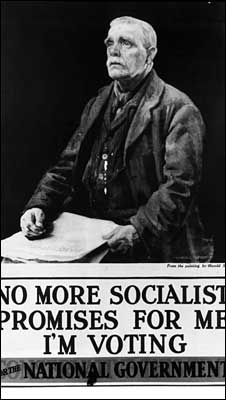
I posted the piece below on July 12th 2017 not long after Theresa May had taken the Tories to a narrow victory over Labour in the June 2017 General Election.
Even then over two years ago there was speculation as to whether a Tory Government could last in Office and if it couldn’t what could be done to stop Jeremy Corbyn becoming Prime Minister and challenging the austerity agenda.
Even allowing for the fact that Ramsay Macdonald opposed the First World War I’m no fan of his. At the same time he had been Prime Minister and was a not inconsiderable politician which is more I think than can be said for most and perhaps all of those mooted currently as leaders of a National Unity regime
I’m not a regular reader of the Daily Mail (in fact I rarely glance at it all, hopefully for obvious reasons). However when the cultural historian Dominic Sandbrook writes a piece I do look.
The Mail is no friend of Jeremy Corbyn and Sandbrook’s piece is predictably dismissive of the Labour leader (although it does express concern that he wont be friendly to Theresa May). By contrast Sandbrook thinks that May has the greatest sense of national political leadership of anyone since Baldwin. Unfortunately he notes ‘not even Mrs May’s greatest admirers (i.e. Sandbrook) would claim her past few months have been a triumph’.
Sandbrook’s solution is for there to be a 1931 style National Government, when the then Labour Prime Minister Ramsay Macdonald split the Party and joined with Tory leader Baldwin to push through an austerity agenda.
Sandbrook argues that the National Government meant Britain ‘emerged from the worst economic crisis of modern times in remarkably good times’. Hmmm.
Many would argue that what really sorted out the 1930s economic crisis was gearing up for the Second World War. The 1945 Labour Government faced an economy that was more or less bankrupt and required significant economic help from the US. Even so it founded the NHS, nationalised coal and rail and built much public housing.
The 1930s National Government did none of these things.
The result of 1931 was to split Labour and leave it as a rump in the 1935 Election, only recovering in 1945.
What Sandbrook’s history hints at, questionable as it is, is a Tory Plan B. May called an Election to increase her majority but instead lost it as Labour gained ground.
Jeremy Corbyn will clearly not be playing the role of Ramsay Macdonald and uniting with Ms May (or much more likely some other Tory leader) in a National Government to pursue austerity.
That doesn’t mean to say though that there might not be a few Labour MPs who wouldn’t find this attractive (a few only are required on the Parliamentary arithmetic). The issue is who their leader on the Labour side, the new Ramsay Macdonald, might be. Sandbrook has no suggestions.
Furthermore, if, as in 1931 a General Election was called to cement a new National Government in Office, is it likely, based on the results of June 8th that austerity candidates would carry the day?
Interesting times and to be fair to Sandbrook, an interesting historical speculation.


Leave a Reply