
Henry Hunt: from craft beer to Peterloo
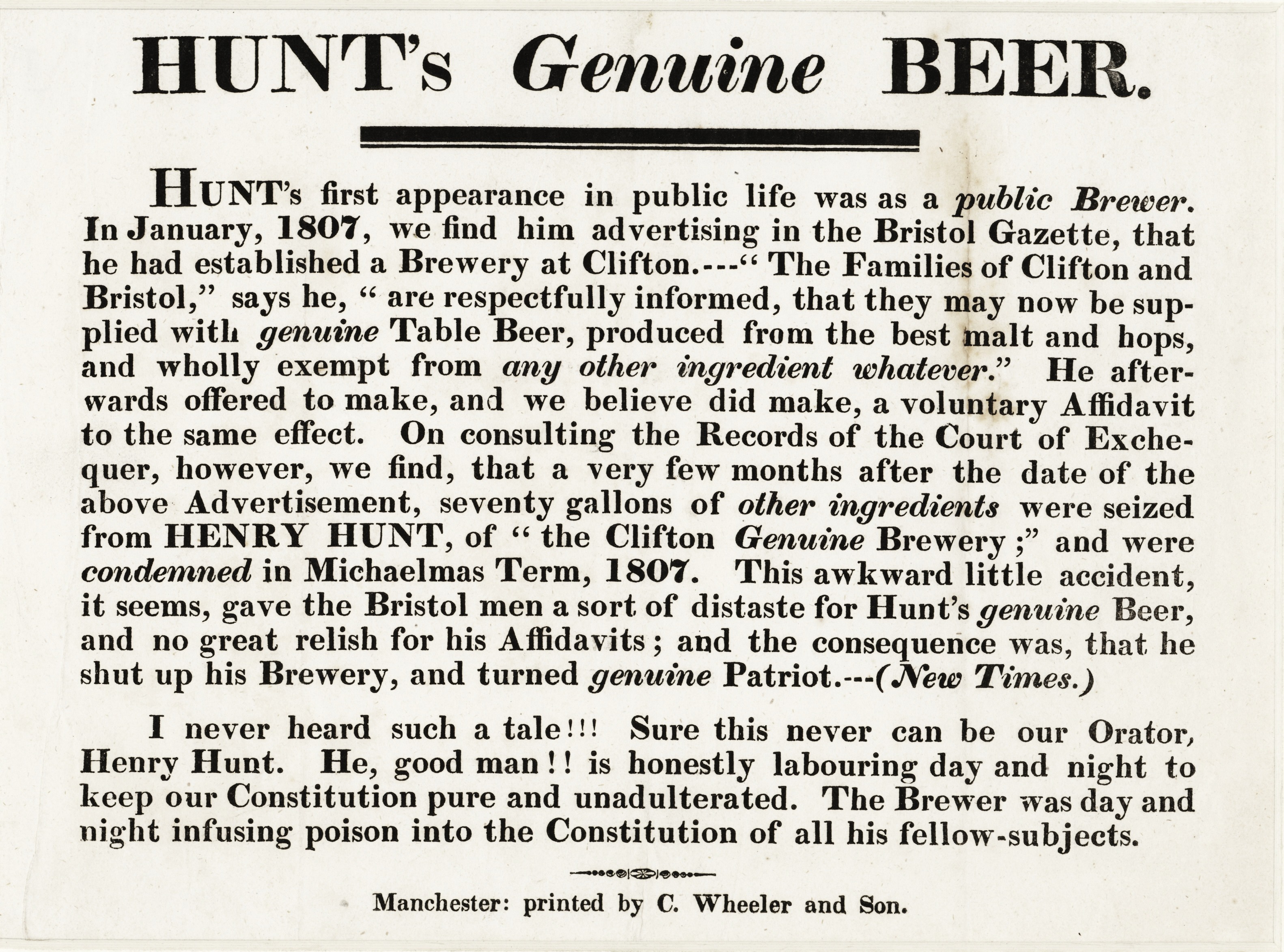
One of the flyers which circulated in Manchester before Henry Hunt spoke at Peterloo made critical reference to his time ten years earlier as a Bristol brewer. The flyer dated 7th August 1819 and signed A Patriot, claimed that Hunt had admitted to using ‘unwholesome drugs’ in the production of his porter. In fact, as below, this was a natural colouring as Hunt endeavoured to produce what today would certainly be styled craft beer
Henry ‘Orator’ Hunt (1773-1835) was one of the best-known English radical leaders of the first half of the nineteenth century, active before the Chartist movement. Hunt was a speaker at Peterloo in Manchester in 1819 and was jailed for the words he spoke there about the vote.
Hunt was a well to do West Country farmer, someone who William Cobbett looked to for agricultural advice, and after his political activities led to the decline of his farming business, he diversified into a range of other business activities including tea and coffee substitutes.
I’ve researched Hunt- the modern biography is by John Belchem-primarily because of an interest in political leadership and Gentleman Leaders, of whom Hunt was certainly one.
In doing so I came across his ownership, in the first years of the nineteenth century, of a brewery in Bristol. The connection between Henry Hunt and brewing is briefly mentioned in Mike Leigh’s film of Peterloo.
Belchem argues that a crisis in stewardship of the Bristol brewery he owned led Hunt to move from his Wiltshire farm to Bristol to assume direct control. It was in Bristol that he found an audience for his radical politics and began on the career that led him to Peterloo on 16th August 1819.
The Jacob’s Well brewery was based on the site of an old distillery at the foot of Brandon Hill on Jacob’s Wells Rd, Hotwells.
Hunt invested in the brewery at the behest of a relative and a young brewer was hired. Barley from Hunt’s farm was used, apparently of top quality and Hunt was keen that the beer produced was of a similar nature. The British Gazette reported it brewing a ‘genuine table beer produced from the best malt and hops and wholly exempt from any other ingredient whatsoever’.
Hunt was determined to avoid the use of additives in his beer and signed up with the Mayor of Bristol to this effect, but it appears the brewer had other ideas. Hunt had to intervene when losses at the brewery mounted and it became clear that the brewer was not only producing bad, adulterated, beer but also siphoning off cash as well. He fled and Hunt took direct control, moving from his farm to Clifton to do so.
I’ve found one further issue related to the brewery. Hunt began using a natural colouring to produce porter style beer. This drew the attention of the Excise- very probably a political interest- and barrels were confiscated from the brewery. Hunt contended, correctly, that he had done nothing illegal and a Court ordered the return of the beer with an apology.
The brewery, still loss making, appears to have been put for sale in 1809 (see below). The connection between beer and radical politics is well known, as is the Tory politics of most large brewery owners- the Beerage. However it is rare to find such a prominent radical figure as Hunt with a brewing heritage.
From Henry Hunt’s Memoirs Volume 2
The brewery was built upon the site of an old distillery, at the rising of a spring called Jacob’s Well, at the foot of Brandon Hill, and immediately below Belleview, at Clifton. The whole was soon completed under my own eye, and finished entirely on my own plan. I took advantage of the declivity of the hill, on the side of which the premises were situated, to have it so constructed that the whole process of brewing was conducted, from the grinding of the malt, which fell from the mill into the mash-tun, without any lifting or pumping; with the exception of pumping the water, called _liquor_ by brewers, first into the reservoir, which composed the roof of the building. By turning a cock, this liquor filled the steam boiler, from thence it flowed into the mash-tun; the wort had only once to be pumped, once from the under back into the boiler, from thence it emptied itself, by turning the cock, into the coolers; it then flowed into the working vats and riving casks, and from the stillions, which were immediately above the store casks into which it flowed, only by turning a cock. These store casks were mounted on stands or horses, high enough to set a butt upright, and fill it out of the lower cock; and then the butts and barrels were rolled to the door, and upon the drays, without one ounce of lifting from the commencement of the process to the end. This was a great saving of labour. I left the concern in the hands of my young friend, with every prospect of success, and I then returned to my farm at Chisenbury; having, as I was taught to believe, laid the foundation of a lucrative concern, from which I expected to derive a liberal interest for the money I had advanced, which was about eight thousand pounds, and at the same time afford a handsome income for my young friend. But such is the uncertainty and precarious state of all speculative concerns of this nature, and such the inconstancy of friendship, that, instead of ever receiving one shilling from this concern, I found it still continue to be a drain upon my purse. Bills were coming due, I was told, and they must be provided for, or the credit of the firm would be blasted. Duty, to a large amount, was to be paid every six weeks, and as often I was called upon to assist in making up the sum. I now began, although much too late, to curse the hour that I became connected with trade. I, however, did not despair. I met all the demands, till, having called in a considerable..
Hunt on the brewing of porter in Bristol in the early nineteenth century
When the act was passed, making it a penalty of two hundred pounds to use any _drug, ingredient_, or _material_, except malt and hops, in the brewing of beer, Alderman Wood obtained a patent for making of colouring, to heighten the colour of porter. This colouring was made of scorched or burnt malt, and it was mashed the same as common malt, which produced a colouring of the consistency of treacle, and having nearly its appearance. As this patent was very much approved of, almost every porter brewer in England used it in the colouring their porter; and amongst that number I was not only a customer of the worthy alderman for colouring, but I was also a considerable purchaser of hops from the firm of Wood, Wiggan & Co. in Falcon Square. I had just got down a fresh cask of this colouring, and it was standing at the entrance door of the brewery, where it had been rolled off the dray, when news was brought me that the new exciseman had seized the cask of colouring, and had taken it down to the excise office. I immediately wrote to Wood, Wiggan & Co. to inform them of the circumstance; upon which they immediately applied to the board of excise in London, and by the return of post I received a letter from Messrs. Wood, to say, that an order was gone off, by the same post, to direct the officers of excise in Bristol to restore the cask of colouring without delay; and almost as soon as this letter had come to hand, and before I could place it upon the file, one of the exciseman came quite out of breath to say that an order had arrived from the board of excise in London, to restore the cask of colouring, and it was quite at my service, whenever I pleased to send for it. I wrote back a letter by the fellow, to say, that as the exciseman had seized and carried away from my brewery a cask of colouring, which was allowed by the board of excise to be perfectly legal to use, as it was made of malt and hops only, unless, within two hours of that time, they caused it to be restored to the very spot from whence it was illegally removed, I would direct an action to be commenced against them. In less than an hour the cask of colouring was returned, and the same exciseman who had seized it came to make an apology for his error. His pardon was at once granted, and so ended this mighty affair; and I continued to use the said colouring, as well as did all the porter brewers in Bristol, without further molestation, as long as I continued the brewery; never having had any other seizure while I was concerned in the brewery.
Detail on the brewery
Henry Hunt announced he was quitting the business and put it up for sale in January 1809 (Bristol Mirror – Saturday 31 December 1808) but it looks to have been still unsold in 1810 ( Bristol Mirror – Saturday 10 March 1810). The brewery was in the hands of J Highett from Weymouth by 1811 (Bristol Mirror – Saturday 09 March 1811) but was put up for sale again the following year (Bristol Mirror – Saturday 29 February 1812). It was put up for sale again in 1813 by Joseph Pope, together with a ‘new copper furnace, never used’. By 1827 it was being described as a ‘late brewery’ (Bristol Mirror – Saturday 24 February 1827).
Thanks to Terry Collmann


Leave a Reply