
Black History Month: the Leader of London Chartism in 1848, William Cuffay
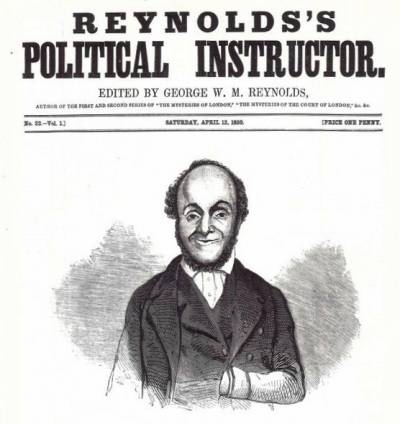
In October 2011 I spoke to an audience of around 100 people in Medway on a labour history related topic.
Considering that getting into double rather than treble figures for any meeting that touches on working class history can be an achievement, the turn-out was excellent.
I doubt it was my oratorical skills, such as they are, that packed them in, however. Rather it was because the talk about the black Chartist William Cuffay was badged as a black history month event.
Official academia is a little ‘sniffy’ about such matters but in schools, libraries and arts venues black history month reaches a big audience.
The criticism is made that some of it is commercialised and sometimes more about broader culture than history but popular history which allows the raising of questions like, imperialism, race and racism, is something the left has struggled to achieve for decades.
One of the greatest black historians and activists CLR James wrote on the subject in 1969 that it was ‘history that black people & white people & all serious students of modern history..have to know’
The life of William Cuffay is now quite well known. Indeed his Wikipedia entry is tolerably accurate. Born in Chatham, his father was from St Kitts and a cook on a British navy ship. He was apprenticed as a tailor moved to London around 1819 and by the 1830s he was an active trade unionist and Chartist.
Cuffay became a leading figure in London Chartism in the 1840s. He was tried and convicted for his alleged part in a revolutionary conspiracy in August 1848. Transported to Australia, Cuffay remained politically active until his death in 1870, aged 82.
Cuffay left no papers and wrote no autobiography so what we can recover of his life comes from newspaper reports and a few official records.
Mark Gregory has done excellent work, reported in a Morning Star article, about Cuffay’s activities in Tasmania. In the UK the digital version of the Chartist Northern Star paper- available free on-line- has made trawling for reports of Cuffay a good deal easier.
What I focused on in my Medway talk however was how we can make sense of Cuffay’s life.
I argued that there are two key points.
Firstly to see Cuffay in the context of the ‘Black Atlantic’ a concept developed by historians Peter Linebaugh and Marcus Rediker in their book the Many Headed Hydra. The point is that there is an imperial link between the Americas, the Caribbean and the UK in the nineteenth century.
That link is slavery, slave ships and the British navy. In the 1790s around a quarter of the British navy was black.
Cuffay the son of a black sailor on a British ship was born in one of the central points of the British naval empire- Chatham.
He found his way to the very centre of that Empire in London, where he organised as a Chartist to try and bring it down. Prevented by the State, he found himself shipped to another part of the Empire-Tasmania, where he continued to be active.
The second point- something pointed out to me by Lord Bill Morris is that Cuffay was the organiser of London Chartism, the man behind the great demonstration of 10 April 1848.
Perhaps Cuffay’s imperial background uniquely fitted him for that role. It may explain why he continued to be active into old age when others did not.


[…] https://kmflett.wordpress.com/2019/10/17/black-history-month-the-leader-of-london-chartism-in-1848-w… […]
[…] https://kmflett.wordpress.com/2019/10/17/black-history-month-the-leader-of-london-chartism-in-1848-w… […]