
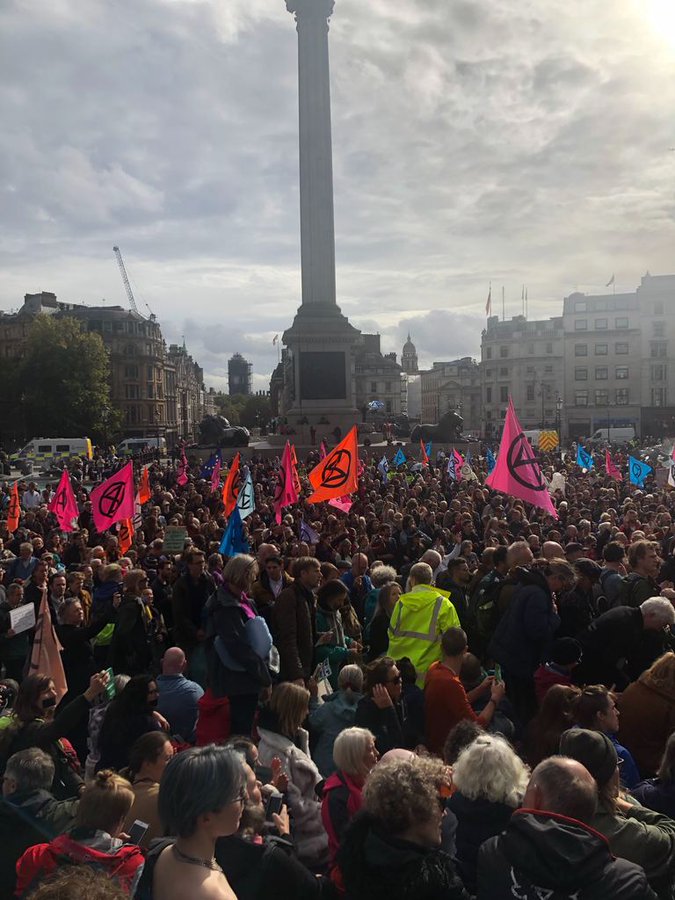
The Extinction Rebellion protests in London which ended on 18th October raised the issue of the Climate Emergency but also of the right to protest.
At 9pm on Monday 14th October Deputy Assistant Commissoner Taylor of the Metropolitan Police suddenly banned all ER protests in London. He had not of course discussed the matter with the Mayor of London who has responsibility for policing in London (as the Tories frequently remind us) but might well have been in communication with Tory Home Secretary Patel.
The ban did not work, at all and this has clearly raised in DAC Taylor’s mind that the law must be changed to make more certain that he can frustrate the democratic right to protest. A Guardian report on this is here:
My brief view is also in today’s Guardian along with other letters:
The history of protest has many instances when a tactic or strategy didn’t work, was ill-conceived or counterproductive. The Extinction Rebellion protest that briefly halted trains in east London might fall somewhere in that area (Extinction Rebellion risks throwing away goodwill, Journal, 18 October). That doesn’t mean that protest on the climate emergency is not required and has some urgency. It also means that the right to protest needs to be protected and defended, in this case from the Metropolitan police. Effective protest that leads to real change is a difficult thing to achieve and historically has required what the sociologist Charles Tilly called an entire repertoire of contention. That is as true now as it was in the 1830s when the Chartists tried everything from petitions to a general strike and an armed rising to try and secure the vote.
Dr Keith Flett
London Socialist Historians Group
A reminder of the history of the defence of the right to protest and organise particularly in respect of police powers was provided by EP Thompson in his collection, Writing by Candlelight:
The Chartist, Radical Liberal, Irish Nationalist and formative Labour movements were distinguished by their sensitivity to libertarian issues, and their suspicion of the polity of statism. When the police forces were enlarged and rationalized (or, as some would have it today, ’modernized’) in the mid-nineteenth century, this was a victory for bourgeois utilitarian bureaucratic policy in the face of intense resistance extending from old Tory localism through Radical Liberalism to outright Chartist opposition— for Chartists and trade unionists very well understood what kind of imperatives dictated government policies. As a consequence of this opposition, the presence of the police in British public life remained unusually subdued. They must be seen as ‘servants’ of… either the gentry or ’the public’, and they must in no circumstances exhibit a brash public presence. And, as a more concrete evidence of the old libertarian tradition, which endures to this day, the British police (at least in Britain) must go about the streets unarmed.


Leave a Reply