
What would E P Thompson have made of the 2019 Election?
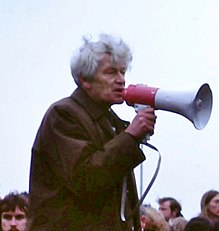
What would the historian and peace campaigner have made of the 2019 Election?
Unless you’re an enthusiast for counter-factual history, Thompson died in 1993, we can’t answer this question.
We can however look at an historically based framework which will allow us to position Thompson somewhere on the electoral map of 2019.
Thompson was a member of the Communist Party, very much a supporter of its Popular Front politics of the 1930s. He walked out with others in 1956 in protest at the Russian invasion of Hungary and following Khrushchev’s Secret Speech on the crimes of Stalin.
Thompson was not a ‘god that failed’ adherent. Rather he remained on the left, and indeed was a founder of the first New Left and of the New Left Review from 1960, which remains in publication.
He was certainly active around Elections. The introduction to his piece on the 1959 General Election, (An Essay on Psephology, New Reasoner, Autumn 1959)is below. Thompson was no great fan of right-wing Labour leader Gaitskell. In the context of 2019 however it needs to be understood that the Labour Manifesto was a social-democratic one which would now probably be labelled Corbynite.
Thompson and others were also involved in promoting an independent socialist challenge in West Fife to see if there was scope for an electoral politics to the left of Labour which was not however associated with the Communist Party. It was something that preoccupied Thompson throughout his post-1956 political life-whether to work within Labour, outside it or perhaps alongside it.
Thompson’s other well-known electoral intervention was in 1983 when he published In Defence of Britain arguing for nuclear disarmament.
When it came to campaigning for an end to nuclear weapons Thompson’s popular front politics were to the fore.
He, for example, spoke at conference fringes of the original SDP on the matter and obviously tried to keep Labour policy on the page of disarmament. His perspective suggested that ending the threat of nuclear war was more important than party politics and he was prepared to make alliances on that point.
A wider point, very much central to his politics in post-1979 Thatcherite Britain was to focus on the importance of civil liberties, democracy and the rule of law and to criticise those on the left who saw them as mere bourgeois diversions. An extract from his work on the Secret State is also below. It draws on his historical work to make political points of the moment.
It is not difficult to see how Thompson might feel about a Tory Government that, for example, in recent days has reportedly threatened the independence of Channel 4. Nor indeed the sympathy he might have for a Labour leader such as Jeremy Corbyn who has a long track record of standing up to authority.
But as I noted above counter-factualism should be avoided and we cant be sure precisely what Thompson would have made of the 2019 General Election because as often there are complicating factors (Europe, Pact, Climate)
We were not waiting, with baited breath, for the accession to power in October 1959 of a socialist administration in Britain.
But the results of the General Election were discouraging none- the-less. Faced with a choice of two evils, the majority of the British people chose the greater evil of the two. The result confirmed our more pessimistic estimates of the direction of social drift within the Opportunity State. It revealed a negative reaction, ranging from hesitation to hostility, to nationalisation on the part of very many working people. The return of a Tory Government will expose the British people to the more predatory forms of capitalist mis-rule and of economic exploitation. The rights of rank-and-file trade unionists and, in particular, of shop stewards, are likely to be placed in greater jeopardy than at any time since 1927.
Extract from the Secret State
Thirdly, I have recited this episode because, in its general outlines, it is now so familiar. The national crisis—the state of emergency— the deployment of armed forces— the attempts to induce panic on the national media— the identification of some out-group as a ’threat to security’— all these are becoming part of the normal repertoire of power. Of course, there are historical precedents for all these things; but never before, since 1816, has government been able to employ this repertoire without deeply and bitterly dividing the nation, and without inflaming the nerves of outrage and resistance in a minority— a minority which, by patient agitation and political education, has often been able to influence the majority, and, in the long run, secure some reversal of the pretentions of power. What is new, in the last two decades, is the dulling of the nerve of resistance and of outrage. Familiarity has bred contempt— not contempt for the state and for the specious alarms and rationalizations of power, but contempt for any possible alternative. And in this moment a new danger appears. For once the libertarian responses of the British people have been brought under sedation, then the reasons for the invisibility of the state within the state begin to lose their force. And so we see the evidence, in the present decade, of the police, the army, the security services, the quasi-official and the pseudo-private agencies of control, becoming more public, engaging in active ’public relations’, lobbying for new curbs on civil rights and for ’simplified’ legal process and attempting to familiarize the public with their intrusive presence. And, in the face of this new danger, the ancient historical nerve begins to throb once more. State Research is one of the evidences of that.
I will conclude by advancing some arguments which are, in part, addressed to my friends of the Left. In doing so, I am bound to tread on corns, left, right and centre. So that I must insist, once again, that these comments are personal, and need carry no assent from the authors of this book.
A large part of the blame for the dulling of the nerve of outrage lies with the left itself. I do not make this as a wholesale accusation. There have been honourable centres of resistance, as in the long and dogged record of the National Council for Civil Liberties. We owe more than is often supposed to the vigilance of a few Labour and Liberal MPs, and even occasional questions from crusty Tory back-benchers. More recently, some journalists have been alerted to the dangers. And there are many others, among the splinters further to the left. But the resistance has been inadequate…


Leave a Reply