
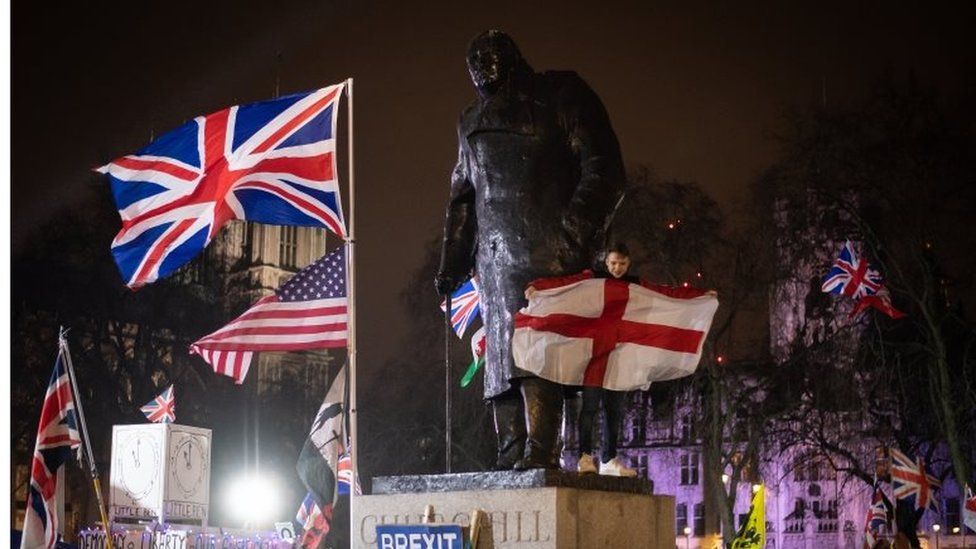
The several thousand who gathered in Parliament Square on the evening of Friday 31st January appeared from all pictures that I saw to be mainly men of a certain age.
How can we characterise such a crowd? It was certainly not one of protest, since the object was to mark the departure of Britain from the EU, which was something achieved by the current Conservative Government.
It may have had aspects of the mob to it but as far I can tell from reports it simply dispersed fairly peacefully at the end of proceedings. A traditional London mob of reactionary intent might well have proceeded to try and sack the offices of the pro-EU Guardian at Kings Cross.
The question of the crowd and particularly that in London has long taken the interest of historians.
In the Making of the English Working Class, E P Thompson, discussing the work of the crowd historian George Rude, looked at supporters of the radical London Mayor in the late eighteenth century John Wilkes.
Thompson wrote:
..the London crowd of the 1760s and 1770s had scarcely begun to develop its own organisation or leaders; had little theory distinct from its ‘managers’; and there is a sense in which it was manipulated.. to ‘operate on behalf of external interests’- the interests of the wealthy tradesmen, merchants and manufacturers of the City who were Wilkes’s most influential supporters.
Yet Thompson also noted of the mob that it was a ‘transitional mob, on its way to becoming a self-conscious Radical crowd’
Whether that was true of those in Parliament Square is one thing but this Financial Times report of Brexit Day celebrations in Boston Lincolnshire which voted Leave 3-1 suggests that Thompson was right to find complexity in the crowd and the mob:
https://www.ft.com/content/8157d358-443e-11ea-a43a-c4b328d9061c


Leave a Reply