
St Pauls Bristol, 2nd April 1980. Was it a riot?
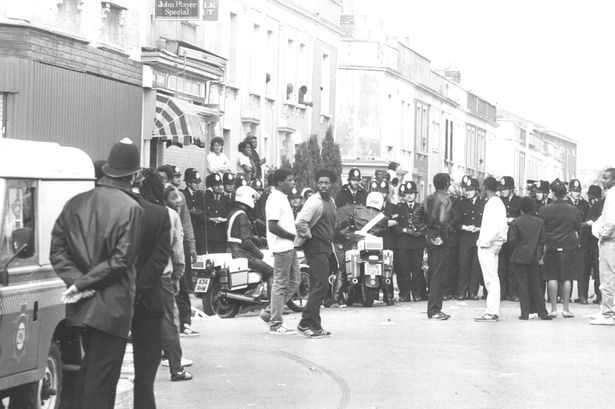
On 2nd April 1980 there took place what was officially described as ‘serious disorder’ in St Pauls Bristol.
The reason was a police raid on the Black and White café. The raid was not as the media inevitably focused on about illegal drugs but about a legal one, alcohol, and alleged infringements of the Licensing law.
As the police admitted (up to a point) at the time and rather more openly in a recent Radio 4 Archive Hour (link below) the police operation was bungled. The officers hung around too long and became a focus of attention.
The attention was about feelings (in practice the actuality) of racist policing and a wider racist society. What took place on the night of the 2nd April saw the police withdraw from the area for several hours and significant damage done to(some) property.
It is sometimes referred to as a riot but the authorities were very clear that legally it was not. Several people charged with riot were acquitted on the basis that whatever they may or may not have done that night it did not amount to the official definition of a riot.
“where 12 or more persons who are present together use or threaten unlawful violence for a common purpose and the conduct of them (taken together) is such as would cause a person of reasonable firmness present at the scene to fear for his personal safety”.
The Home Secretary William Whitelaw reported on the matter to the Cabinet meeting of 24th April 1980 (the minutes are on the Thatcher Foundation website, free to access and download).
He was clear that demands for a public inquiry would not be granted because such things wasted the time of senior judges. He was also clear that he did not want an inquiry because there would be ‘demands for substantial sums of Government money to be spent in the area’ which in his view was not necessary. He noted that he had secured the support of the Labour Shadow Home Secretary Merlyn Rees for this approach too.
The financial issue was important. Under the still in force 1886 Riot Damages Act (replaced 2016) the police were liable for damage to property if a riot took place, but only of course if there had been a riot. Serious disorder wasn’t in the same category.
The Bristol News feature suggests that whether there was a riot or uprising the crowd (or ‘mob’ see media coverage) had a purpose a ‘moral economy’ a collective feeling that they were in modern parlance the ‘have nots’ of society whose voice wasn’t being heard.
The term comes from E P Thompson’s paper The Moral Economy of the Crowd’. Thompson emphasised that his usage of the term referred specifically to the eighteenth century and not other periods. However later he agreed that the term had escaped into the ‘wild’ and was not beyond using it himself in other contexts.
A history well worth remembering not least because the underlying reasons for what happened in Bristol 40 years ago remain with us.
Dr Keith Flett is the editor of A People’s History of Riots (CSP2015)
Archive Hour 4th April 2020
https://www.bbc.co.uk/programmes/m000h1gn
Bristol News in depth article
https://www.bristolpost.co.uk/news/bristol-news/st-pauls-riot-uprising-anniversary-4010214


we were living just outside Bristol that evening and jumped in the car to get there, the police had retreated by then and the cordon was practically non existent so we walked in and joined friends living right by the burned out pan car. Ref your points once the police withdrew there was a wonderful atmosphere and zero violence, rastas stood guard to prevent anyone looting the chemist shop and many flat dwellers woke up next morning to find a doorstep delivery of looted groceries. A friend asked a passer by for a fag and was handed a carton of 200.