
The ‘Illegal Tradition’ in Radical Politics: Armed rising in Scotland 5/6th April 1820
How far the Cato Street Conspiracy on 23rd February 1820 was linked to any genuine national plan is unclear. Government spies were involved in promoting and provoking Cato St, but the political mood behind it, a reaction to the Peterloo Massacre on 16th August 1819 was a genuine one.
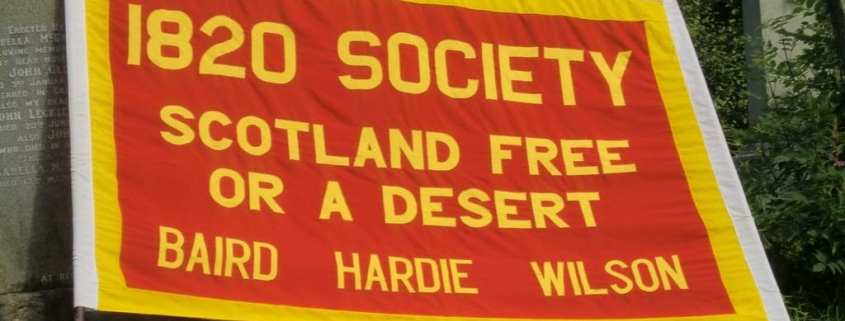
There were three attempted risings shortly after the arrest of the conspirators-one in Glasgow and two in Yorkshire. In the neighbourhood of Glasgow small parties of weavers rose on 5 and 6 April (with their famous banner, Scotland Free or a Desart), there was a sharp encounter with the military at the ‘Battle of Bonnymuir’… It seems that the insurgents believed they were acting their part in a plan for simultaneous risings in Scotland, Yorkshire, Lancashire and Carlisle- in all the weavers strongholds. There was a General Strike across the West of Scotland, the first in British history.
E P Thompson, The Making of the English Working Class
Thompson drew the distinction between a Parliamentary tradition focused on London, combining middle class radicals and self educated artisans but ignoring a wider working class audience, and the ‘illegal tradition’ which had little connection with this. It pursued various forms of political direct action.
The Scottish armed revolt was not the last on British soil. The ‘illegal’ tradition extended to the Battle of Bossenden Wood in May 1838 and the Chartists in Newport in November 1839 as well as the Dublin Easter Rising in 1916 (subsequently not part of British soil)
Battle of Bonnymuir
An Account of the Battle which took place at Bonnymuir, on Wednesday the 5th April, 1820, betwixt about 50 of the Radicals and a party of the Military;
Kilsyth, 5th April 1820
This morning a gentleman residing in this parish belonging to the Falkirk troop of Yeomanry Cavalry; left home to join his troop at Falkirk, and had proceeded a short way from his own house, when he came up with between 25 to 30 Radicals, all armed with pikes, muskets, and pistols, who stopped him and requested him to give up his arms, which he refused to do, and showed them a disposition to resist. They told him (at the same time presenting at him several pistols) that resistance would be vain, as they would kill him on the spot. He, however, got off retaining his arms and meeting with an Orderly from Kilsyth going with dispatches to Stirling, informed him it would be improper to proceed. They accordingly both returned to Kilsyth and reported, when the Commanding-Officer there ordered ten men and a serjeant from the 10th Hussars and as many of the Yeomanry Cavalry, to escort the Orderly and the other Gentleman on their several roads, and to endeavour to fall in with these armed Radicals if possible. The Radicals, in the interval, had been joined by a number more, who proceeded along the Canal Bank towards Bonny-muir, having taken several fowling-pieces and a pitch-fork from farmhouses in the neighbourhood of Bonnybridge.
The Cavalry, on their arrival at Loanhead, being informed of their proceedings, immediately went to Bonnymuir in search of the Radicals, and, on coming up with them, they showed a disposition to fight rather than fly; having taken their position behind an old dyke, they allowed the Cavalry to come within thirty yards of them, when they fired a volley; the Cavalry instantly charged, firing a few shots when going over the dyke; the Radicals received the charge with their pikes, and made all the resistance in their power, but they soon found themselves in a bad situation, and throwing away their arms, endeavoured to escape, when the Cavalry secured nineteen prisoners; three of whom are wounded, two remained on the field so badly wounded as not to be able to be carried to Stirling Castle, where the prisoners are lodged. Eight or ten of those who escaped are said to be wounded, and have not been able to go from the place where the affair happened. The whole number of the Radicals did not exceed forty or fifty. None of the Cavalry are severely wounded; two are slightly in the hand; and one horse severely wounded in three different places (since dead) and a number of horses slightly.
It is reported that the whole of the prisoners belong to Glasgow, except one of the name of Baird, said to be their leader, who lately resided at Condorrat. It is said that the whole had been drilling in the Calton Green of Glasgow this morning, that they left that place about four o’clock, and went over the country in a straggling way till they arrived at Bonnymuir, where they expected to be joined by a number from all parts of the country during the evening and tomorrow.


Leave a comment