
136 years since the first London May Day marches
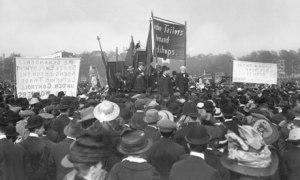
The celebration of May Day is a labour movement tradition. Yet as Eric Hobsbawm and Terence Ranger reminded us in a famous collection of studies, traditions are invented and May Day is no different.
The first London May Day demonstrations were on Thursday May 1st and Sunday May 4th 1890 both in Hyde Park.
It might be thought that these very substantial protests, the Thursday demonstration involving a significant strike, marked a point on the development of May Day as we know it now.
That is not the case. In May 1889 there were no demonstrations, and that was also true for the earlier years of that decade.
The tradition of May Day was in fact invented by the Second International at its meeting in 1889. The idea was to mark the 1886 Haymarket Massacre in the US, where police shot down demonstrators.
This may have been in the minds of those who gathered for the first London May Day protests the following year. But the mobilising motif here was the fight for the legal 8 Hour Day.
It is useful to reflect that while celebrating the start of May is partly about the coming of Spring which has certainly always been with us, the human element of an event to mark the rising of labour is very much something that was deliberately conceived and built by a conference of activists. It struck a chord internationally and led to mass mobilisations on the streets. It is an important point for those who think that mobilising people can’t work.
Reynolds’s Newspaper reported that the first London May Day demonstration on May 1st 1890 was ‘only partial’. Nevertheless this was still sufficient to cause ‘upwards of 2000 constables’ to be ‘drafted into the West End during the afternoon’.
The march assembled at 3pm in Temple Gardens and proceeded to Hyde Park. It is a route still very familiar to demonstrators today, 136 years on.
The composition of the march was slightly different to the one that would have take place in London this May Day weekend however. It consisted of mineral water workers, mathematical instrument makers, female envelope makers and jam and pickle makers amongst others.
This was a new tradition being forged so the banners themselves were also new. Reynolds’s reported that one read ‘those that dare not celebrate this day are slaves’ reflecting the fact that people had walked out of work to join it.
The march reached Hyde Park at 5pm and heard speakers including John Burns and William Morris from the socialist left of the movement.
The march on Sunday May 4th attracted the attention of Engels who noted that it was the ‘English proletariat rousing itself from forty years winter sleep’. Reynolds’s was at pains to point out that ‘there is a complete entente cordiale between the two organising committees and every wish to work in harmony on Sunday’.
The official organising committee in 1890 had not been able to take on board the demand for the 8 hour day although this followed in later years.
The following week on 11th May Reynolds’s reported that the London May Day march in 1890 had been the ‘most remarkable ever held in London’.
In 1891 Reynolds’s reported of the May Day march: the working classes are becoming weary of the old party catchwords and shibboleths, the political chicanery which disgraces the administration of Great Britain and of the narrow and mean and personal and petty way in which the affairs of the nation are conducted.
A tradition had been invented that makes its impact still.


Leave a comment