
The lockdown is being further eased in England, where Johnson believes he has control, from June 1st with sport re-starting.
Its far from clear at best that this wont help to cause the spread of COVID-19 given that new cases remain rather than higher than other European countries that have lifted lockdowns to an extent.
Making historical comparisons is always difficult and comparing early 21st century society with C19th society is in that category. There is one clear comparison when it comes to epidemics. Certainly in the first half of the nineteenth century there was no vaccine or real understanding of most such as cholera. Similarly there is no vaccine for COVID-19 although in terms of medical science we are in a completely different place when it comes to understanding disease.
Even so this means that since there is no absolutely safe way to get out of lockdown and open ended national lockdowns, even if desirable to a few, wont work in a world that is firmly global, political decisions do have a role to play. Problems start to occur when it is suspected that such decisions are taken in the interests of the few rather than the many.
I’ve been re-reading Richard J Evans, Epidemics and Revolutions in Nineteenth Century Europe (Past & Present 120, 1988). Suitably thanks to the present situation you should be able to read it free on-line via JSTOR if you aren’t a member of an academic library.
Evans touches on the cholera epidemic of 1831/2 in Europe which was a time of revolution (even almost in Britain).
In reaction to the outbreak of cholera which was endemic and caused numerous deadly epidemics in the nineteenth century (and is still at it in the twenty-first century in some parts of the world) in 1831 European Governments introduced a range of restrictions which may seem familiar. These included quarantine, isolation and restrictions on movement, in those days mainly enforced by the military before the rise of regular police forces.
The Prussian Government which had threatened to shoot people who ignored the restrictions relaxed them in September 1831 due to ‘economic problems’. The Hapsburg monarchy abandoned quarantine arguing that it had led to ‘consequences more mischievous than the malady itself’ and the Russians did the same.
Evans notes that the relaxation of restrictions represented Governments giving way to some extent to pressures from traders, manufacturers and merchants. They had argued that deprived of a living the labouring classes ‘driven to desperation’ would fan the ‘flames of rebellion’.
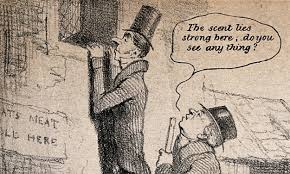
When cholera arrived in Britain the Government abandoned efforts to control it, fearful that restrictions would lead to revolution. However in 2020 there are no historians on SAGE except Dominic Cummings (First Class Degree, Oxford University, Ancient & Modern History)….
In 2020 some at least of the policy decisions of Governments seem to be driven by similar concerns as those in the 1830s, although they had the excuse that they had no real science to inform them.
Still neither revolt or revolution is on the agenda. Not quite yet anyway…


Leave a Reply