
Easing out of lockdown: Is it time for a Grand National Holiday?
The Government continues an easing of lockdown measures in England at least, against advice from some scientists.The Guardian Editorialised in June that while lockdown couldn’t go on forever, it should end only when its safe.
Quite so but that begs an important question. It will only really be safe when there is a vaccine for COVID-19 and that may be a while off.
Of course travel and workplaces could be much safer and risk minimised. The issue with that for some, as the Tories push to end lockdown now, and have reduced the furlough to ‘encourage’ people back to work, is that will hit profits.
The real battle arguably is whether the Government is successful in restarting the economy as it was, in the old way, before March 2020,or whether change can be implemented. To give one example, it is surely more than time to push ahead with a green new deal.
If that isn’t happening and with summer here there is a another strategy we can find in history, a Grand National Holiday. That would involve refusing to return to work until the Government concedes that measures for a new normal are required.
It has been tried before in 1839
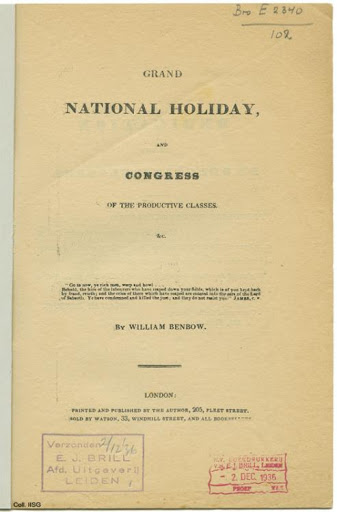
The ‘Holiday’ was the idea of William Benbow. Like many radical activists in the nineteenth century he ranged across a variety of occupations, from pornographer to coffee house keeper to grocer and journalist, to survive.
He had been pushing the idea of a Sacred Month for decades in radical circles. He published it as a pamphlet in the early 1830s and this can be freely accessed on the internet.
Benbow’s plan might well have stayed simply an interesting idea were it not for the fact that the Chartist Convention of summer 1839 adopted it as policy and determined to put it into operation in August of that year, starting on the 12th of the month.
The plan was a simple one: to disengage from capitalism until the system stopped working.
This meant that not only was no work to be done, but that supporters of the ‘Sacred Month’ should withdraw any savings they had in banks or other institutions. They were also required to abstain from all excisable articles such as drink and tobacco. On 12th August 1839 in many, mainly northern areas, the pubs were shut.
It was argued that aside from anything else this prevented any disorder and drunkenness as the month got underway.
The weekly Chartist newspaper The Northern Star for the 17th and 24th August 1839 reported meetings across the north, often with very large turnouts comprising a majority of the working population of particular areas, which then proceeded to march to surrounding locations to pull others out in support of the Sacred Month.
Perhaps the best way of describing it is a mass flying picket, but before the motor vehicle, the only way to do this was to march on foot.
There is not a uniform picture of how long people stayed out for- some days in a number of areas- but not the whole month. Again the logistics were complicated. With so many out, and long before any kind of welfare system, people had to balance support for the holiday with the need to survive in terms of eating and providing for those unable to work.
Even in areas where the strike did not take hold there was at least symbolic support. In London for example on 12th August there was a mass Chartist meeting on Kennington Common for example.
It didn’t ultimately work but 180 years on working people are much better organised to give it a go.


Leave a Reply