
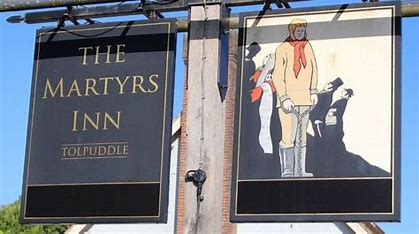
The Tolpuddle Martyrs & history: work still in progress
Over the last few years at the time of the annual Tolpuddle Festival Ive taken a break from my usual researches in the archives (which centre on the period after Tolpuddle) to take a look at various issues and angles which may help to explain a bit further what Tolpuddle was about and what it came to mean.
There are some who claim that Tolpuddle is primarily an historical ‘myth’ an event used by later generations to promote, for example, solidarity. There are worse things, but in reality Tolpuddle had a significant impact at the time in the 1830s and afterwards.
It might be thought that since Tolpuddle took place 190 years ago there really isn’t much new that can be said about it. Of course the detail of the actual events is a matter of historical record and the Martyrs Museum in Tolpuddle itself does an excellent job of making sure they are available.
But understanding why Tolpuddle happened, why it happened in the way that it did, and the impact that it had is much more complex. These are not things to which there are definitive answers but in questioning and researching the matter not only can a little more light be thrown on the Martyrs themselves but some important thoughts for labour movement activists today can arise.
There is a good deal of original material about the Martyrs available. Understanding what it means, and what it might tell us today, is something, in a modest way, I’ve been working on with the pieces below.
In terms of where Tolpuddle research is going I’d suggest that the view of E P Thompson from 1963 is 60 years on proving influential:
E P Thompson’s Making of the English Working Class contains a number of references to the Tolpuddle Martyrs and perhaps particularly the impact that their victimisation had.
However he also reminds us that they were far from alone in being victims of a justice system that was determined to protect the rule of the wealthy at the expense of the poor:
Since Luddites or food rioters do not appear satisfactory ‘fore-runners’ of ‘the Labour Movement’ they merited neither sympathy or close attention. And this bias was supplemented, from another direction, by the more conservative bias of the orthodox academic tradition. Hence ‘history’ has dealt fairly with the Tolpuddle Martyrs… but the hundreds of men and women executed or transported for oath-taking, Jacobin conspiracy, Luddism, the Pentridge and Grange Moor risings, food and enclosure and turnpike riots, the Ely riots and the Labourers’ Revolt of 1830 and a score of minor affrays, have been forgotten by all but a few specialists, or, if they are remembered they are thought to be simpletons or men tainted with criminal folly’
Keith Flett July 19th 2024
(2011)The puzzle of Captain Swing & Tolpuddle
Captain Swing was a wave of rural revolt over wages and new technology that swept through parts of the English countryside in the last months of 1830. The classic study by Eric Hobsbawm and George Rude now belongs to a previous generation of labour historians. Fortunately new research on Swing is being done with an issue of Southern History devoted to it.
Some of the new research questions whether there was an overarching theme to the Swing revolt or whether it was perhaps not more focused on local grievances.
Yet patterns of class and political outlook can still be discerned, a point not controversial to Hobsbawm and Rude but perhaps more so to some of the new generation of Swing historians.
A starting point is to ask why while Swing protests were a feature of the Dorset countryside in the last months of 1830, Tolpuddle is the only real example of trade union organisation developing in an area impacted by Swing.
Swing and Tolpuddle are rarely mentioned in the same historical context, though many of the demands of Swing, as Hobsbawm and Rude noted, for example around wage levels, were ones which would come to be seen as classic ‘trade union issues’
Tolpuddle is the only example of note of agricultural trade unionism in the 1830s, and it was not until the 1870s that the National Union of Agricultural Labourers led by Joseph Arch became a feature of the rural scene.
Historians have argued that the repression of Swing was so draconian in many areas- a few were executed and more were transported to Australia-that it was a generation before people felt confident to organise again.
57 ‘Swing’ prisoners including several women were tried at Dorchester. 27 were found guilty. Hobsbawm and Rude note that the sentences in such cases were ‘quite remarkably severe’ in a few cases leading to execution and in 481 instances nationally transportation to Australia.
An Act of November 1830 allowed Beer Houses to open legally. It was known to local ruling classes that these drinking establishments allowed radicals to gather and discuss politics. They may have had some role in Swing. The impact of drink on activity being what it was they were left alone. At Tolpuddle the labourers met not in a pub but in a Methodist meeting house. Sober and primed with a subversive religious mindset, the State felt it had to act.
A final puzzle is how Swing and then Tolpuddle appeared in Dorset.
Local circumstances can produce grievances and actions about them, but the appearance of Swing protests at Bere Regis in November 1830, at exactly the same time as Swing protests elsewhere in the country suggests some co-ordination.
There were regular coaches from London to Dorchester that would have stopped at numerous points on the way. These brought newspapers with news of developments elsewhere, and people who could spread news by word of mouth for those who were not literate.
The same applies to the Tolpuddle men, who organised against the backdrop of increasing trade union organisation in London of which they must have heard, or, since Methodism may have required some ability to grasp religious texts, read.
It may be argued that as with Swing the transportation of the Martyrs was enough to deter others.
However Swing type protests continued in Dorset throughout the 1830s and 1840s. Meanwhile an interesting and rather overlooked study by Charlesworth also draws attention to one reason why Tolpuddle was not repeated. From the 1840s London coaches were replaced by trains which stopped at far fewer places and provided less opportunity for interaction with rural populations.
(2012) Tolpuddle and the Unstamped: Solidarity & Ideas
Within weeks of the sentence of transportation passed on the Tolpuddle Martyrs at Dorchester in March 1834 there was a demonstration of over a hundred thousand people on Copenhagen Fields in London, while 40,000 gathered in Newcastle and there was a large public meeting in Manchester.
Yet this was a time before the telephone, let alone the mobile phone. E-mail, Facebook and Twitter were still over 150 years from being tools for activists. Even the telegraph was not yet in use.
How did activists, let alone the many ordinary workers who attended such gatherings find out about the fate of those at Tolpuddle?
Partly as I have mentioned previously news spread through the old coaching routes that were by the 1830s soon to be overtaken by the railways.
However a new specifically working class press also played an important role.
Establishing quite how much of a role still requires detailed and painstaking historical research. Literacy levels amongst the newly developed working class were patchy in the 1830s and distribution networks for radical papers outside of major centres uncertain.
Papers like Henry Hetherington’s Poor Man’s Guardian had a circulation of over 10,000 in the early 1830s- 2500 copies were required to be sold for the paper to break even- and its readership- much beyond the circulation figure-was more than that and as EP Thompson noted overwhelmingly working class.
The Poor Man’s Guardian was not a stamped paper although it carried news stories and so was an illegal publication. Publishers, journalists and vendors could be and were arrested and jailed for their involvement with such papers.
The Six Acts of 1819 had required a 4d stamp for newspapers meaning that few could retail for less than 7d. The Unstamped press sold for a penny.
By the early 1830s the National Union of the Working Classes had a network of branches and agencies for papers like the Poor Man’s Guardian. Over 740 vendors of the Unstamped appeared in Court between 1831-6 when the level of Stamp Duty was significantly decreased.
On 29th March 1834 the Poor Man’s Guardian reported a London meeting to petition for the remission of the Martyrs sentences but noted that ‘petitioning Parliament is fast getting out of fashion’
On 5th April 1834 the paper reported that the King had confirmed the sentence and it argued that universal suffrage was needed to address such injustice.
The following week the Martyrs made the front page as the 12th April edition argued that their case had ‘roused the entire country’
Subsequent issues of the Poor Man’s Guardian report the great meeting in Newcastle [19th April] and the Copenhagen Fields demonstration in London [26th April]
By May 10th the paper was reporting a West Yorkshire deputation to Lord Melbourne which called again for remission of the Martyrs sentences.
The Poor Man’s Guardian was a paper of relatively few pages and its coverage of the Martyrs case and protest at it would have reached a significant working class audience.
However while reporting trade union struggles the paper preferred a strategy of winning the vote to workplace organisation.
Interestingly when a network of its distribution agencies is checked it can be seen that the paper reached Frome and Salisbury in the south-west but it did not have an agent in Dorchester.
In seeking to understand why the Tolpuddle Martyrs chose the road of trade union organisation over petitioning for the vote- both strategies current in the early 1830s- the influence, or otherwise, of the Unstamped Press may well have been a significant factor.
The Unstamped press could provide publicity to struggles like those of the Martyrs and hence help to stimulate solidarity. It could also influence by its Editorial direction the kind of ideas that helped to form the nature and character of the struggle and solidarity. It is a complex historical mosaic which would still repay further research on the extent and influence of the Unstamped press
(2013) From Tolpuddle to Joseph Arch: traditions of organising
The view of industrial organised labour in the nineteenth century was that agricultural workers- often unskilled- were hard to organise. Hence the solidarity offered on the occasions when they did such as Tolpuddle in the 1830s and later when Joseph Arch led the ‘revolt in the field’ in the 1870s.
This begs a question. What happened to agricultural workers organisation in Dorset, probably the most rural English County, from the mid-1830s to the 1870s? Was it simply broken, or were their attempts to organise?
In the early twenty-first century in the UK we are used to union organisations with a long and continuous history. But this is far from the only reality, both historically in Britain and around the world today.
The rise of Arch’s agricultural workers union in the 1870s rested on two issues.
Firstly the resolution of some legal framework for trade union activity between 1869-71. Secondly the successful battles by urban workers for the nine hour day. The impact on agricultural workers in a rural area like Tolpuddle can be imagined.
The Martyrs had been transported for trying to organise a union. Now it was legal to do so, so that fate was off the agenda. Secondly there was evidence that organising brought actual improvements in working conditions.
By the 1870s the rural world was changing. The railway had appeared in Dorset for example. Not only did it offer easier travel and access to the world, it also became an alternative source of employment. On the railways though, as in agriculture, battles for union organisation were hard fought.
Cheap newspapers provided new perspectives on the world and there were possibilities of getting out of the low wage culture of Tolpuddle altogether. Dorset wages were historically some of the lowest in the country. Falling wages had been one of the concerns of the Martyrs and was the spur for sporadic Chartist attempts at organising in the area in the 1830s. A report in 1844 had reported that wages in the County were ‘so low that they cannot fall, their normal state is one of the deepest privation’. Even by 1860-1 Dorset was still near to the bottom of the agricultural wages league table, the weekly wage being 9s 5d. This in a County were just nine people owned 10,000 acres each of land in 1873.
Such circumstances are rarely the most fruitful basis for union organisation, workers being too concerned just simply to labour to live.
The Times on 19th December 1873 reported that Joseph Arch had spoken in Dorchester together with a Colonel Denison. The Colonel was the Emigration representative of the Government of Ontario.
The idea was that the most effective way to improve conditions for agricultural workers was to reduce the supply by some emigrating. The Union’s policy was to assist workers to move out of areas like Tolpuddle and by January 1874 7-800 had done so.
The Union was able to effectively organise in areas like Tolpuddle but while there is evidence that thousands signed up, membership was not stable, and nor was support for union activity. In the June 1874 strike just 23 union members received strike pay in Dorset, though the eviction of some in Milborne St Andrew nearby to Tolpuddle from tied housing got significant press coverage.
While the possibility of continuous workers organisation was tough in an area like Tolpuddle, the impulse to it and the memory of it remained. So for example ion March 1875 on the 41st anniversary of the Martyrs there was a presentation to James Hammett. An address talked of the ‘days of oppression’ that were not yet over
(2014)Tolpuddle & Oaths: Why the Martyrs were not guilty
The taking of oaths was a feature of early British trade unionism and indeed a feature of many others of British life too in the eighteenth and nineteenth century.
The swearing of oaths was often about loyalty and certainly about secrecy- Taisez Vous in the French- keeping silent about what you knew.
In a world where trade unions had no legal protection, for example for their funds, and often had craft trade secrets to keep, trying to ensure that members stayed firmly in the fold was an essential task and the oath played a part in that.
It was perhaps the taking oaths that more than anything disturbed the ruling class and it was certainly a central feature of the Tolpuddle Martyrs case.
The Martyrs were prosecuted under a 1797 Act which made the taking of oaths illegal. It did not, and could not, apply to all oaths. After the ruling class itself had institutions such as the Freemasons and Orange Order that relied on oaths as a central feature of membership. Rather it depended on the precise wording of the oath and whether the purpose of the meeting where the oath was taken was legal or illegal.
With the repeal of the anti-union Combination Laws in 1825 the Tolpuddle meeting was legal. No details of the precise oath taken have survived, which is not surprising, since only fragments of it were ever produced as evidence in the Dorchester Court Room.
It is thought that the oath taken was not borrowed either from Yorkshire trade unions, where such things were common, or from the Grand National Consolidate Trade Union, whose activities provided the wider context for the Martyrs meeting. Rather it was constructed by George Loveless himself and was likely to have been very much trade union focused. In all probability it was not llegal either.
In a 1966 article W H Oliver argues that after the conviction of the Martyrs Government law officers reviewed the outcome and themselves agreed that the verdict was probably unsafe.
Causing concern to employers by organising a trade union meeting and taking an oath of membership may have annoyed and perhaps frightened employers but it was not illegal.
However the Tolpuddle verdict while very likely unsafe in terms of the existing law did serve a purpose to employers. Many trade unions who employed oaths looked again at whether they would continue to use them.
Oliver suggests that the unsafeness of the verdict was one reason why the campaign for a pardon for the Martyrs and their return to England was successful in a relatively short period of time.
The point is underlined by one of the other significant union disputes of the moment, the Derby lock-out of 1833-4. Thousands of workers were out on strike for some months, and the reason was not a wage demand but because they had joined a trade union. Again it was particularly the taking of an oath of membership that caused concern to employers. No legal action was taken.
Not all in the early labour movement were happy with oath taking.
Robert Owen was opposed to it but from within the movement itself James Morrison, Editor of the Pioneer, a radical paper very much associated with the GNCTU was also against it. He saw oaths as part of a reactionary past.
After all building a democratic, open, mass working class movement, could hardly rest on the taking of secret oaths. The Chartists certainly did not employ such a device. Rather they used membership cards and rules to build organisation.
(2015)How and why the case of the Tolpuddle Martyrs was heard
According to some new research on Tolpuddle by revisionist historian Carl Griffin the reason why the TUC has been able to promote what he regards as the ‘mythology’ of the Dorset labourers story- his point is that they were far from exceptional in being pursued by the authorities for trade union activity in the rural West of England- is because George Loveless was a literate man and wrote down his experiences while others did not.
Hence the story of the Tolpuddle Martyrs was able to be marked, particularly after the centenary year in 1834, while others whose stories remained largely unknown, detailed only in Court records, were left to the enormous condescension of posterity.
Griffin does have a point, made 50 years ago by EP Thompson in the Making of the English Working Class. Namely that while the Martyrs are, rightly, remembered numbers of others, some of whom were hung are barely mentioned in the historical record. It is not the case of the Tolpuddle men that is exceptional but the way it has been kept in the public mind on this reading.
Griffin argues that the family relations of the Tolpuddle men, brothers worked in the unionised flax industry in Bridport, or had links to trade union organisation and ideas in metropolitan centres like London and Leeds, meant that they were part of a wider movement.
Whether or not the case of the Tolpuddle union was exceptional, the movement that was built after they were sentenced to be transported, and the fact that they were able in due course to return, was something that had not been seen before. It relied on a network of solidarity, whether a literal or virtual brotherhood and sisterhood.
Griffin does not dwell on this point but it is an important one.
The case of Tolpuddle was taken up by Robert Owen’s Grand National Consolidated Trade Union as an issue to organise around and agitate about.
Demonstrations were held, meetings called, solidarity financial collections made, and Parliament was petitioned.
Here we move beyond Griffin’s critique of the Tolpuddle narrative and into a very contemporary discussion.
The Martyrs supporters did not have a political party to campaign for them- the Chartists formed the world’s first working class political party in 1841- nor did they have a helpful framework of laws with which to pursue the case.
The decision to prosecute and transport the Martyrs for the swearing of oaths was of doubtful legality but no Employment Acts were broken in doing so. They did not exist.
Rather the campaign for the Martyrs had to rely on what was known in the nineteenth century as ‘pressure from without’.
That is the trade union campaign had to exert pressure by demonstrations and meetings and they also had to rely to some extent on some friendly radical middle class MPs to reflect these in the House of Commons.
Of course it could not be as good as directly elected working class representatives making points directly in Parliament. But it was nevertheless a strategy that worked.
The historical point was that while the strategy of relying on what were known as ‘gentleman leaders’ is not ideal, it was something that reflected the realities of the time and it was rooted in early working class organisation and politics.
Several radical MPs such as William Cobbett, who was a Tory, took up the Martyrs cause in Parliament. In particular it was pressed by Thomas Wakley, the MP who also founded the Lancet medical journal.
The Parliamentary pressure to pardon the Martyrs would not have taken place without working-class organisation by early trade unionists, but the fact that it did underlined that when the labour movement has a cause and a point to make it will be heard, come what may
(2017)The real legacy of the Tolpuddle Martyrs: the organised labour movement
The real legacy of the Tolpuddle Martyrs
In their book on rural protest in the 1830s, Captain Swing, Eric Hobsbawm and George Rude, make the point that the Tolpuddle Martyrs appear to have been the only case where rural poverty and bad working conditions led to the organisation of a trade union.
Agricultural trade unionism did not appear in a significant sense until the 1870s under the leadership of Joseph Arch. Certainly the Martyrs had some longer-term influence on that development. Arch referenced the case of the Tolpuddle Men when at rallies to organise the union. However given the fate of the Martyrs it might be argued that it’s not surprising no one followed their example.
However just because there was no upsurge in trade union organisation did not mean that there was no activity. This is what Captain Swing details. In that sense the penalty for fire raising, destruction of machinery or riot, could be more severe than the Martyrs received, not transportation but death.
There is another way of making sense of this and it lies with an analysis developed by the US social movement theorist Charles Tilly which is based on ‘repertoires of contention’.
The point made by Tilly, who studied forms and methods of radical and working-class protest in Britain in the late eighteenth and early nineteenth centuries, is that the union formed by the Martyrs was part of a wider change in the way that people contended with authority about the conditions they found in their daily lives.
Tilly’s thesis is that the way people protested in 1780 had almost completely changed by fifty to sixty years later.
In the case of the Martyrs, there was a very large, trade union focused demonstration in London in 1834 that sought to petition the Home Secretary Lord Melbourne to release the Tolpuddle men. As with Peterloo 15 years earlier the authorities exhibited extreme concern..
The issue was not large numbers of people gathering together as such. After all this happened at fairs and festivals, as it does now. Rather the concern was that the gathering had a political purpose.
Tilly notes the Whigs (Liberals) of the day were prepared to concede that workers organising in a trade union to protect their interests was acceptable. However they did not like the idea that this organisation should actually promote worker’s rights- that was political. Hence with the Martyrs case, these same bourgeois politicians believed that trade unions should be lawful, so the sentence was inappropriate, but did not like the idea of the matter becoming ‘politicised’ around the defence of trade union rights in general.
The defence campaign for the Martyrs pushed at the boundaries of what was and what was not considered acceptable protest.
As might be expected the large London demonstration passed off peacefully, despite fly-posted Government warnings about it.
There was further criticism that funerals of trade union activists who had died which were usually accompanied by a procession of their workmates, were hearing speakers supporting the Martyrs case.
The issue here, again, was not the funeral procession but the fact that it had become, as bourgeois critics saw it, politicised.
It was part of a change that saw contention move from street protests, riots and in the countryside the burning or damaging of machinery and crops, to the more organised and disciplined forms of protest that remain familiar to us today.
That meant the large well organised, and disciplined trade union march. It meant the well-publicised and structured public meeting and it meant, from the formation of the National Charter Association in 1841, a working class political party with membership cards and meetings.
This was the real legacy of the Martyrs
(2018)Tolpuddle: one of the first times the State bent the law to attack working people but not the last
Tolpuddle: one of the first times the State bent the law to attack working people but not the last
The law in a capitalist state favours the rich. The better off are more likely to be able to afford to pursue justice and perhaps more likely to get a better outcome when they do.
At the same time of course since at least the 1860s the labour movement has exerted considerable pressure and energy on pushing for changes to the law (and sometimes for the law not to apply in some employment matters) and it still does. The latest piece of Tory anti-trade union legislation was passed in 2017. It was opposed and hopefully when Labour returns to Office it will be repealed.
There is a difference however between class law and occasions when the law is deliberately bent with hand-picked judges and juries to give the State the result it wants on a particular occasion.
The case of the Tolpuddle Martyrs in 1834, six farm labourers tried in Dorchester in March 1834 and sentenced to seven years transportation to Australia for administering an illegal oath is a case in point.
The labourers were prosecuted under a 1797 Illegal Oaths Act which had been aimed at naval mutinies. It was unclear at best why it should apply in Tolpuddle and the judge in the case spent some time in legal argument justifying why it should.
Since the convictions were later overturned on appeal it seems reasonable to suggest that it actually did not apply but the Government rightly judged that it could get away with it for a period when it was concerned about growing trade union organisation.
The Times Editorial on the case (21st March 1834) makes interesting reading. It said (in part):
The offence of swearing agricultural labourers, and binding them to the observance of an illegal oath, by ceremonial partaking of mingled folly, superstition and ferocity was brought home to the accused and the conviction was followed by a sentence of transportation for seven years against the whole of them, six in number. This sentence as regards the poor deluded men who are the objects of it seems to us too severe, but it may be useful if spreads alarm among those more powerful and acute disturbers of the town populations throughout England who combine in spite of high wages and whose combinations are as destructive to honest workmen as they are to all but the richest masters.
It could not be clearer that while the Times thought the Dorchester convictions were doubtful it also thought they served a useful purpose.
The State was at it again in 1848. On 10th April 1848 it passed the Crown and Government Security Act apparently designed to deal with unrest in Ireland. It was used however against the Chartists particularly a passage on ‘open and advised speaking’, that is a pre-meditated attack on the Government. Numbers of Chartists were arrested and jailed including the leader of London Chartism William Cuffay who was also sentenced to be transported to Australia.
There have been other instances since and one thinks for example of Orgreave during the 1984/5 miners strike where, were an inquiry ever to be held, it would be interesting to see what is made of issues around political policing and political courts.


Leave a Reply