
The battle for opportunity in education: memoirs of a comprehensive school student
I was the first in my family ever to go to University. My father had professional qualifications as a librarian but no degree. My mother left education at 14 to get a job in the late 1930s. She told me women were not encouraged to continue with studying.
I went to a North London Comprehensive School (in Muswell Hill) and then to a first degree at one of the newish Polytechnics in Teesside. I was keen to understand what life was like Oop North as opposed to North London and tbh the experience of those years was probably more educational than the degree…
I went on to study at the Institute of Education, London University (now part of University College London)where I got a PhD in the History of Education.
I was the first school year in London not to sit the 11+ exam (I still remember the teacher announcing this)and hence the first fully comprehensive year. Clearly it never did me any harm as by the end of it in 1975 I had become a revolutionary socialist.
The wider point was that the boom of the 1960s and the arrival of a Labour Government in 1964 had underwritten both a significant extension of higher education as the need for a more skilled workforce was appreciated (tho strangely I learnt those kind of skills, as an engineer, on the job in telecoms)and a belief that education in general was a good thing for everyone, not just the well to do
The progress made in the second half of the 1960s was arguably a high water mark from which successive Governments have been retreating ever since. Its true though that during the New Labour years from 1997-2010 that while the retreat was not halted or reversed it certainly slowed a bit- at least until tuition fees made a policy appearance.
Below is a piece I wrote in 2017 about the advances that were made in education and what they meant:
Grammar schools had been part of a tri-partite system of education introduced by the 1944 Butler Education Act. Butler was a Tory but had consulted widely on the contents of the Act which aimed to set the framework for a new education system at the end of the Second World War.
The Act was implemented by the 1945 Attlee Government and provided for Grammar Schools, Secondary Technical Schools and Secondary Schools. The decision as to which secondary school a pupil would attend was made by pupils sitting an 11+ exam. Hence the future life chances of many were determined at that age. The Grammar School could be the route to University and a successful career, while the secondary modern school indicated a life of often poorly paid manual labour. It was without doubt a class system of education, albeit one allegedly based, because of the exam, on a meritocracy.
The 1944 Act did allow for comprehensive schools, taking in pupils of all abilities, and some of these were set up in the years that followed.
The left in particular campaigned for a move to a fully comprehensive school system. The 1944 Act consigned many able working class students to the academic scrap heap simply because they failed an exam at 11 years old. It did the same for numbers from better off backgrounds too.
The unfairness and inequality of this inspired the left but capitalism itself was changing. The economy required more skilled workers and the Robbins Report in 1963 led to a wave of new Universities to meet the expanding requirement for graduates in the post-war economic boom.
The push for comprehensive schools to provide a greater number of University entrants also met that economic need.
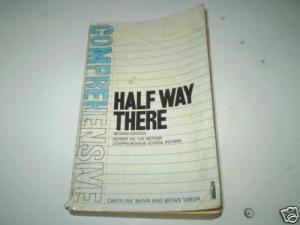
The most prominent of the campaigners for comprehensive education were Caroline Benn and a Marxist Professor of Education Brian Simon. The campaign often met in the office of Benn’s partner, Tony.
The election of a Labour Government in 1964 with a modernising agenda meant the way was clear for a move to comprehensive education. Under new Education Secretary Anthony Crosland the Department of Education’s Circular 10/65, issued in July 1965, underlined a clear preference for comprehensive schools.
The DES however had no direct power to order Local Authorities to move away from the tri-partite model. What Government did have was funding.
With a post-war boom in childbirth Local Authorities were faced with providing more schools and DES circular 10/66 made it clear that funding for these would only be forthcoming if the schools were comprehensives.
This policy lasted until the election in 1970 of a Tory Government with new Education Secretary Margaret Thatcher countermanding it in favour of allowing a few hardline Tory areas to stick with grammar schools.
Yet by then the switch to Comprehensive education was well underway. In 1970 Caroline Benn and Brian Simon published Halfway There, a 600 page report on progress towards a fully comprehensive system which appeared as a Penguin paperback book.
The history of why and how the comprehensive school came about is well worth remembering as successive Governments try to turn the educational clock back to the 1950s.


Leave a Reply