
The Publicans & Cheesemongers who rode with the Yeomanry at Peterloo, Manchester 16th August 1819
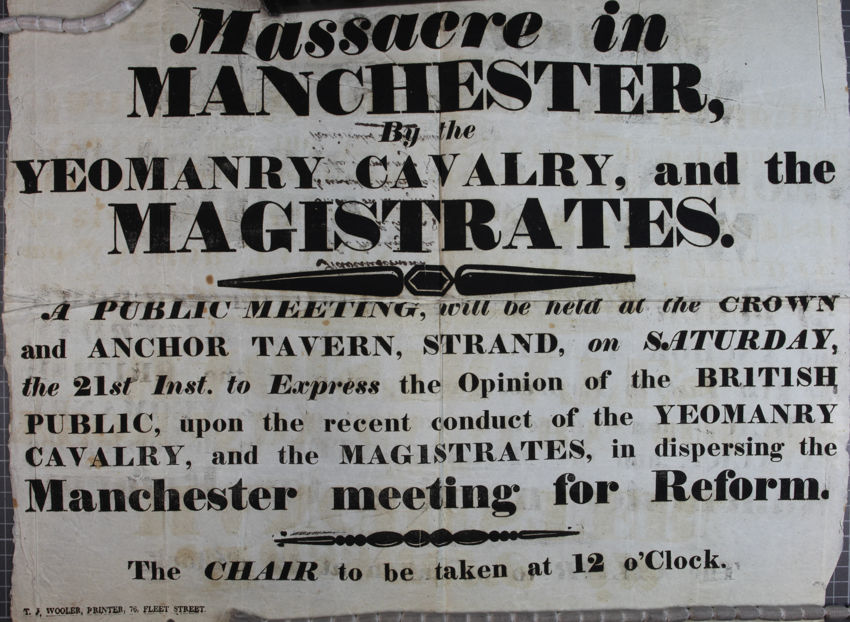
206 years ago today on 16th August 1819 a large crowd gathered at St Petersfield in central Manchester to demand the right to vote. They were attacked by the Manchester Yeomanry wielding sabres on horseback. At least 15 were killed and hundreds were injured in what is known as the Peterloo Massacre.
There is a fascinating list of many of those who were there on the day:
http://peterloomassacre.org/names.html
I’ve picked out the names of Publicans who rode with the Yeomanry (& a couple of cheesemongers for good measure) to underline that in the nineteenth century those who brewed beer and sold it tended to be Conservative in political affiliation, even if this was not true of many of their customers.
According to Ian Beckett in his book The Amateur Military Tradition 1558-1945 a possible reason for the participation of Publicans in the Yeomanry was fear of the magistrates withdrawing their licence of they did not.
Samuel Bamford’s classic account of Peterloo and the time around it, Passages in the Life of a Radical has a considerable number of references to cheese, bread (and sometimes beer) in the meetings and gatherings before 16th August 1819.
Publicans at Peterloo who rode with the Yeomanry
John Beeston, Windsor Castle (George Inn) Deansgate
William Bowker, Kings Head, Old Shambles
George Burgess late of Hen & Chickens, Deansgate
Jacob Chadderton, Wool Pack, Pendleton
Cope (first name missing) Liquor Vaults, Corner of Bridge St
Edward Hulms, Blue Cap, Salford
Lees (first name missing) Crown & Thistle, Half St
John Reid, Globe, Gartside St
Cheesemongers at Peterloo who rode with Yeomanry
Anthony Joseph, 32 Deansgate
Heyward (first name missing) St Mary’s gate
As Robert Poole noted in his 2019 history of Peterloo, publicans were susceptible to pressure from the authorities who might threaten their licence.
Then as now there was concern at what the ‘lower classes’ got up to in ‘low’ public houses were authority might find it difficult to have spies or informers without being discovered. Hence information from landlords was important. Actually riding with the Yeomanry was a rather different matter- a mark of social class, or aspiration to it.
Again as Poole notes of the 100 or so Yeomanry publicans were the largest single specific group does suggest a high probability that some if not most of them were drunk by the time they cut down protesters.
There is some reference to pubs in a range of reports to the authorities that were made in July and August 1819 and published in Hansard later in the year:
The common toasts with the lower class in the public-houses, are, “the Cap of Liberty,” and, “May the Wings of Liberty never lose a Feather.”
The actions of publicans on 16th August 1819 did not go un-noticed or un-actioned.
An Oldham paper, The Chronicle printed an account of how radicals reacted by boycotting pubs (29th October 1955)
Following the massacre at Peterloo, or St. Peter’s Square, Manchester, Oldham’s reformers had rather a rough time and it was dangerous to be known as a reformer. Many publicans – and publicans were a privileged class – acted as spies and informers. This was repugnant to the reformers and they took steps to alter this state of things.
Action was taken one Oldham Wakes. The Radicals erected tents and brewed their own beer. They held conversations as to what was, what ought to be, and what ought not to be, and what should be. They had a strict look-out to see that none were present except men known for their views on politics. In a very short time many publicans let it be known that the time was ripe for change.
In spite of the publicans’ change of heart many Radicals still met in private houses, principally on Sunday afternoons. A peck of ale would be brewed and the eatables would be muffins and toasted cheese. One of the favourite meeting places was at the home of Ben-at-Peacote’s, near Sholver.
At the meetings it was customary for someone who could read to read aloud Cobbett’s “Twopenny Trash” as opponents described Cobbett’s ‘Political Register’, Hetherington’s ‘The Poor Man’s Guardian’ and the ‘Dispatch’, in which the leader was sometimes written by William Johnson Fox, later to be M.P. for Oldham.
————————-


Leave a Reply