
Keir Starmer, the jobs crisis & the polls. Way Over Yonder in the Minor Key?
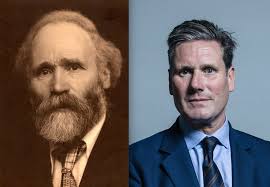
The Guardian has started to worry about the depths of the developing jobs crisis and Labour’s continuing poll lag with the Tories. I share the concern. I’m not a huge fan of Keir Starmer’s politics but I do want Johnson & Co out of Office before 2024. Electing a Labour Government is far from the only way of bringing that about, but it’s part of it.
A couple of pieces by two of the Guardian’s most insightful columnists Aditya Chakrabortty and Larry Elliott have addressed the point.
Chakrabortty makes the point that while the jobs crisis will hit the Chancellor’s current popularity, its less obvious that Labour will benefit. That poses the question of an absence in his column. What is Starmer doing on this?
Larry Elliott highlights the jobs crisis. His tendentious comments on Labour’s 2019 campaign are not well made in my view but his conclusion that Starmer has much scope to propose radical measures certainly is.
Neither really addresses what Starmer is actually doing. The Commons is on holiday but before the recess Starmer was effective about putting Johnson on the spot. One might suggest that this isn’t difficult but a wider point is that not that many people notice unless it’s a really big issue like Cummings. Secondly while he has been in my view far too uncritical of the Government, the criticisms he has made are to the point on jobs, support for hard hit areas of industry and so on. He has also been making these points around the country.
Its not making so much of an impact, certainly in terms of the polls. No doubt his supporters will argue that he has a legacy of poor polls to grapple with. Perhaps, but the problem is that there is little sign of drawing ahead of what is not just a politically malign but incompetent Government
I’d suggest that a key point is that whatever qualities Starmer has political leadership is not yet one. The ability to engage widely and broadly is not only not there but I suspect is not something he is that personally keen on doing on either. The cult of personality is not a great thing, and there are at least two current UK examples of why it isnt. At the same time though politics is theatre and a leader needs a larger than life presence. Even Oxford economist Harold Wilson managed that.
Starmer’s ratings are occasionally better than Johnson but given the dishevelled shambles he is one might reasonably think they could be better. After all Starmer while he will hardly win a political excitement poll is at least compos mentis.
There is another issue which is nothing to do with Starmer but it is very real nonetheless. Both Chakrabortty and Elliott touch on it. That is that a failure of Labour to capitalise on discontent with the Government is not a new thing.
On the other hand in a previous political era after successive Labour election defeats, a serious error by the Major Government did boost Labour.
By 1992 Thatcher had been forced to resign over the Poll Tax debacle and was replaced by John Major. Major, unexpectedly and quite narrowly, beat Labour, led by Neil Kinnock, in a General Election on 9th April 1992. For the few months afterwards the Tories led Labour on average by 5 points in the opinion polls.
Then came Wednesday 16th September 1992, ‘Black Wednesday’. On that day the Tory Government withdrew the pound from the European Exchange Rate Mechanism (ERM). In order to protect the pound Chancellor Lamont raised interest rates from 10% to 12% in the morning, and then up to 15% in the afternoon.
The following day interest rates returned to 10% but the damage was done in terms of electoral standing. Voters with mortgages, perhaps more inclined to vote Tory, had seen the spectre of the cost rising by 50% in a day. If it had happened once clearly it could happen again.
By November 1992 polls were showing ratings of around 30% for the Tories and 50% for Labour. They changed little until the eventual election in 1997. Labour’s lead was nothing to do with Blair, who wasn’t Labour leader in 1992, but with an event so potentially cataclysmic in its impact that it stuck in voter’s minds.
Johnson’s COVID-19 errors are in a completely different league to Lamont’s interest rate debacle, yet there is no Labour lead. Blaming Jeremy Corbyn wont work here anymore than blaming Neil Kinnock would have been relevant in September 1992.
I’m not the great enthusiast of the Parliamentary road to socialism (or even mild reform) and would focus on pressure from without. That isn’t Starmer’s politics so the ball is in his court to address what is a very important matter for all those who have been shafted or are about to be shafted by the Tories.
Work and a serious debate in progress. People’s jobs and futures depend on it.


Leave a Reply