
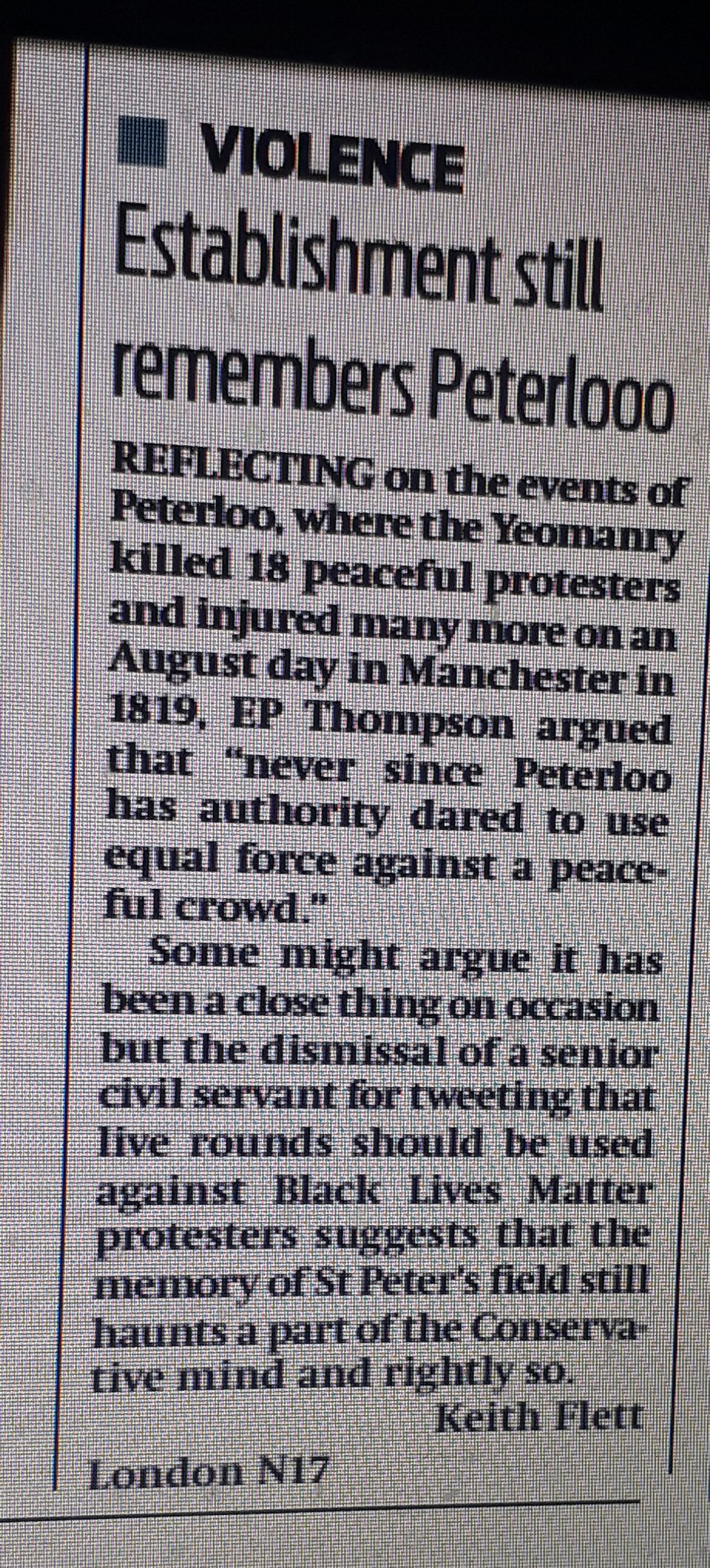
Morning Star 5th September
It has been reported that one of those who responded to Dominic Cummings call for ‘weirdos’ to join the Civil Service has subsequently been dismissed for tweeting that live rounds should be used against Black Lives Matters protesters. He has subsequently apologised.
It suggests however that the parameters of how the State should approach protests which were set as E P Thompson noted, after Peterloo in August 1819 when 18 people were killed by the Yeomanry and hundreds injured still apply. Different ‘rules’ apply to the treatment of industrial disputes as Thompson again noted- ‘henceforward strikers or agricultural workers might be ridden down or dispersed with violence’. However he suggested, when it came to democratic protest after Peterloo ‘Even Old Corruption, knew, in its heart, that it dare not to do this again’.
However the matter remains current as can be seen by reaction to the Extinction Rebellion protests in early September and before that, and also still current, Black Lives Matter protests.
Newspaper reports have suggested that the Government might classify such activity as ‘criminal’. According to the Murdoch Times (6.9.20) protesters might be treated as ‘saboteurs of democracy’ with new laws designed to criminalise protest.
The voice of reason that is the Metropolitan Police Federation has called for protests in London to be banned.
The Six Acts passed after Peterloo in 1819 aimed to do much the same thing. They did not of course work. Protests grew.
A reminder if it was needed that the democratic right to protest and the parameters that exist around it need to be protected perpetually against the illiberal and authoritarian


Leave a Reply