
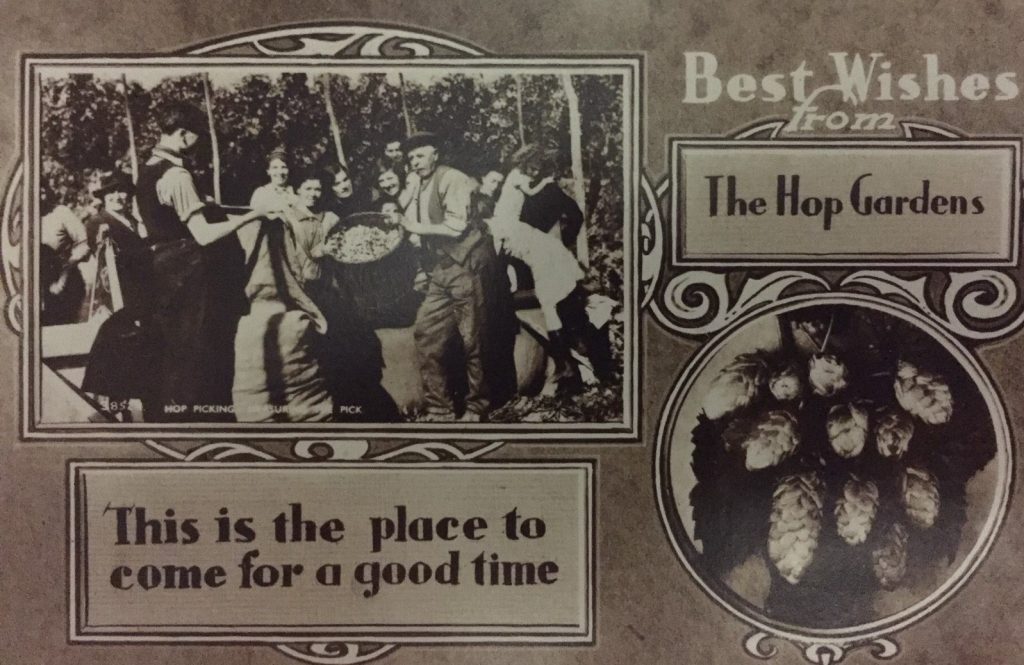
George Orwell, Hop Picking & trade unionism in the 1930s
Its more or less the end of the hop picking season in the UK and Green Hop beers are being produced.
In 2020 except for very small scale amounts it’s a mechanised process in the main.
A reminder below however of what up until at least the 1950s was a significant early autumn source of seasonal work.
George Orwell’s commentary reminds us in the final line of his own prejudices but also underlines the difficulty of unionising in many areas of the brewing and beer industry, an issue that is with us still.
When one starts work the farm gives one a printed copy of rules, which are designed to reduce a picker more or less to a slave. According to these rules the farmer can sack a picker without notice and on any pretext whatever, and pay him off at 8 bushels a shilling instead of six – i.e. confiscate a quarter of his earnings. If a picker leaves his job before the picking is finished, his earnings are docked the same amount. You cannot draw what you have earned and then clear off, because the farm will never pay you more than two thirds of your earnings in advance, and so are in your debt till the last day. The binmen (i.e. foremen of gangs) get wages instead of being paid on the piecework system, and these wages cease if there is a strike, so naturally they will raise Heaven and earth to prevent one. Altogether the farmers have the hop-pickers in a cleft stick, and always will have until there is a pickers’ union. It is not so much use to try and form a union, though, for about half the pickers are women and gypsies, and are too stupid to see the advantages of it.
Orwell Sept 1931


I guess the last sentence won’t feature much in Orwell studies on a Eng Lit course.